



This test is used to measure the acidic content present in edible flavour, with the result expressed as acetic acid. It gives an indication of the acidity level of the sample and can be useful for routine quality checking. The test is usually performed by titrating the sample with a standard alkali solution until the acidic components are neutralized. The amount of alkali used during the test is then used to calculate the acidity as acetic acid.
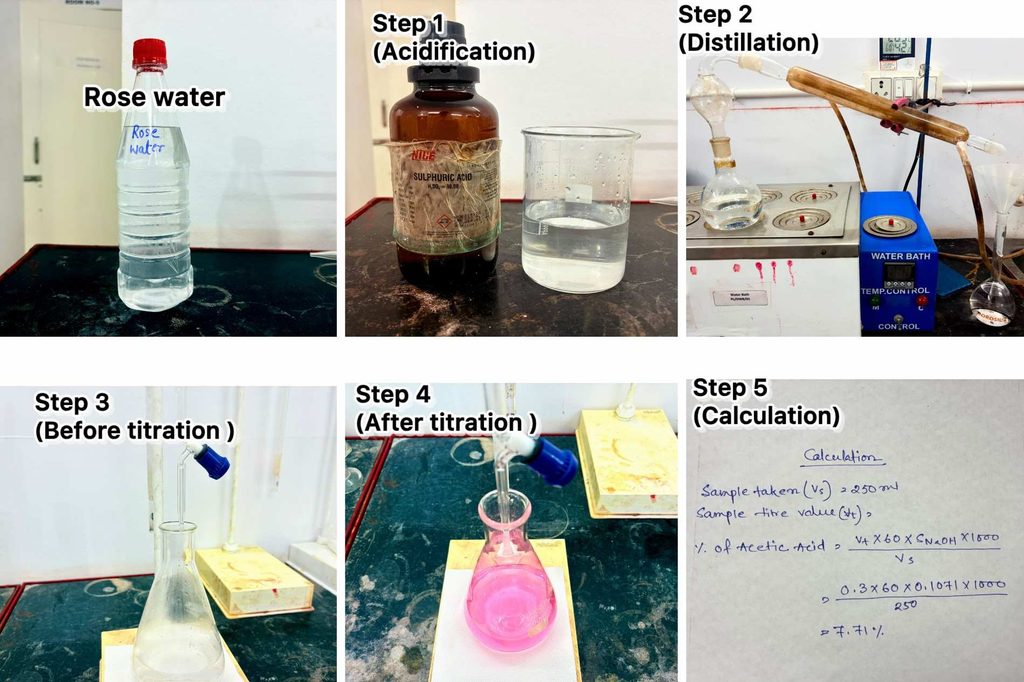
Here we use rose water for acidity as acetic acid test.
Apparatus used in acidity as acetic acid test
- Distillation Unit :To distill the solutions.
- Condenser : To condensing steam during distillation.
- Titration Burette (50 ml capacity) : Used to add NaOH solution drop by drop and measure the volume used.
- Measuring Cylinder & Pipettes (200 ml capacity) : Accurate measurement of sample & H2SO4.
- Heating Mantle : It provides consistent high heat(approx 75°C-85°C) during distillation.
- Beaker(250 ml capacity): To hold the sample during acidification.
- Water Tap : To continuous supply of the water throughout the distillation process.
- Weight Balance(4 digit) : To weigh the sample & reagents.
- Conical Flask (250 mL): Used to hold the sample and indicator during titration.
- Volumetric Flask (250mL): Used to collect the distilate.
Chemicals Used in acidity as acetic acid test
- Phenolphthalein Indicator: Prepared by dissolving phenolphthalein powder in alcohol. It helps identify the end point by changing colour during titration.Preparation process described previously.
- Standard NaOH Solution (0.1 N): Used to neutralize the acid in the sample during titration.Preparation process described previously.
- Concentrated Sulphuric Acid : It acts as a reagent.H₂SO₄ provides an acidic medium.
- Distilled Water: Used to dilute the sample and prepare the blank. Its conductivity should be below 5 µS/cm to prevent impurities from affecting the results.
Testing Procedure of acidity as acetic acid in Rose water
| Steps | Procedure |
| Sample weighing and preparation | Take 250 ml Rose water in a clean and dry beaker and add 5 ml of H2SO4 in it and distilled using horizontal distillation unit.After distillation,collects 200-220 ml of distilled solution and make the volume up to 250ml using a volumetric flask. |
| Titration | Take distilled solution in a clean conical flask and add 2–3 drops of phenolphthalein indicator. Fill the burette with 0.1 N sodium hydroxide (NaOH) solution and slowly add the NaOH solution to the solution while gently swirling the flask. Continue adding it until a faint pink colour appears and remains for about 30 seconds. Note the final burette reading and calculate the volume of NaOH used. Finally, use the titration readings to determine the acidity of the rose water, expressed as acetic acid. |
Calculation of acidity as acetic acid Rose Water
% Acetic acid = (Vt x 60x SNaOH x1000) / Vs
[Vt = Titre value Sample, SNaOH = Normality of Standard Sodium Hydroxide solution,Vs= Volume of sample,Molecular Weight of CH3COOH=60]
Purpose of testing of acidity as acetic acid
- To determine the total titratable acidity of the edible flavour.
- To assess product quality and consistency.
- To ensure compliance with applicable quality standards and specifications.
- To detect variations in acidity that may affect flavour and product stability.
Handling mistakes to be avoided during Testing of acidity as acetic acid
- Use clean glassware to prevent contamination.Always use clean, dry glassware.
- Rinse the burette with NaOH solution before filling it.
- Remove air bubbles from the burette tip.
- Measure the sample accurately.
- Add NaOH slowly near the endpoint to avoid excess titration.
- Swirl the flask continuously to mix the solution properly.
- Take burette readings at eye level to avoid reading errors.
- Calculate the acidity carefully using the correct formula and readings.
Conclusion
The acidity of edible flavour was tested by titration using sodium hydroxide (NaOH) solution and phenolphthalein indicator.This experiment helped determine the amount of acidity present in the sample and provided an idea about its acidic nature.During the test, the sample was measured carefully, and NaOH was added slowly until the endpoint was reached. Proper handling of the chemicals and accurate recording of the readings were important for obtaining a reliable result. The experiment also helped in understanding the practical application of acid-base titration in laboratory testing. Overall, the acidity test is a useful method for checking one aspect of various flavour’s quality like Kewra Water, Vineagar as well as Chilli Sauces,Continental Sauces,Tomato Sauces etc.If you need professional testing support, you can also contact Pro Research & Testing Laboratory for further assistance.You can also join our Internship Programme if you’re looking to enhance your skills, gain practical experience, and grow professionally.
Frequently Asked Questions (FAQs) on Acidity as Acetic Acid in Rose Water
1. Why is acidity tested in edible flavour?
The test helps check the acidic nature and provides useful information for routine quality control.
2. Which method is used for this test?
Acidity is usually determined by titration using a standard sodium hydroxide (NaOH) solution.
3. Which indicator is used during the test?
Phenolphthalein is used as an indicator. The solution changes from colourless to a faint pink colour at the endpoint.
4. Why is NaOH used in the test?
Sodium hydroxide reacts with the acidic substances in sample. The amount required during titration is used to calculate the acidity.
5. Why is the result expressed as acetic acid?
It provides a standard way of reporting the acidity of the sample. It does not necessarily mean that acetic acid is the only acid present.
6. How is the endpoint identified?
The endpoint is reached when a faint pink colour appears and remains for about 30 seconds.
7. What precautions should be taken during the test?
Use clean glassware, measure the sample correctly, check the burette for air bubbles, and add NaOH slowly near the endpoint.
8. What can cause errors in the result?
Incorrect measurements, contaminated equipment, improper titrant concentration, and adding excess NaOH can lead to inaccurate results.
How We Verified This Testing/Research Procedure :
This testing procedure is done under qualified analyst .Continually monitored by expertise.Repeatedly testing is always done to get accurate result.
 Written by
Sramana Ghosh (M.Sc. Microbiology, MAKAUT)
Designation – Quality Manager
 Reviewed by
Anwesha Das (M.Sc Microbiology,BU)
Designation – Microbiologist
 Verified By
Dr. Jyotirmoy Kumar Dey (Phd,Chemistry)
Designation – Senior/Chief Chemist
Experience – 25 Years +
Published On: 15th October,2026 Updated On: 15th October,2026