



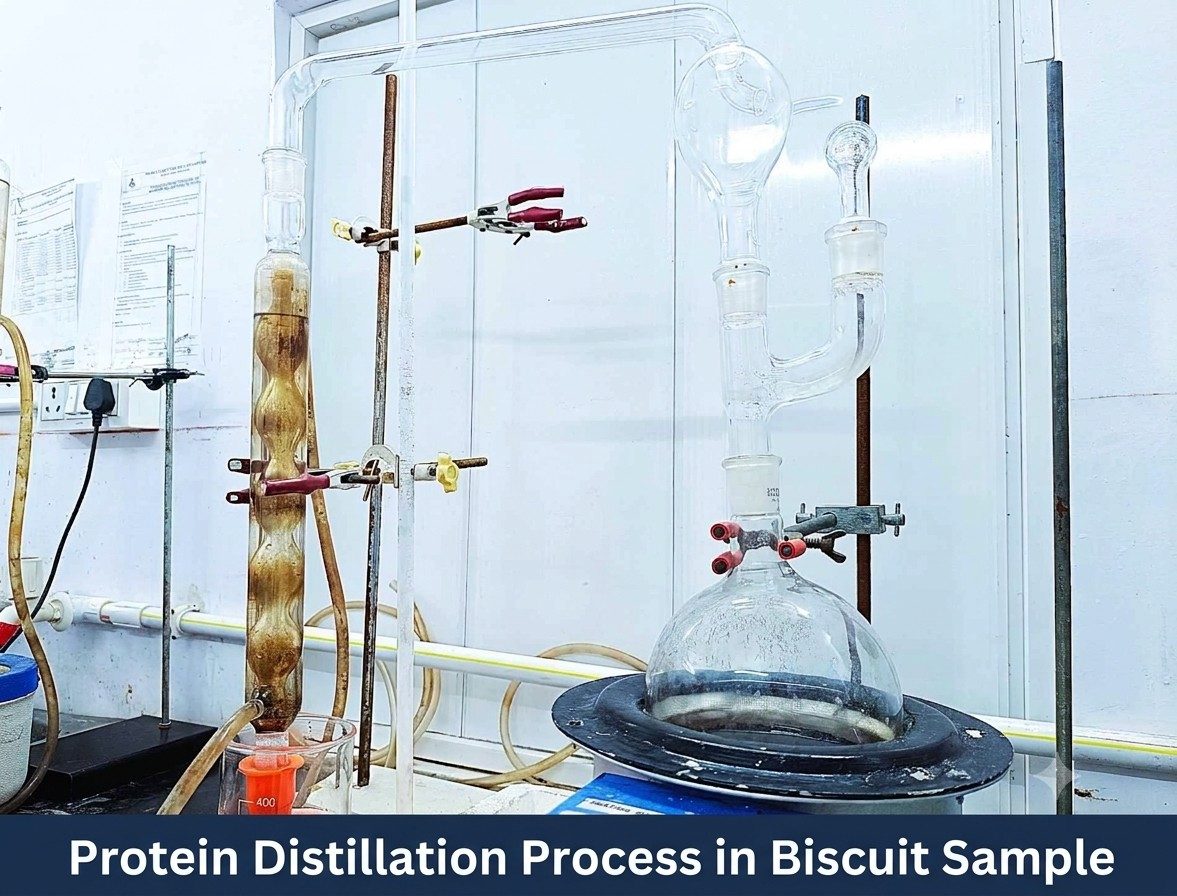
The bismuth percentage test is carried out to determine the amount of bismuth present in a sample. It helps to check the composition and purity of the material and ensures that the bismuth content meets the required specifications.This test is useful for checking the quality of raw materials and maintaining consistency during metal production. It also helps manufacturers verify the composition of bismuth metal before using it for different industrial purposes.
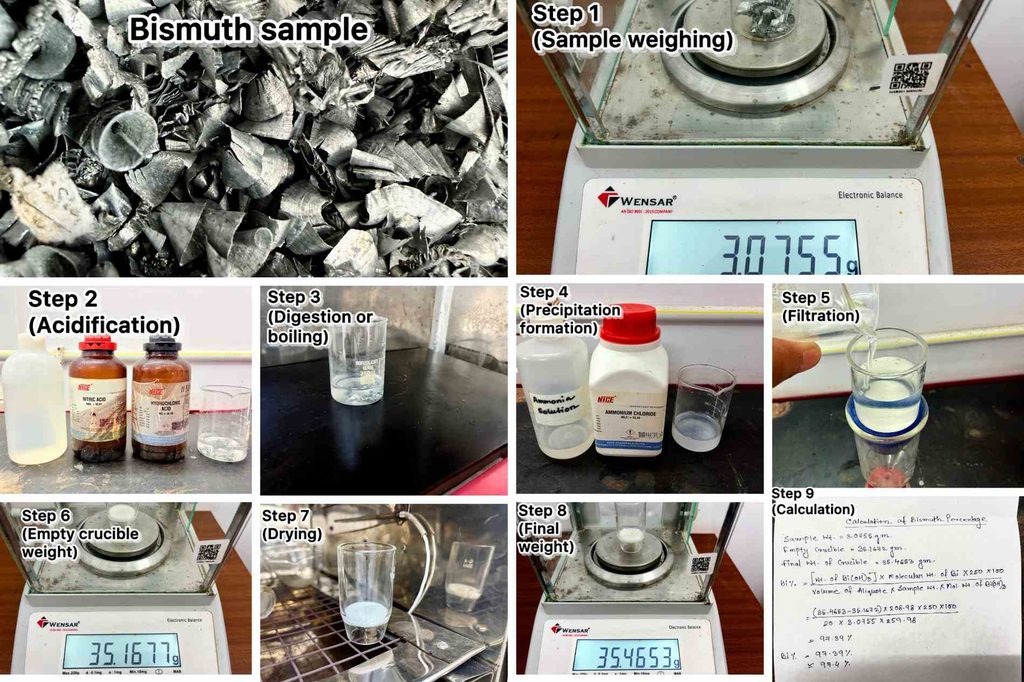
Here we use pure bismuth metal for determination of bismuth %.
Instruments, Glassware & Chemicals used in testing of Bismuth
| Equipment / Chemical | Purpose |
|---|---|
| 4-Digit Weighing Balance | Used to weigh the sample accurately before starting the analysis. |
| Hot Air Oven | Used to dry the crucible or laboratory apparatus at the temperature required by the test method, generally at 95°C-100°C. |
| Desiccator | Used to cool hot crucibles after heating and protect them from moisture before weighing. Silica gel beads are used as a desiccant inside the desiccator. |
| Hot Plate | Used to heat the sample during digestion or boiling. |
| Vacuum Pump | Used to create suction, allowing the liquid to pass through the crucible during filtration. |
| Beaker (250 mL) | Used to hold and mix the sample and solutions during the testing process. |
| Volumatric Flask(250ml) | Used to volume makeup of the sample solution. |
| G4 Gooch Crucible with Filtration Unit | Used to separate the precipitate from the liquid after boiling, as required by the test method. |
| Whatman No. 1 Filter Paper | Used to filter the sample and remove suspended particles or precipitates. |
| Nitric Acid & Hydrochloric Acid | Used to digest the sample and help dissolve the substances being analysed. |
| Ammonium Chloride & Ammonia Solution | Both are used to form precipitation of Bismuth. |
| Distilled Water | To mix the sample during digestion. The conductivity of distilled water should be <5 μS/cm to prevent contamination. |
Procedure to Test of bismuth
| Sample Preparation & Digestion | Take 2-3 gm homogenized sample in a beaker and add 25 ml of distilled water & 25 ml of nitric acid & Hydrochloric Acid to digest.After completion of reaction boil the solution in a hot plate for 30min till half reduction. Allow it to cool.Add 25 ml of distilled water ,if the solution looks clear then transfer it into a 250 ml volumatric flask quantitatively and volume make up to 250ml.Take aliquote of 20-25 ml add pinch of ammonium Chloride & ammonia Solution slowly till a dense white colour granular precipitate of bismuth hydroxide appears.Warm gently and allow to stand for atleast 30 minutes. |
| Filter & drying | Dry a clean G4 gooch crucible & take the empty weight.Filter the sample with G4 gooch crucible through suction and wash with distilled water. Dry the crucible at 95°C-100°C at hot air oven with its contents until the constant weight. |
| Calculation | Note the value & calculate by using following formula % Bismuth = Weight of Bi(OH)₃ x 208.98x 250×100 /Volume of aliquote x 259.98 x Weight of Sample [molecular weight of Bi=208.98,molecular weight of Bi(OH)₃ =259.98] |
Importance of Bismuth Percentage Test in Bismuth Metal
- Determination of Purity: Helps determine the percentage of bismuth present in the metal sample and assess its purity.
- Quality Control: Ensures that the bismuth metal meets the required quality specifications before use or supply.
- Raw Material Inspection: Helps verify the quality of bismuth metal received from suppliers.
- Composition Verification: Identifies variations in bismuth content that may affect the overall composition of the metal.
- Batch-to-Batch Consistency: Helps maintain uniform quality across different batches of bismuth metal.
- Industrial Applications: Confirms whether the bismuth content is suitable for its intended use in alloy production and other industrial processes.
- Quality Assurance: Provides reliable analytical data to support quality checks and decisions regarding the acceptance or rejection of a metal sample.
Handling Mistakes to Avoid During Bismuth Percentage Testing in Bismuth Metal
- Contamination During Testing: Make sure all glassware, instruments, and sample containers are clean and free from residues that could affect the analysis.Proper cleaning Process described previously.
- Incorrect Sample Weighing: Weigh the sample carefully using a calibrated analytical balance. Any error in the sample weight can affect the final percentage.
- Incomplete Sample Dissolution: Follow the specified procedure to dissolve the metal completely. Undissolved particles may cause errors in the test result.
- Improper Use of Reagents: Use the correct reagents in the required concentrations. Incorrect preparation or contaminated reagents may interfere with the analysis.
- Uncontrolled Heating: Maintain the temperature and heating time specified in the procedure. Excessive heating or improper evaporation may lead to sample loss.
- Loss During Sample Transfer: Transfer the sample and prepared solution carefully between containers to avoid spillage or loss of material.
Conclusion
The bismuth percentage test is performed to find out how much bismuth is present in a metal sample. Accurate testing depends on proper sample preparation, careful handling of chemicals, and correct calculations. The result helps assess the quality of the metal and determine whether it meets the required specifications. Regular testing also helps maintain consistent quality in bismuth metal.The bismuth percentage test helps determine the bismuth content in a metal sample and check its quality. Careful handling of the sample, proper testing, and accurate calculations are necessary to obtain reliable results. Photographs of the testing procedure can also help explain the different steps and make the process easier to understand.Also, if you want professional help or need more advanced testing, you can contact Pro Research & Testing Laboratory for your testing needs.You can also join our Internship Programme if you’re looking to enhance your skills, gain practical experience, and grow professionally.
FAQs About Bismuth Percentage Testing in Bismuth Metal
1. What is the purpose of the bismuth percentage test?
The test is used to measure the amount of bismuth present in a metal sample. It helps check the purity and quality of the material.
2. Why is bismuth content checked in metal?
Checking the bismuth content helps determine whether the metal meets the required composition and is suitable for its intended use.
3. Which equipment is required for this test?
Common equipment may include an analytical balance, laboratory glassware,and heating equipment, depending on the method followed.
4. What can cause errors during bismuth testing?
Errors may occur due to inaccurate weighing, contaminated glassware, incomplete dissolution, improper reagent preparation, sample loss, or incorrect calculations.
5. What is the acceptable bismuth content in metal?
The acceptable content depends on the grade of the metal and the relevant product specifications. The test result should be compared with the specified limit.
6. How can accurate test results be maintained?
Accuracy can be improved by following the approved procedure, using calibrated equipment, preparing reagents correctly, and checking calculations before reporting the result.
7. When should bismuth percentage testing be carried out?
Testing may be required when raw materials are received, during production quality checks, or before a finished batch is approved for supply.
How We Verified This Testing/Research Procedure :
This testing procedure is done under qualified analyst .Continually monitored by expertise.Repeatedly testing is always done to get accurate result.
 Written by
Sramana Ghosh (M.Sc. Microbiology, MAKAUT)
Designation – Quality Manager
 Reviewed by
Anwesha Das (M.Sc Microbiology,BU)
Designation – Microbiologist
 Verified By
Dr. Jyotirmoy Kumar Dey (Phd,Chemistry)
Designation – Senior/Chief Chemist
Experience – 25 Years +
Published On: 29th October,2026 Updated On:29th October,2026