



Calcium oxide , may be present in spices due to contamination. Its determination is important for assessing the quality, purity, and safety of spice products. Excessive calcium oxide can affect the chemical characteristics of spices and may indicate adulteration or improper processing.At our laboratory, the determination of calcium oxide in spice samples is carried out using established analytical procedures under controlled laboratory conditions.The result is expressed as the percentage of calcium oxide present in the sample.
Here we take Red Chilli Powder to test the Calcium Oxide.
Equipments and Glasswares used in calcium oxide test in spices
- Beaker(250 ml): It is used to hold the sample during boiling.
- Muffle Furnace: It is used to make ash of sample & filter paper .
- Analytical balance(4 digit): Needs to weigh the chemicals and sample accurately.
- Measuring cyclinder(25 ml ,10 ml): To measure the volume of distilled water.
- Pipette(5 ml, 25 ml): To transfer the accurate volume of chemical into the sample.
- Hot plate: it is used to boil the sample.
- Whatman 1 & Whatman 40 Filter paper with Funnel: To filter the solution & transfer liquids or powders safely into narrow-mouthed containers and to filter mixtures.
- Tongs & Gloves: To holds the silica crucible of ash sample.Use safety gloves and protective eyewear while handling hot dishes.
Chemicals used in calcium oxide test in spices sample
- Conc. Hydrochloric acid: It helps to dissolve the ash/ minerals components.
- Dilute Hydrochloric acid(1:1): Used to adjust the pH of the solution before forming of precipitation.To prepare it, dissolve 50 ml hydrochloric acid in 50 ml distilled water.
- Nitric acid: Helps to digest/dissolve minerals & oxidizing organic matter during the digestion step.
- Ammonia:It is used as precipitating agent.
- Ammonium Hydroxide: Makes the solution alkaline and helps in separation and precipitation steps.
- Ammonium Chloride: Helps in the selective separation of calcium during the ammonia treatment.
- Methyl red indicator: Used to check the pH of the solution.Preparation process described previously.
- 20 % Ammonium oxalate Solution: Reacts with calcium ions to form calcium oxalate precipitate.Prepare it by adding 20 gm ammonium oxalate in 100 ml distilled water.
- Distilled Water: Used for dilution, washing and preparation of solutions & chemicals.The conductivity should be less than 5 µS/cm to avoid adding impurities to the test.
Testing procedure of calcium oxide in Red Chilli Powder
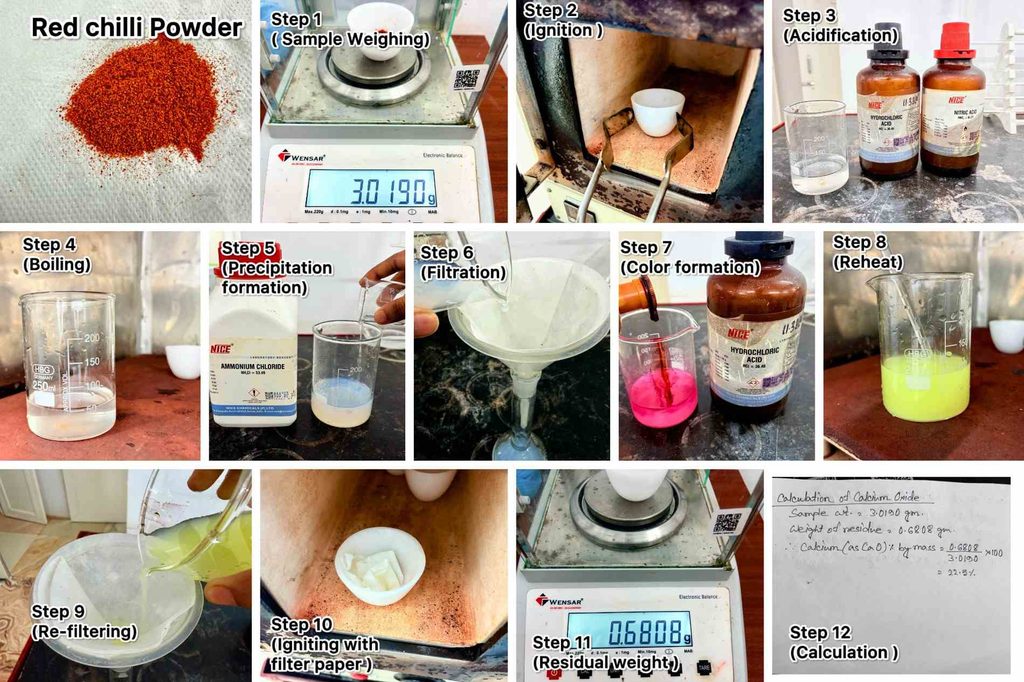
- Weigh accurately about 2-5 g of test sample in a silica crucible and make ash of it in a Muffle furnace(700°C)
- The ash is then transferred into a 250 ml beaker.
- Add 25 ml distilled water,15 ml of conc. HCl & 5 ml of conc. Nitric acid (HNO3) into it.
- Boil the beaker in a hot plate till the nitrous fumes are out and volume is reduced to half.
- Cool the beaker and add 10 ml distilled water,1 gm ammonium chloride.
- After that add ammonium hydroxide till the solution will be strongly ammoniacal, with a precipitation comes in the beaker.Heat to boil.Allow to stand for 3 hour or longer.
- Warm & filter the solution through the Whatman-1 filter paper till ammonia free.Boil again till ammonia free.
- Cool the solution and add 2 drops methyl red indicator and nutralized with dilute 1:1 HCl to red colour.
- After that add dilute ammonium hydroxide till the colour is yellow.
- Warm it on hot plate and add 25 ml of 20% ammonium oxalate in hot condition.
- Add excess ammonia & stirring continuously till ammoniacal smell comes.
- A floculent precipitation of calcium oxalate comes, allowed to settle for 1 hr.
- Filtered it through Whatman-40 & washed till oxalate & chloride free.
- Ignite the precipitation of calcium oxalate with the filter paper in a Muffle furnace(850°C)
- Cool and take the weight.
Calculation of calcium oxide test in spice
Calcium Oxide (as CaO) % by mass = {weight of residue of calcium oxide/weight of sample }×100
Purpose of calcium oxide testing in spice
- Detecting Adulteration: The primary purpose is to catch fraud.
- Verifying Quality and Purity: Every authentic spice has a fixed range of mineral content. A calcium oxide level that exceeds standard limits indicates that the spice is low-grade.
- Nutritional Assessment:The test helps estimate the natural calcium and nutrient levels present in the spice for nutritional labeling.
- Safety Compliance: Ensuring the spice is free from contaminants.
Handling Mistakes to be avoided during the test of calcium oxide in spices
- Ensure the spices sample is thoroughly mixed before analysis.
- Use a properly calibrated analytical balance and avoid weighing errors or loss of sample during transfer.
- All glassware should be clean and free from residues of acids, alkalis, or previous samples.Proper cleaning Process described previously.
- Use properly prepared and standardized reagents.
- Add acids carefully according to the method. Excess acid can affect the reaction and final result.
- Add indicator in the specified quantity.
- Run the required reagent blank and apply the blank correction accurately.
Conclusion
This method determines calcium oxide content in spices, which is important for assessing the quality, purity, and safety of spice products. Excessive calcium oxide can affect the chemical characteristics of spices and may indicate adulteration or improper processing.The primary purpose is to catch fraud. It ensure that the product is safe for human consumption. If there is any difficulty during testing, expert help can be taken from Pro Research & Testing Laboratory.You can also join our Internship Programme if you’re looking to enhance your skills, gain practical experience, and grow professionally.
FAQS on Determination process of calcium oxide in spice
1. Why is Calcium oxide tested in spices?
A. It is tested to check whether calcium oxide is present as an adulterant or in excess amount.
2. Why is a muffle furnace used?
A. A muffle furnace provides high temperature for complete ashing and ignition.
3. Why is nitric acid used?
A. Nitric acid helps in oxidizing during the digestion step.
4. Why is ammonium hydroxide added?
A. It makes the solution alkaline and helps precipitate interfering hydroxide followed by filteration.
5. Why is constant weight important?
A. It confirms that the residues has reached a stable weight and gives a more accurate result.
6. Why is the solution allowed to stand for 3 hours ?
A. To allow the precipitate to form completely and settle properly.
How We Verified This Testing/Research Procedure :
This testing procedure is done under qualified analyst .Continually monitored by expertise.Repeatedly testing is always done to get accurate result.

 Written by
Ankita Samanta (M.Sc Microbiology,Vidyasagar University)
Designation – Junior Microbiologist
 Reviewed by
Anwesha Das (M.Sc Microbiology,BU)
Designation – Microbiologist

 Verified By
Dr. Jyotirmoy Kumar Dey (Phd,Chemistry)
Designation – Senior/Chief Chemist
Experience – 25 Years +
Published on: 9th october,2026 ; Updated On : 9th october,2026