
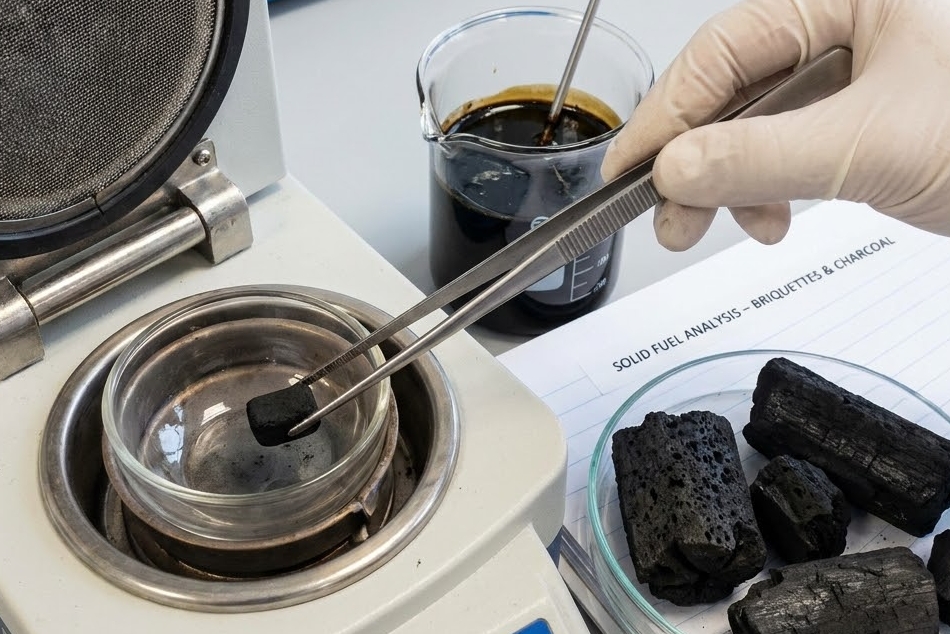
Gross Calorific Value (GCV), also known as the Higher Heating Value (HHV), is the total amount of heat energy released when a quantity of fuel is completely burned under standard conditions. It shows how much energy a fuel contains. A fuel with a higher GCV produces more heat and is considered a better energy source.
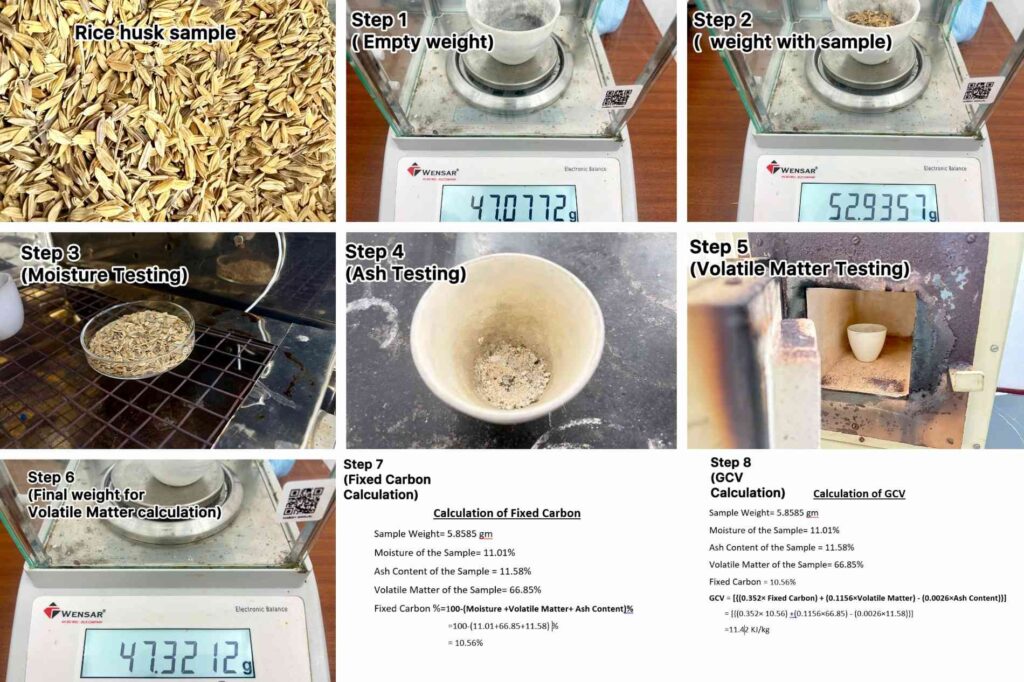
Here we used Rice Husk for determination of GCV.
Instruments & Glasswares used during the test of GCV:
- Hot Air Oven-Maintains the sample at a constant temperature (usually 105 ± 2°C) to remove its moisture. The reduction in sample weight after drying is used to determine the moisture content.
- 4 digit Analytical Balance-Provides precise measurements of the sample’s mass before and after drying, allowing accurate calculation.
- Moisture Dish-Serves as a container for the sample during the drying process while protecting it from contamination and material loss.
- Desiccator-Allows the dried sample to cool in a dry, sealed environment, preventing it from absorbing moisture from the surrounding air before weighing.
- Tongs-Used to safely pick up and transfer hot moisture dishes & crucibles and other glassware without direct contact.
- Silica Crucible– A high-temperature-resistant silica container, used to hold food samples during the incineration process.
- Muffle Furnace– It is used to incinerate organic matter at high temperatures(500°C-900°C), leaving behind inorganic ash as the residual material.
Testing Procedure for Gross Calorific Value (GCV) detection:
| Steps | Procedure |
| Moisture Content | Take 5 gm of sample in a moisture dish for moisture analysis. Process described previously. |
| Ash Content | Take the moisture free sample in a dried silica crucible for ash making. Process described previously. |
| Volatile Matter | Take 1gm moisture free sample in a dried silica crucible. Ignite the sample at 900°C for 7 minutes at muffle furnace. It becomes greyish black in colour. After 3 minutes weight the sample and calculate the loss in weight by the method of ash. |
| Fixed Carbon | To determine fixed carbon, calculation is as follows- % Fixed Carbon =100-(Moisture +Volatile Matter+ Ash Content)% |
| Gross Calorific Value | Gross calorific value or GCV is determined by calculation method as describes below. [{(0.352× Fixed Carbon)+(0.1156×Volatile Matter) – (0.0026×Ash Content)}] in Kilo cal / Kg |
Purpose of Gross Calorific Value analysis in Solid Fuel Sample:
- To determine the total heat energy released when a fuel burns completely.
- To assess the energy content and quality of the fuel.
- To compare the performance and efficiency of different fuels.
- To help decide the efficiency of fuel based on its energy content.
Handling Mistakes should be avoided during GCV testing:
- Keep all glassware clean and dry to avoid contamination .Proper cleaning Process described previously.
- Dry the crucible properly before testing to avoid incorrect ash values due to moisture.
- Avoid using a wet or unclean crucible, as it can change the measured ash weight. Proper cleaning process describes previously.
- Do not heat the sample above 700°C(for ash content), as it may cause loss of some minerals.
- Make sure the sample burns completely; incomplete burning can give wrong ash results.
- Avoid opening the muffle furnace when it is hot to maintain temperature and protect the crucible.
- Use tongs while handling the hot crucible to prevent burns.
- Recheck the calculations and enter the values properly to avoid errors in results.
- Transfer the sample carefully to ensure that no material is lost during handling.
Conclusion about the testing of GCV in Solid Fuel Sample:
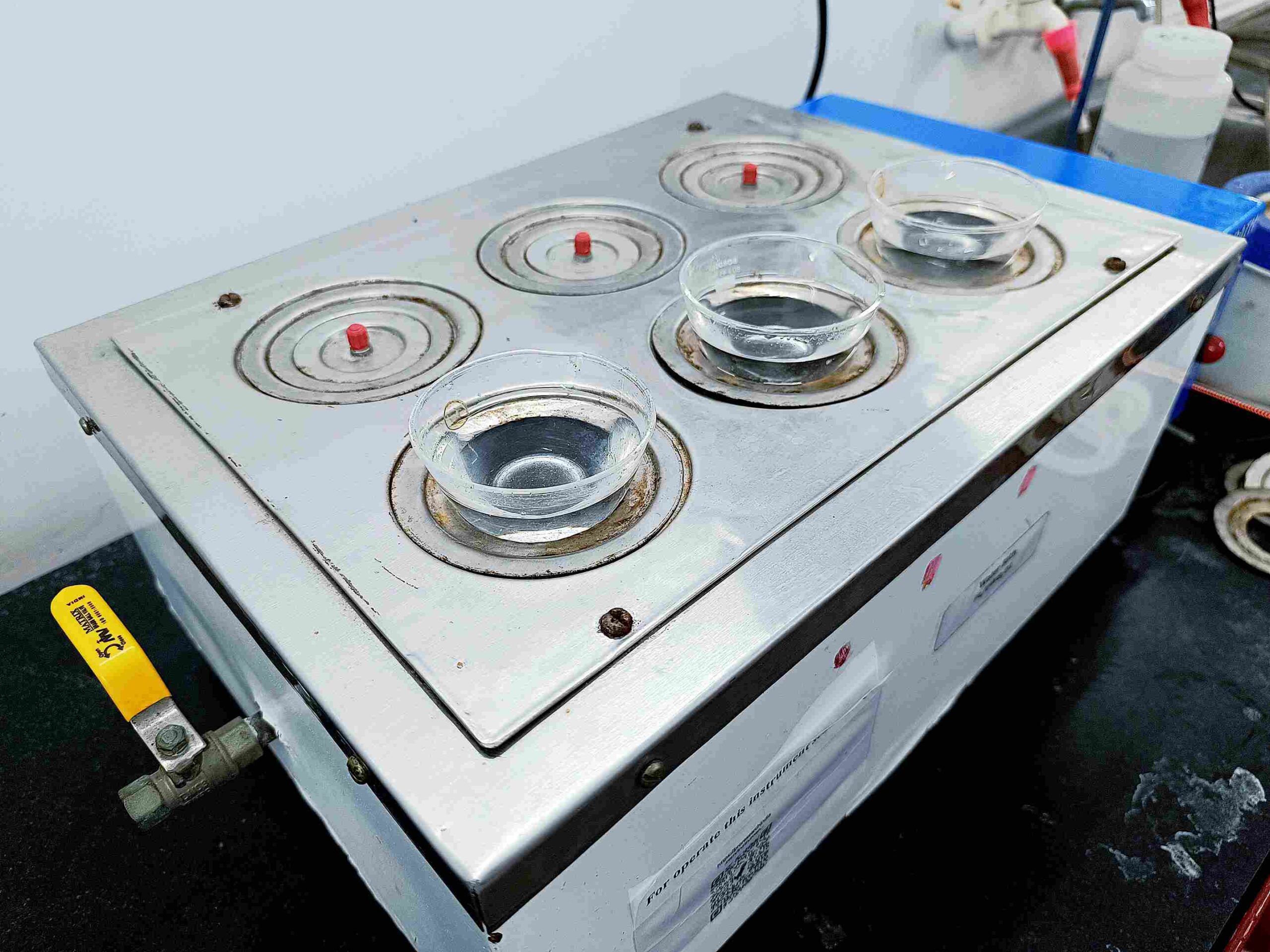
The GCV test shows that it has good energy potential and can be used as a biomass fuel means as it is a biofuel it can be used as an alternative fuel in boilers and biomass energy systems. Overall, GCV testing helps determine the energy value and suitability of sample as a sustainable biomass fuel. By following this procedure, the Gross Calorific Value (GCV) of sample can be determined accurately in a laboratory using the required equipment and glasswares. To understand the testing procedure you can check our real time photo attached with this writing or also you can reach to Pro Research & Testing Laboratory for the advance testing.
Frequently Asked Questions (FAQs) – Gross Calorific Value Test in Solid Fuel Sample
What is GCV Test?
The Gross Calorific Value (GCV) test determines the amount of heat produced when a fuel sample undergoes complete combustion. It is used to assess the energy potential of the fuel and its effectiveness for different heating and power generation purposes.
Why GCV test is performed?
The GCV test is carried out to determine the heat energy produced by a fuel during complete combustion. It provides information about the fuel’s calorific value, performance, and suitability for various energy applications.
At which temperature volatile matter testing performed?
Volatile matter testing performed at 900°C for 7 minutes through muffle furnace.
Why to desiccate the samples?
Samples are dried in a desiccator to remove excess moisture and avoid moisture absorption from the environment. This process helps maintain sample stability and improves the accuracy of test results.
Why to test fixed carbon?
The fixed carbon test is performed to find the amount of carbon left in a fuel after removing moisture, volatile matter, and ash. It helps to understand the fuel’s burning capacity and energy value.
How We Verified This Testing/Research Procedure :
This testing procedure is done under qualified analyst .Continually monitored by expertise.Repeatedly testing is always done to get accurate result.

Written by
Sramana Ghosh (M.Sc. Microbiology, MAKAUT)
Designation – Quality Manager
Reviewed by
Anwesha Das (M.Sc Microbiology,BU)
Designation – Microbiologist
Verified By
Dr. Jyotirmoy Kumar Dey (Phd,Chemistry)
Designation – Senior/Chief Chemist
Experience – 25 Years +