
The alkalinity of water soluble ash indicates the amount of alkaline substances present in the portion of ash that dissolves after treatment with acid.The alkalinity is determined by measuring the amount of standard sulphuric acid required to neutralize the alkaline components present in the ash sample.
Here we used powdered black tea sample for water soluble ash test.
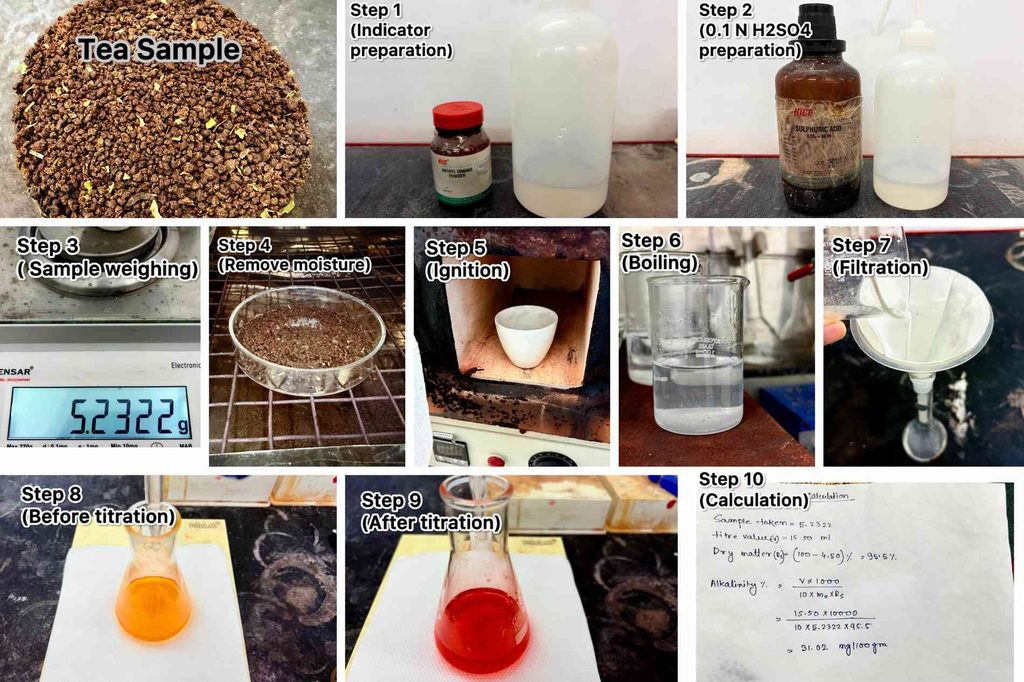
Equipments and Glasswares used in Alkalinity of Water Soluble Ash Test:
- Muffle Furnace – Used to burn the organic matter in the food sample and obtain inorganic ash.
- Silica Crucible – Used to hold the sample during ashing and withstand high temperatures.
- Hot Air Oven – To remove moisture to obtain dry matter.
- Analytical Balance (4-Digit) – Used for accurate measurement of the sample weight with a readability of 0.0001 g.
- Ashless Whatman No. 1 Filter Paper – Used to separate insoluble residue and soluble residue during filtration. It produces negligible ash and minimizes interference in residue measurement.
- Burette (50 mL capacity) – Used to deliver the standard sulphuric acid titrant accurately during the titration.
- Conical Flask & Beaker (250 mL) – Used for mixing the sample, indicator, and titrant.
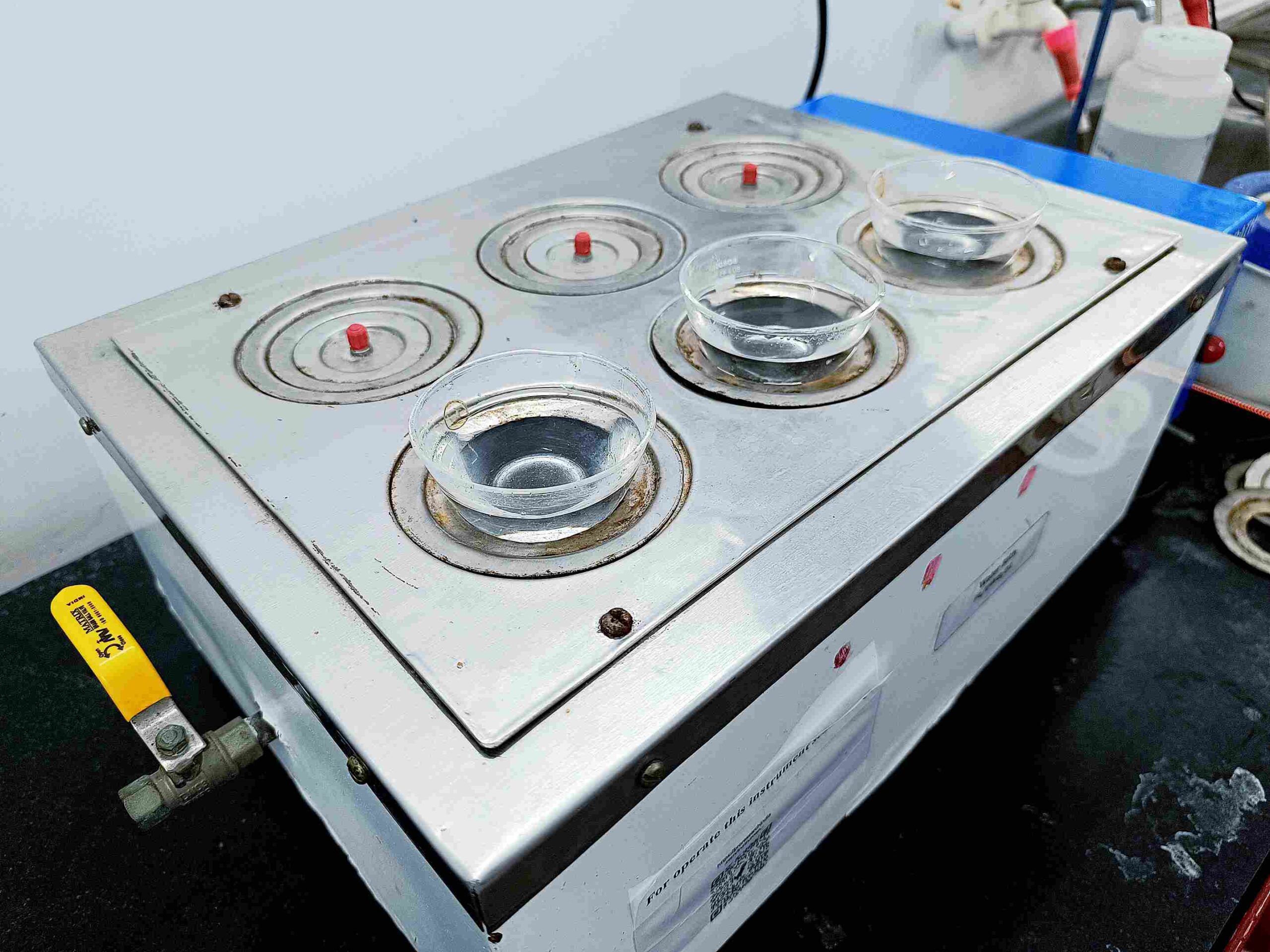
- Hot plate -Used to boil the solutions.
Chemicals used in Alkalinity of Water Soluble Ash Test:
- 0.1 N Sulfuric Acid (H₂SO₄): This acid is used as the titrating solution in alkalinity analysis. It reacts with alkaline components in tea, and neutralizes them during titration.
- Methyl Orange: Methyl orange is used as indicator, helps to determine the endpoint. Dissolve 0.1 gm methyl orange in 100 ml of distilled water.
- Distilled Water: Distilled water is used for preparing the required solutions and dilutions. Water with low conductivity, preferably <5 µS/cm, is recommended to minimize interference from dissolved impurities.
Method of testing of Alkalinity of Water Soluble Ash:
| Sample preparation | Take approx 5-10 gm of moisture free tea sample(Process described previously) & make it ash(Procedure described previously), |
| Addition of distilled water | Transfer the ash into a beaker & add 50 ml of distilled water to it.Heat nearly to boiling. |
| Filteration and ignition | Filter using whatman no 1 filter paper.Repeat with washing the beaker with hot distilled water. |
| Preparation of 0.1(N) Sulfuric Acid | Dilute 2.8 ml of concentrated sulfuric acid to 1000 ml volumetric flask . Standardization Process described previously. |
| Sample Preparation | Take the 50ml of filtrate in a conical flask. Add 2–3 drops of Methyl Orange indicator.The solution appears orangish in colour. |
| Titration | Take the solution in the flask and slowly add 0.1 N sulphuric acid from the burette. Keep shaking the flask gently while adding the acid. Stop adding when the colour changes from orangish to red. Repeat the titration three times and note down the volume of acid used each time.Note the volume of acid used at this endpoint. |
Calculation for Alkalinity of Water Soluble Ash Test in Tea Sample
Alkalinity of water soluble ash in Tea(mg/100gm) =(V x 10000)/(10 x m0 x RS )
V=volume, in millilitres, of 0.1 (N) H2SO4, m0= mass in grams,RS= dry matter content
Purpose of determination of alkalinity of Water Soluble Ash:
- To determine the alkaline nature of water-soluble ash.
- To estimate the amount of alkaline salts present in the sample.
- To assess the purity and quality of the material.
- To detect possible adulteration or contamination.
- To compare the sample with prescribed quality standards.
Handling mistakes should be avoided while testing of alkalinity of water soluble ash:
- Use clean and dry glassware.Proper cleaning Process described previously.
- Avoid loss of ash during transfer and filtration.
- Ensure complete extraction of water-soluble ash.
- Use properly standardized acid for titration.
- Add the acid slowly near the endpoint.
- Avoid overshooting the titration endpoint.
- Remove air bubbles from the burette before use.
Conclusion of Alkalinity of Water Soluble Ash Analysis in tea
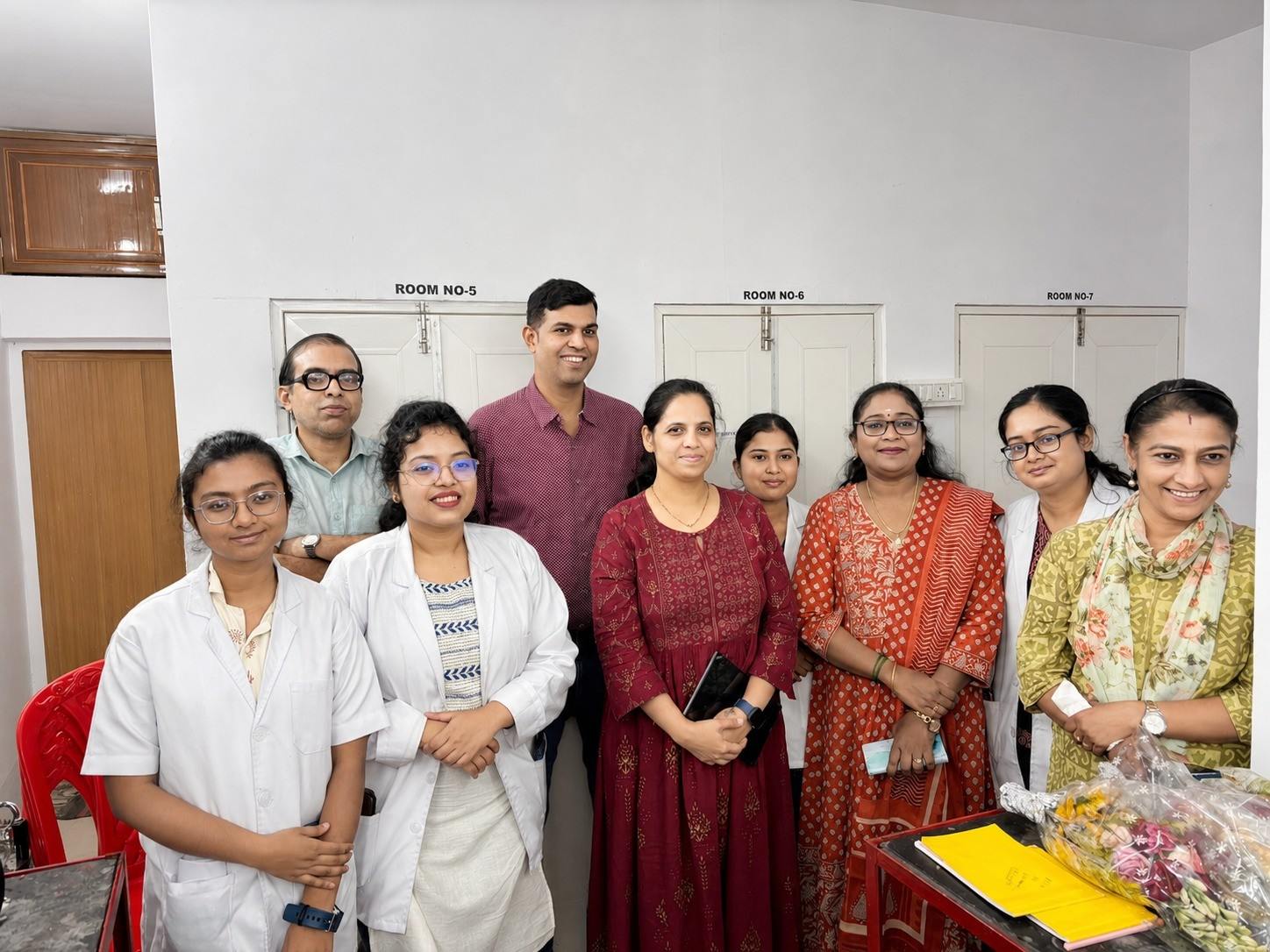
The alkalinity of the water-soluble ash in tea was determined to estimate the basic mineral salts present in the soluble ash fraction. This analysis provides useful information about the mineral composition and overall quality of tea. The obtained result can be compared with the standard value to determine whether the tea sample(example-black tea,green tea,white tea,chamomile tea etc) meets the required quality specifications.The attached photos offer a quick look at our testing process. For professional testing support, contact Pro Research & Testing Laboratory.If you are Interested in gaining practical experience and building your skills join our Internship Programme and grow with hands-on learning.
FAQs on Alkalinity of Water Soluble Ash in tea
1.What is water-soluble ash in tea?
Water-soluble ash refers to the mineral content of tea that can dissolve in water. It mainly consists of sodium,potassium,chloride residues.
2. What is alkalinity of water-soluble ash?
It indicates the amount of alkaline substances present in the water-soluble portion of tea ash.
3. Why is it determined?
It is used to assess the quality and mineral composition of tea.
4. What is the principle of the test?
The water-soluble ash is extracted with water and the extract is titrated with a standard acid.
5. What are the main sources of error?
Incomplete extraction, loss of sample during filtration, incorrect endpoint detection, and calculation errors.
6. How can errors be reduced?
By using accurate measurements, clean apparatus, standardized reagents, and careful titration.
How We Verified This Testing/Research Procedure :
This testing procedure is done under qualified analyst .Continually monitored by expertise.Repeatedly testing is always done to get accurate result.
 Written by
Sramana Ghosh (M.Sc. Microbiology, MAKAUT)
Designation – Quality Manager
 Reviewed by
Anwesha Das (M.Sc Microbiology,BU)
Designation – Microbiologist
 Verified By
Dr. Jyotirmoy Kumar Dey (Phd,Chemistry)
Designation – Senior/Chief Chemist
Experience – 25 Years +