
The inorganic chloride test is a qualitative test used to check for the presence of chloride impurities in a sample. Chloride ions, if present, react with a suitable reagent such as silver nitrate to produce a characteristic precipitate of silver chloride. The appearance of this precipitate provides evidence of chloride contamination. This test is commonly used in laboratory analysis to assess the purity and quality.
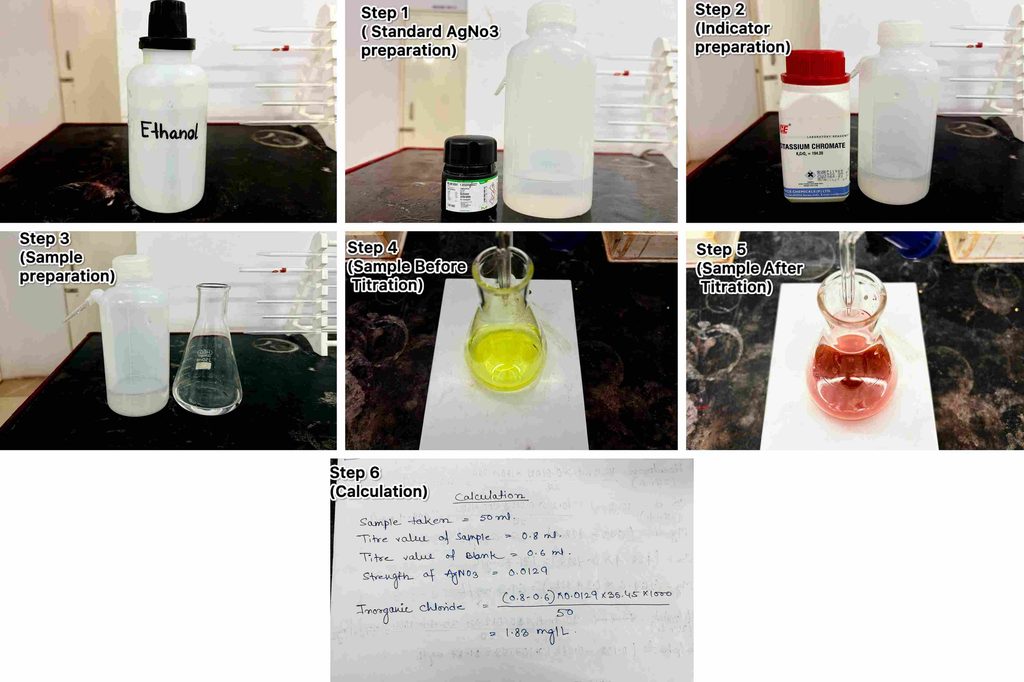
Here we use Ethanol or Ethyl Alcohol (C2H5OH) for inorganic chloride testing.
Equipments used in inorganic chloride testing:
- Conical Flask (50 mL): Holds the sample and reagents during titration.
- Burette (50 mL): Measures and delivers silver nitrate accurately during titration.
- Volumetric Flask (1000 mL): Used to prepare solutions to an exact volume.
- Pipettes (25 mL, 50 mL): Transfer measured volumes accurately.
- 4 digit Analytical Balance: Accurately weighs chemicals for solution preparation.
- Whatman No. 41 Filter Paper: Used to filter indicator or reagent solutions.
Chemicals used in inorganic chloride testing:
- Potassium Chromate (K₂CrO₄): Used as the indicator; a reddish-brown color appears at the endpoint when chloride ions have been completely precipitated. Potassium Chromate (K₂CrO₄) indicator preparation is Previously described.
- 0.0141 N Silver Nitrate (AgNO₃): Serves as the titrating solution and reacts with chloride ions to produce a white silver chloride precipitate.Preparation of 0.0141 N Silver nitrate (AgNO₃) is Previously described
- Standard Sodium Chloride (NaCl) Solution: Used to standardize the silver nitrate solution by providing a known chloride concentration for accurate analysis.
- Distilled Water: Used for preparing and diluting solutions. Low-conductivity water helps prevent interference from unwanted chloride ions.he conductivity of distilled water should be <5 μS/cm to prevent contamination.
Procedure for Inorganic Chloride Determination in Ethanol:
| Step | Process |
| Sample Preparation | Take 50 ml ethanol in a clean and dry conical flask. Add 50 ml of distilled water. |
| Titration & Calculation | Titrate with 0.0141N AgNO₃ as previously described till the colour changes to brick red. |
Formula for Calculation:
Chloride,mg/l =(V1– V2) x N x 35.45 x 1000/ V3
V1= Sample titre value
V2 =Titre value of Blank
V3 = Volume in ml of sample taken for titration
35.45 = Equivalent weight of chloride ion
N = Normality of silver nitrate solution.
Purpose of Chloride Determination Test in Ethanol:
- To identify whether chloride impurities are present in the ethanol sample.
- To evaluate the chemical purity of ethanol.
- To detect contamination that may occur during processing, handling, or storage.
- To verify that the sample complies with specified quality requirements.
Handling mistakes to avoid during inorganic chloride test:
- Using uncleaned glassware and tap water-Use clean glassware and distilled water to avoid contamination. Proper cleaning Process described previously.
- Adding too much reagents-Do not add excess reagents. Add reagents slowly and in the correct order.
- Incorrect AgNO₃ concentration – An improperly prepared solution can give wrong results.
- Excess titration – Stop immediately when a permanent reddish-brown color appears.
- Wrong indicator quantity – Excess or insufficient potassium chromate can make the endpoint unclear.
- Poor stirring – Inadequate mixing can cause an inaccurate endpoint.
- No blank correction – This may result in a higher chloride value than the actual amount.
- Light exposure – Keep silver nitrate protected from light, preferably in an amber bottle.
Conclusion of Inorganic Chloride Test in Ethanol
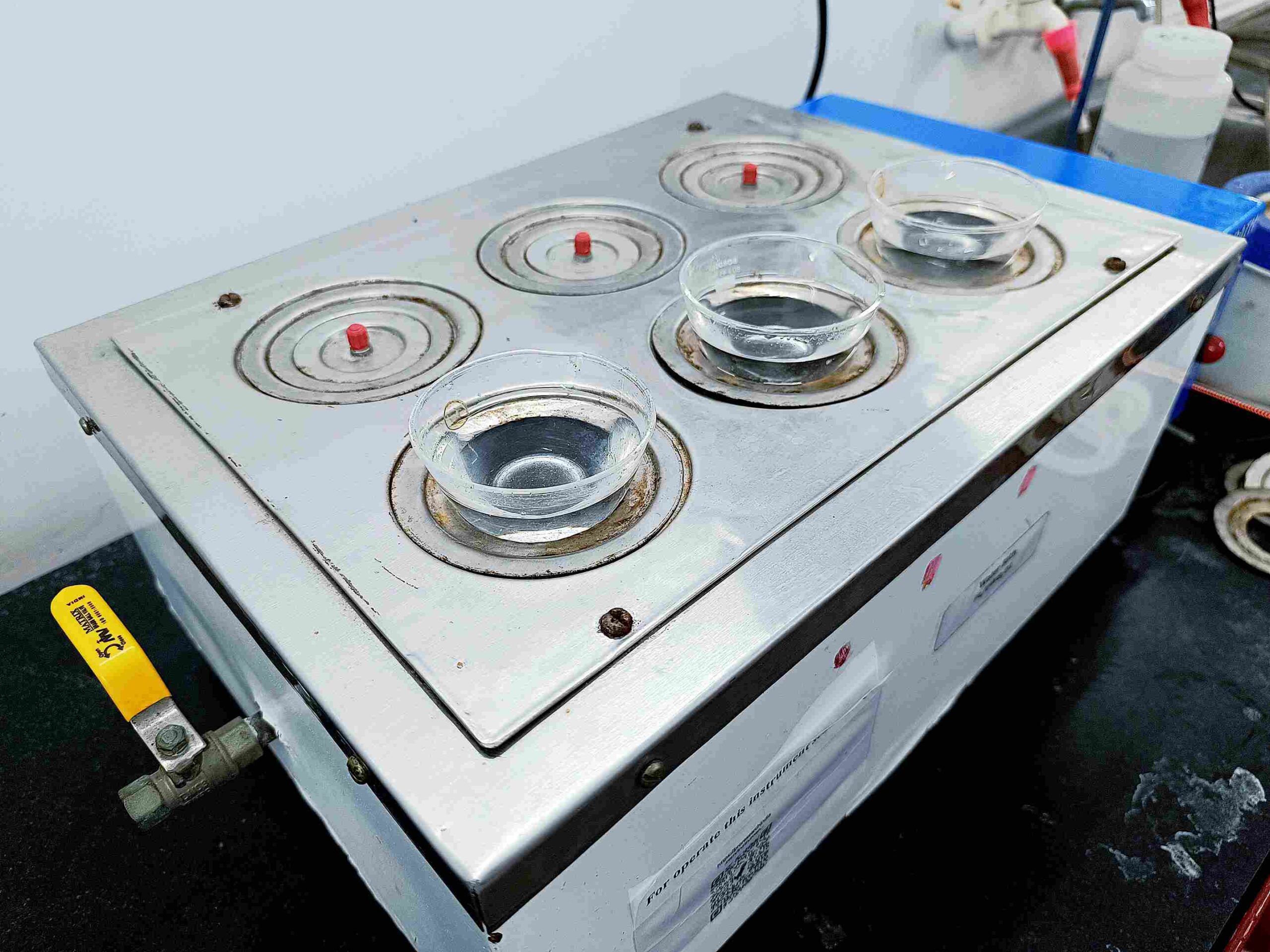
The inorganic chloride present in ethanol can be detected by its reaction with silver nitrate, producing a characteristic precipitate. Proper reagent handling and careful observation help obtain dependable test results. The procedure can be applied in laboratories and industrial facilities to check inorganic chloride in ethanol. Careful testing and proper use of reagents provide dependable results and help maintain product quality. Furthermore, for better understanding of the procedure, photos can provide a simple visual guide. For detailed or advanced analysis, you can also reach out to Pro Research & Testing Laboratory for professional laboratory testing. You can also join our Internship Programme if you’re looking to enhance your skills, gain practical experience, and grow professionally.
FAQs of Inorganic Chloride Determination Test in Ethanol
1. What does inorganic chloride mean in ethanol?
It means chloride ions present as unwanted inorganic impurities.
2. Why is this test performed?
The test helps check the purity and quality of ethanol.
3. Which reagent is commonly used?
Silver nitrate or AgNO3 is commonly used to identify chloride ions.
4. What indicates the presence of chloride?
A precipitate of silver chloride suggests chloride is present.
5. What may affect the test result?
Dirty and contaminated glassware, incorrect quantities of reagents etc can lead to unreliable results.
How We Verified This Testing/Research Procedure :
This testing procedure is done under qualified analyst .Continually monitored by expertise.Repeatedly testing is always done to get accurate result.

Written by
Sramana Ghosh (M.Sc. Microbiology, MAKAUT)
Designation – Quality Manager
Reviewed by
Anwesha Das (M.Sc Microbiology,BU)
Designation – Microbiologist
Verified By
Dr. Jyotirmoy Kumar Dey (Phd,Chemistry)
Designation – Senior/Chief Chemist
Experience – 25 Years +