

Phosphorus is an essential mineral naturally present in cereal grains and cereal-based products. It plays an important role in energy. Detecting phosphorus in cereal products helps measure nutritional value and monitor artificial phosphate additives for quality control. Phosphorus can be determined by suitable colorimetric or spectrophotometric methods.
Here we take Besan / Gram Flour to test the phosphorus in our lab.
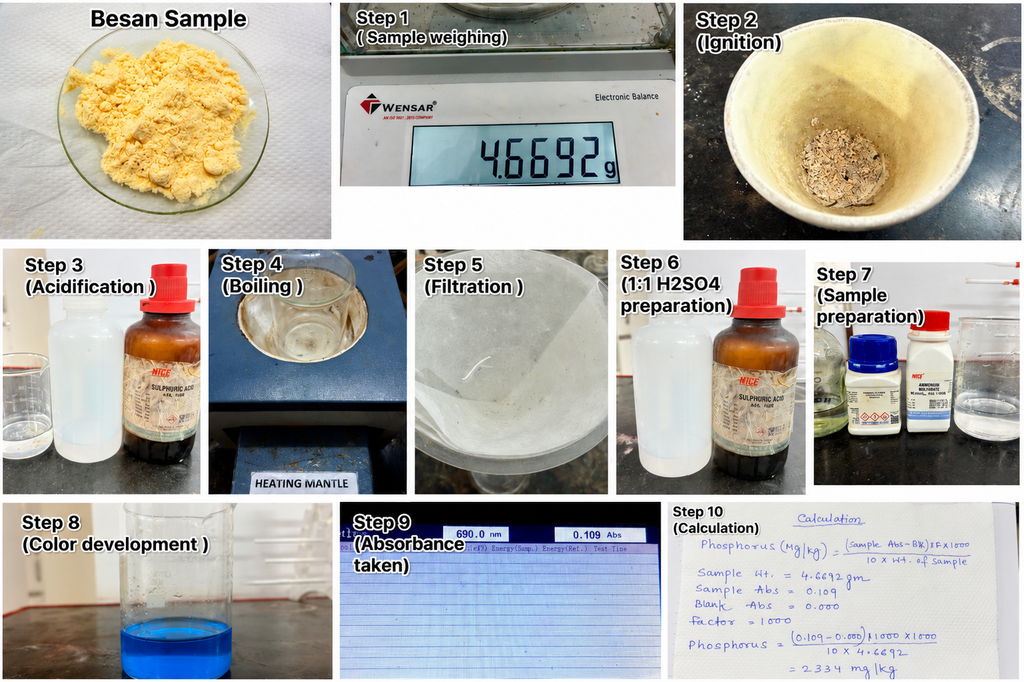
Apparatus used in the determination of phosphorus in cereal products:
- Spectrophotometer (690 nm)– Used for the quantitative determination of Phosphorus concentration in the cereal products by measuring its absorbance at 690 nm.
- Analytical Balance(4-digit)– Used to measure desirable amount of sample .We use 4 digit balance for this testing.
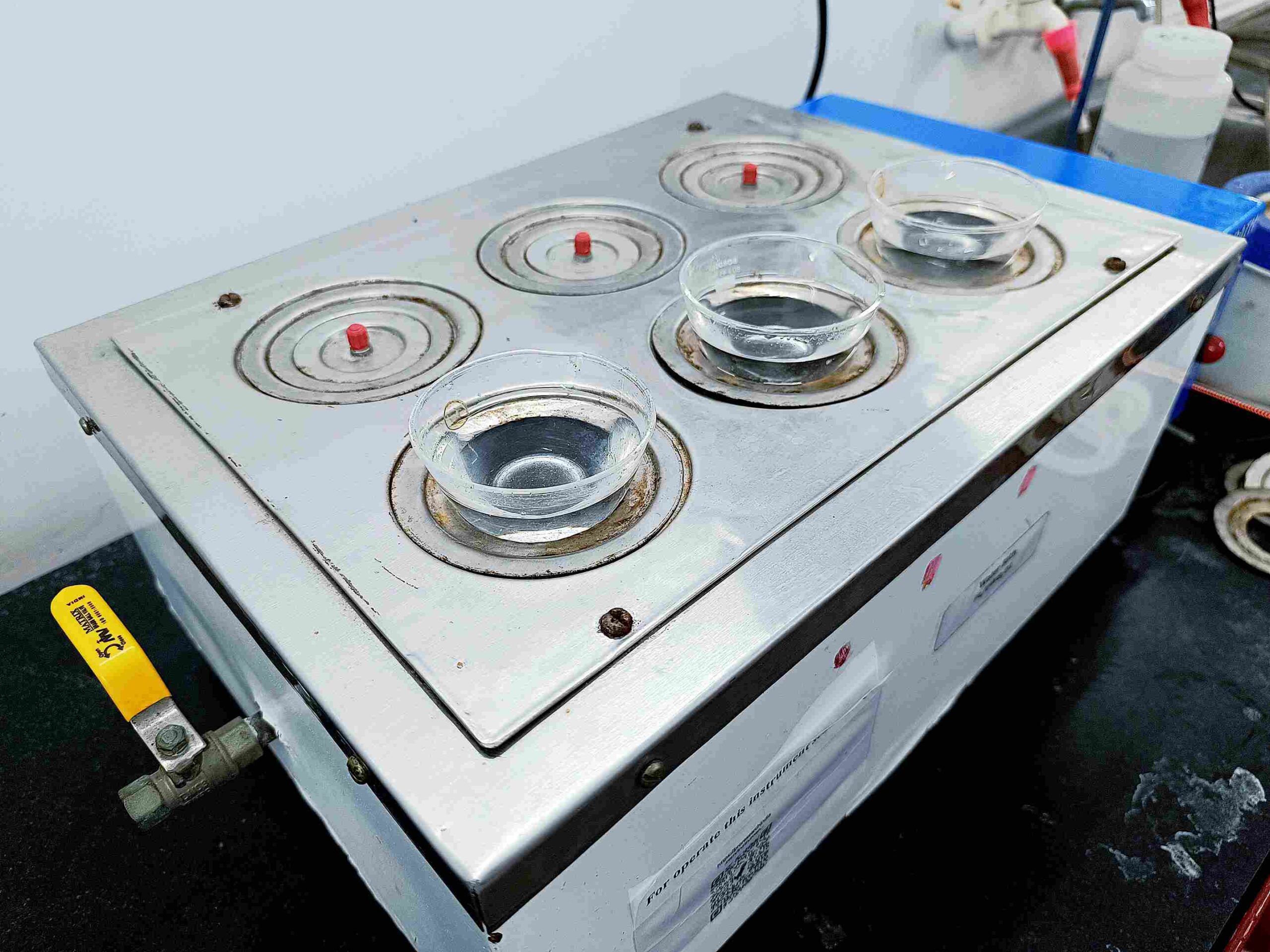
- Heating Mantle – Used to boil the sample after acidification.
- Silica Crucible– This high-heat resistant container made of silica, holds the food sample during incineration.
- Hot Air Oven– To dry(at 105°C) the crucible before starting the procedure.
- Muffle Furnace– It provides high temperature turns the inorganic residue into ash.
- Tongs-To hold the hot crucible safely without direct contact.
- Desiccator– It maintains moisture free environment to prevent rehydration of ash before weighing. Silica beads are used in the desiccator which absorbs the moisture from the crucible.
- Beaker (100 mL)-Hold the sample and reagents.
- Pipette(5 ml)-It is an equipment used to accurately measure and transfer small amounts of liquid.
- Standard Volumetric Glassware (100 mL)-A volumetric flask is laboratory glassware designed to prepare solutions to an exact, specified volume.
- Filter paper with funnel-It is used mainly for separating insoluble particles from digested cereal sample.
Chemicals used in the determination of phosphorus in cereal products:
- Distilled water-It is used for reagent preparation and dilution.The conductivity of distilled water should be <5 μS/cm to prevent contamination.
- 1:1 Sulfuric Acid-Provides the acidic environment necessary for the molybdate-phosphate reaction. Take 50 ml distilled water in a beaker and add 50 ml sulfuric acid.Label it 1:1 sulfuric acid.
- Stannous Chloride-It acts as a reducing agent(develops the blue colour).Preparation process described previously.
- Ammonium molybdate-It reacts with phosphate to form a Phosphomolybdate complex.Preparation process described previously.
- Phosphorus standard solution-It is used for preparing the calibration curve.Preparation process described previously.
Procedure of Phosphorus testing in cereal products:
- At first take the sample and if it is not in powder form grind it properly to obtain a uniform powder.
- Accurately weigh 5g of sample in a silica crucible & turns completely ash into a muffle furnace.whole process for ash described previously.
- Take a 100 ml beaker to hold the ash and add 2 ml 1:1 Sulfuric acid to digest it. After digestion, allow the sample to cool.
- Transfer the solution through suitable filter paper.Filtration removes insoluble particles and gives a clear solution.Volume make up to the 100 ml.
- Add 4 ml 1:1 H2SO4 solution then 4 ml ammonium molybdate & 10 drops stannous chloride. Wait for color development.
- Take absorbance at 690 nm. Run a blank sample using distilled water in the same way. Perform the test at least in 2 set to get accurate result.
- Calculate the phosphorus content by using following formula.
Calculation:
F=C/A
C = Concentration of Phosphorus in standard (mg/L)
A = Measured absorbance for the standard
F = factor
Phosphorus (mg/kg)= {(Sample abs-Blank abs) x F x 1000}/(10 x Weight of Sample)
Importance of Phosphorus test in cereal products:
- The measured phosphorus content can support accurate nutritional information when phosphorus is declared as part of the product’s nutrient composition.
- It provides information about the mineral content.
- It helps maintain consistent quality of cereal products.
- It can help identify changes in raw materials or added phosphate ingredients.
Precautions to be taken during phosphorus determination test in cereal products
- Use clean glassware to avoid phosphorus contamination. Proper cleaning Process described previously.
- Take an accurate sample weight using calibrated analytical balance.
- Too much or too little sulfuric acid can prevent proper complex formation.
- Prepare standard phosphorus solution accurately.
- Always run a reagent blank along with sample.
- Filter the digested sample properly to remove insoluble particles.
Conclusion of Phosphorus testing in cereal products
Phosphorus detecting in cereal products helps to measure nutritional value. It also monitor artificial phosphate additives.The procedure can be applied in laboratories and industrial facilities to check Phosphorus determination in any cereal products like flour, wheat etc. Careful testing and proper use of reagents provide dependable results and help maintain product quality. Furthermore, for better understanding of the procedure, photos can provide a simple visual guide. For detailed or advanced analysis, you can also reach out to Pro Research & Testing Laboratory for professional laboratory testing. You can also join our Internship Programme if you’re looking to enhance your skills, gain practical experience, and grow professionally.
FAQs of Phosphorus determination in cereal products
1. What is phosphorus?
Phosphorus is an essential mineral naturally present in cereal grains and cereal-based products.
2. Why is this test performed?
The test helps check the purity and quality Cereal products.
3. Which reagent is commonly used to digest the sample?
Sulphuric Acid is commonly used to digest the sample as it reacts fast.
4.Which method is follow to determine phosphorus in cereal products?
Phosphorus can be determined by suitable colorimetric or spectrophotometric methods.
5. What may affect the test result?
Dirty and contaminated glassware, incorrect quantities of reagents etc can lead to unreliable results.
6. What is the use of Stannous Chloride?
Stannous chloride acts as a reducing agent.
HHow We Verified This Testing/Research Procedure :
This testing procedure is done under qualified analyst .Continually monitored by expertise.Repeatedly testing is always done to get accurate result.

 Written by
Ankita Samanta (M.Sc Microbiology,Vidyasagar University)
Designation – Junior Microbiologist
 Reviewed by
Anwesha Das (M.Sc Microbiology,BU)
Designation – Microbiologist

 Verified By
Dr. Jyotirmoy Kumar Dey (Phd,Chemistry)
Designation – Senior/Chief Chemist
Experience – 25 Years +
Published on: 4th September,2026 ; Updated On : 4th September,2026