
Total chromium testing in water is used to measure the overall amount of chromium present in a sample, including both Cr(III) and Cr(VI). Chromium may enter water from natural sources and industrial activities such as metal processing and leather tanning. Since excessive chromium can affect human health and aquatic life, its determination is important for assessing water quality and environmental safety.
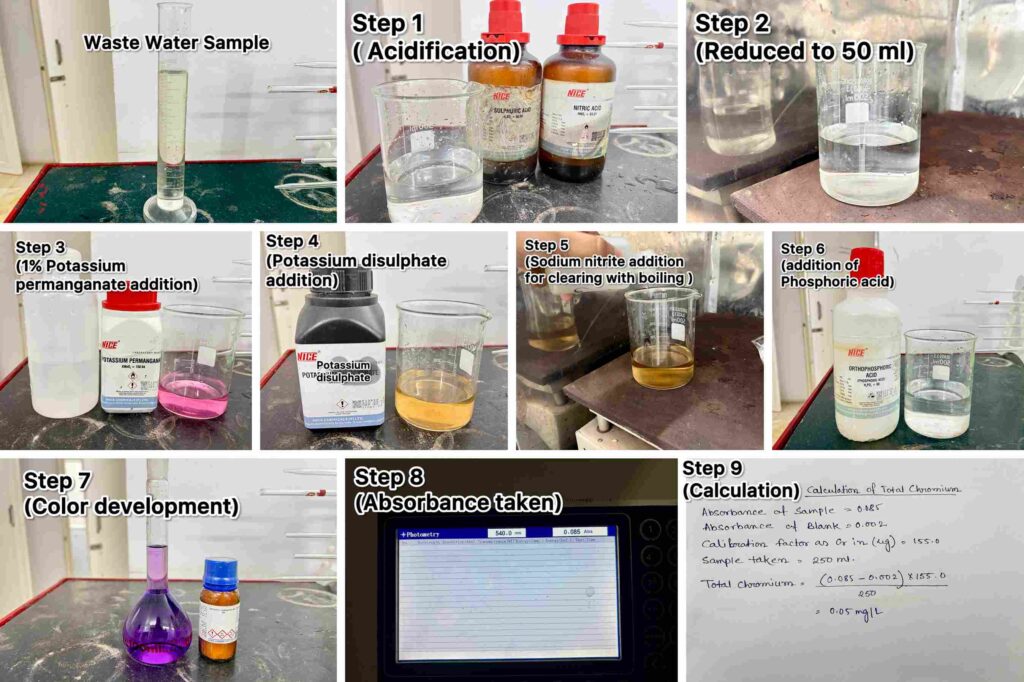
Here we used waste water for detect chromium. Process is described below-
Apparatus used in the detection of Total Chromium in Water Sample:
- Spectrophotometer (540 nm): Used for the quantitative determination of chromium concentration in the water sample by measuring its absorbance at 540 nm.
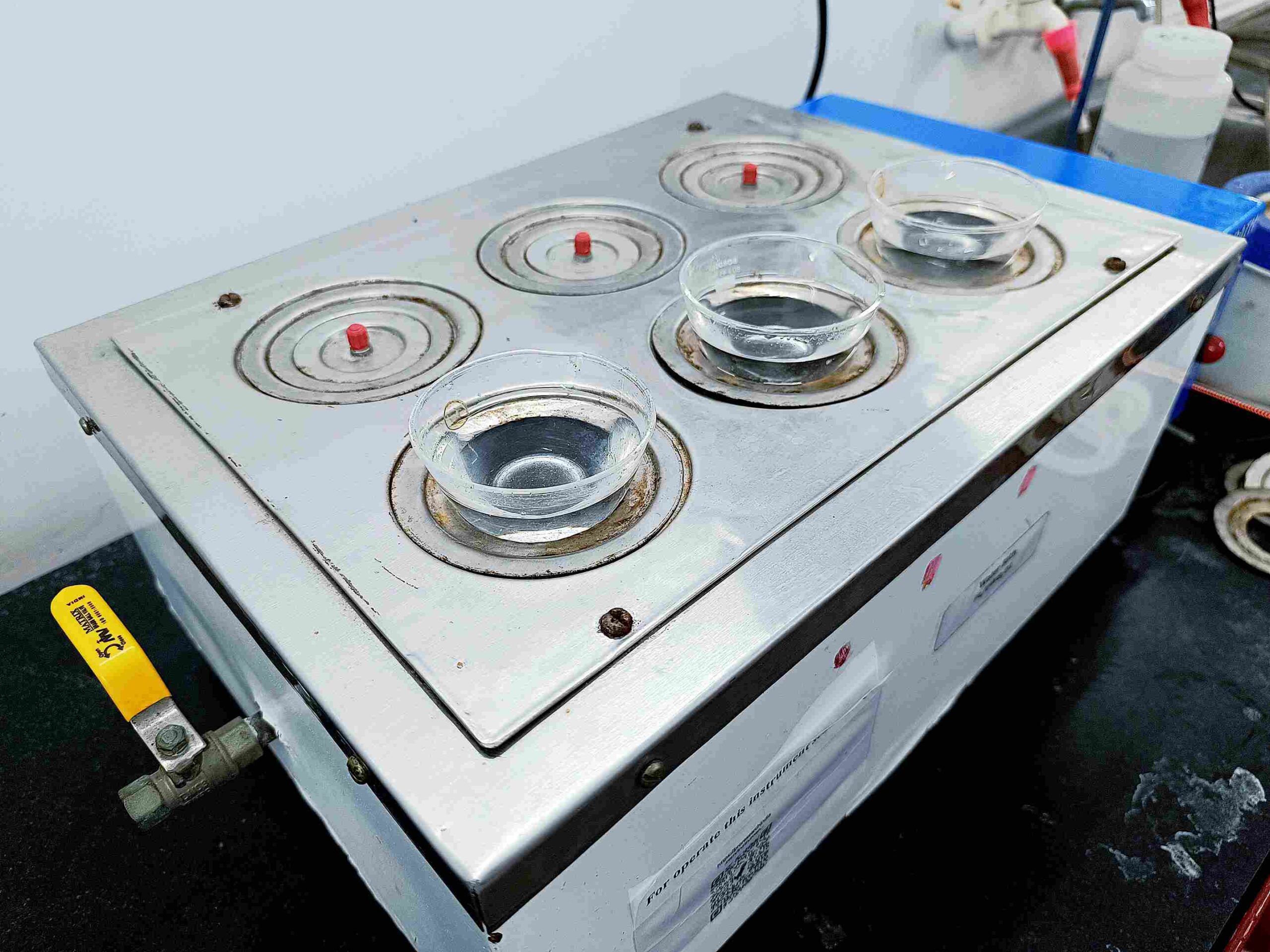
- Hot Plate: It provides constant heat to boil the solvent.
- Measuring Cylinder(250 ml): Used to measure the sample accurately.
- Beaker (500 mL): Hold the sample and reagents.
- Pipette(5 ml,2ml):It is an equipment used to accurately measure and transfer small amounts of liquid.
- Drop Bottle: Used to add the reagents drop wise.
- Standard Volumetric Glassware (100 mL): A volumetric flask is laboratory glassware designed to prepare solutions to an exact, specified volume.
Chemicals used in the detection of Total Chromium in Water Sample:
- Nitric Acid (HNO3)-Acts as a oxidising agent.It converts Chromium(III)+ to Chromium(VI)+.
- Sulphuric Acid (H2SO4)-Acts as a reaction medium. Nitric acid mix with H2SO4 to increase reactivity.
- Potassium Permanganate(KMnO₄)-Dissolve 1gm of potassium permanganate in 100ml of distilled water to make 1% potassium permanganate solution.It also acts as a oxidising agent and converts Chromium(III)+ to Chromium(VI)+.
- Potassium Peroxidisulfate(K2S2O₈)-It’s an oxidising agent and converts Chromium(III)+ to Chromium(VI)+
- Sodium Nitrite-Dissolve 1gm sodium nitrite in 100ml of water to make 1% sodium nitrite solution. It is a reducing agent and acts as scavenger of excess KMnO4.
- Phosphoric Acid-It creates the necessary acidic conditions for the reaction to take place.
- 1,5-Diphenyl Carbazide(DPCZ)-Prepare the diphenyl carbazide reagent by dissolving 0.25 g of 1,5-diphenylcarbazide in 50 mL of acetone. The resulting DPCZ solution serves as a color-developing reagent for the spectrophotometric determination of chromium [Cr(VI)] in water samples. In the presence of Cr(VI), DPC reacts to produce a characteristic pink-violet complex, whose intensity can be measured spectrophotometrically.
- Filter Paper-Used to filter the solution.
- Distilled Water-Used to prepare reagent and used for dilution without introducing impurities that may interfere with the reaction.The conductivity of distilled water should be <5 μS/cm to prevent contamination.
Procedure of Total Chromium Testing in water sample:
- Take 250 ml of sample. Add 5 ml of nitric acid(HNo3) & 2ml of sulphuric acid(H2SO4).
- Slowly boil till the volume reduced to 50 ml and cool.
- Add 1% of potassium permanganate solution drop wise till the pink colour persist.
- Add a slight pinch of potassium peroxidisulfate. Boil till the solution turns brownish in colour.
- Now add 1% of Sodium Nitrite solution drop wise and boil till the solution become clear.
- Allow it to cool and add 2 ml of phosphoric acid.
- Transfer the solution through filtration into 100 ml volumetric flask and volume make up to 100ml.
- Add 2ml of 1,5-Diphenyl Carbazide solution.A pink colour develops.
- Measure the absorbance at 540nm.Similarly run a blank and measure the absorbance.
Calculation-
Chromium(Cr)= (Absorbance-Blank) X calibration factor/Sample taken
Importance of Total Chromium Test in Water Sample:
- Measure chromium levels – Determines the amount of chromium present and to identify chromium [Cr(VI)], which is more toxic.
- Protect health – Helps assess possible risks from toxic chromium forms.
- Monitor water quality –To check the quality of wastewater before it is released into the environment and ensures water remains within safe limits.
- Check treatment efficiency – Evaluates how effectively chromium is removed during water treatment.
Precautions to be taken during Total Chromium Test in Water Sample
- Check the test procedure and calculations carefully.
- Check the sample for contamination or incorrect preparation.
- Verify all calculations and record results correctly.
- Transfer the sample carefully to prevent material loss.
- Use the correct amount of reagents.
- Keep all glassware clean and dry to avoid contamination.Proper cleaning Process described previously.
Conclusion of Total Chromium Testing in Water Sample
The process used to determine total chromium in waste water sample as well as surface water, drinking water, pond water etc.The observed result helped determine whether chromium was present in the sample. It is check if water filters and purification systems are successfully removing chromium. By following these method, you can easily test the total chromium content of water sample at laboratory & also manufacturing industry with availability of the equipments & chemicals.To understand the procedure you can check our real time photo attached with this writing or also you can reach to Pro Research & Testing Laboratory for the advance testing.
Frequently Asked Questions (FAQs) – Chromium Content Test in water sample
1. Why chromium test is important for water sample?
Ans- Chromium testing is important in water because chromium is toxic,hazardous and harmful to humans and aquatic life. It helps identify industrial contamination, check whether treatment is effective, and ensure that the wastewater meets environmental discharge standards.
2. Which chromium ion is more toxic and why?
Ans-Cr(VI) is more toxic than Cr(III) because it can enter cells easily and cause damage to DNA and other cellular components. Long-term exposure to Cr(VI) can also increase the risk of cancer.
3. What is the principle of chromium test?
Ans-The principle of chromium testing is based on a chemical reaction that produces a specific color. The color intensity is measured to determine the amount of chromium present in the water sample.
4. What can affect the accuracy of the test?
Ans-Incorrect weighing, contaminated glassware, incomplete dissolution, sample loss, and calculation errors.
5.Why is distilled water used during testing?
Ans-Used to prepare reagent and used for dilution without introducing impurities that may interfere with the reaction.
How We Verified This Testing/Research Procedure :
This testing procedure is done under qualified analyst .Continually monitored by expertise.Repeatedly testing is always done to get accurate result.

Written by
Sramana Ghosh (M.Sc. Microbiology, MAKAUT)
Designation – Quality Manager
Reviewed by
Anwesha Das (M.Sc Microbiology,BU)
Designation – Microbiologist
Verified By
Dr. Jyotirmoy Kumar Dey (Phd,Chemistry)
Designation – Senior/Chief Chemist
Experience – 25 Years +