

Bulk density is one of the important physical properties of bio charcoal, which refers to the mass of bio charcoal present in a given volume, including the spaces between its particles. It provides useful information about the physical structure, packing characteristics and overall quality of the material.
Different biomass materials produce bio charcoal with different physical characteristics, resulting in variations in bulk density. Since bio charcoal generally contains a porous structure with numerous internal and external spaces, its bulk density is often relatively low. The determination of bulk density is important for understanding its storage capacity, transportation, handling and suitability for agricultural and industrial purposes.
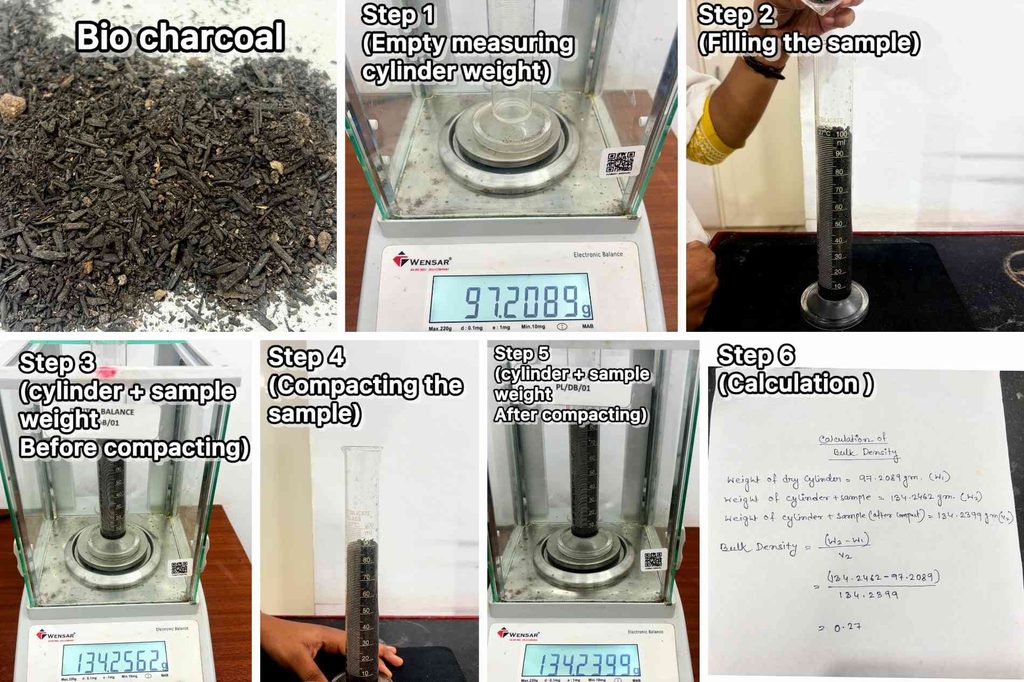
Here we used bio charcoal for determination of bulk density.
Instruments and glassware used in testing of bulk density
- Measuring Cylinder(100ml)-Used to measure the sample.
- 4 digit Analytical Weight Balance-Used to measure the mass of samples and glassware accurately.
- Rubber pad-Used to provide a stable surface and prevent glassware from slipping or breaking.
- Hot Air Oven-Used for drying glassware and sterilizing heat-resistant laboratory materials
Procedure to Test of Bulk Density of Charcoal
Weigh a 100 ml Measuring Cylinder and dry it at hot air oven(W1)
│
▼
Filled the cylinder with the bio charcoal sample up to the 100ml mark and note the volume(V1)
│
▼
Weigh the cylinder along with the sample using 4 digit analytical weigh balance(W2)
│
▼
Tap the cylinder for 2 minutes.Put a rubber pad below the cylinder for support.
│
▼
Measure the compact volume(V2)
Calculation
Bulk Density= (W1-W2) / (V2)
W1=Weight of Dry Cylinder
W2= Weight of Sample with Cylinder
V2=Final Volume
Importance of Bulk Density Test of Bio-charcoal
- Quality assessment: Helps evaluate the physical characteristics and quality of bio charcoal.
- Porosity: Provides an idea about the packing behaviour and porous nature of bio charcoal.
- Storage: Helps estimate the space required for storing biocharcoal.
- Soil improvement: Helps understand the effect of biochar application on soil structure, aeration and water retention.
- Agricultural application: Helps determine its suitability for use as a soil amendment.
- Comparison: Allows comparison of biocharcoal produced from different biomass materials.
Handling Mistakes to Avoid During Bulk Density Testing of Biocharcoal
- Moisture content: Make sure the sample has a consistent moisture condition before testing.
- Improper filling: Fill the cylinder carefully without leaving large gaps.
- Excessive shaking: Do not shake or press the sample too much, as it may affect particle packing.
- Sample loss: Avoid spilling fine particles while transferring the biocharcoal.
- Unclean equipment: Always use clean and dry measuring cylinder. Proper cleaning Process described previously.
- Weighing errors: Check the balance before measuring the sample weight.
- Wrong volume measurement: Ensure that the container volume is measured correctly.
- Inconsistent procedure: Follow the same testing method for all samples.
- Recording mistakes: Note down all measurements carefully to avoid errors in the final results.
Conclusion
The bulk density test provides a better understanding of the physical characteristics of biocharcoal. It helps determine how the material is packed and how much space it occupies. The result is useful for comparing biochar produced from different raw materials and understanding its suitability for soil application, storage and transportation. Thus, bulk density is an important factor in studying the quality and practical uses of biocharcoal. Photographs taken during the experiment help show each step of the testing process clearly. They make the procedure easier to follow and provide evidence of the practical work. For further testing or more accurate results, contact Pro Research & Testing Laboratory for your testing needs.You can also join our Internship Programme if you’re looking to enhance your skills, gain practical experience, and grow professionally.
FAQs About Bulk Density Test of Biocharcoal
1. What is bulk density of biocharcoal?
Ans-Bulk density refers to the mass of biocharcoal present in a given volume, including the spaces between particles.
2. Why is the bulk density test performed?
Ans-It is performed to understand the physical properties, packing behaviour and storage requirements of biocharcoal.
3. Which equipment is used for this test?
Ans- A measuring cylinder or known-volume container, weighing balance and sample of biocharcoal are commonly used.
4.Does the type of biomass affect bulk density?
Ans- Yes, different raw materials produce biocharcoal with different particle structures and densities.
5.Does moisture content affect the result?
Ans- Yes, moisture can increase the sample weight and affect the measured bulk density.
6. Why should the sample not be compressed during testing?
Ans-Excessive compression changes the arrangement of particles and may give an incorrect result.
7. What is the importance of bulk density in agriculture?
Ans-It helps understand how biocharcoal behaves when mixed with soil and its possible effects on soil structure and aeration.
8. Can bulk density vary with pyrolysis temperature?
Ans-Yes, changes in pyrolysis temperature can affect the structure and porosity of biocharcoal, leading to variations in bulk density.
9. Why is proper sampling important?
Ans- A representative sample helps produce reliable results and makes comparison between different biochar samples easier.
10. Where is bulk density information useful?
Ans-It is useful in agriculture, storage, transportation, biochar production and other industrial applications
How We Verified This Testing/Research Procedure :
This testing procedure is done under qualified analyst .Continually monitored by expertise.Repeatedly testing is always done to get accurate result.
 Written by
Sramana Ghosh (M.Sc. Microbiology, MAKAUT)
Designation – Quality Manager

Reviewed by
Riya Ghosh (M.Sc. Food Technology, MAKAUT)
Designation – Chemist
 Verified By
Dr. Jyotirmoy Kumar Dey (Phd,Chemistry)
Designation – Senior/Chief Chemist
Experience – 25 Years +
Published On: 11th November,2026 Updated On:11th November,2026