
The viscosity of liquid fuel is tested to check its flow and thickness. In liquid fuel, viscosity is an important physical property because it effects on engine performance. The viscosity of oil is commonly determined using a kinematic viscometer.
Here we take diesel for the Viscosity Test.
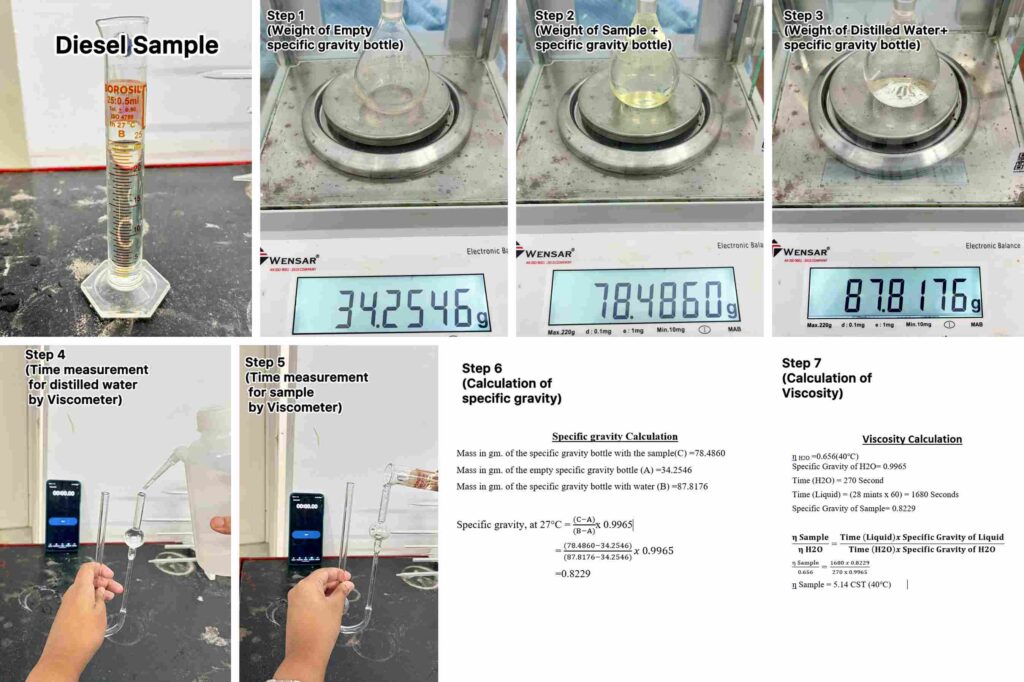
Apparatus used in viscosity determination of Liquid fuel Sample:
- Viscometer: To determinate the viscosity of engine oil .
- Stopwatch: For measuring flowtime accurately .
- 4 digit Analytical balance: Provides the highly accurate sample weight.
- Hot Air Oven(105°C): To dry the specific gravity bottle & Viscometer.
- Specific Gravity bottle: Used to determine the exact mass of a specific volume of liquid for evaluating it’s density.
- Measuring Cylinder: For handling the diesel oil.
- Stand and clamps: For holding the viscometer in position.
- Distilled Water: Distilled water is used as a standard reference in the test. It helps calibrate instruments and compare weights accurately, ensuring the specific gravity & viscosity of sample is measured without errors from impurities.The conductivity of distilled water should be <5 μS/cm to prevent contamination.
Method Followed to test the viscosity determination of diesel oil Sample:
| Step 1 | At first we measured the specific gravity of the diesel oil. Process described previously. Calculation of Specific Gravity=Specific gravity, at 27°C = {(C-A)/(B-A)} x 0.9965 C= Mass in gm of the specific gravity bottle with the sample. A=Mass in gm of the empty specific gravity bottle. B= Mass in gm of the specific gravity bottle with water. |
| Step 2 | Clean and dry the viscometer through hot air oven, ensure that there is no previous oil or dirt remaining. |
| Step 3 | Mix the diesel oil sample gently to make it homogeneous, avoid introducing air bubbles. |
| Step 4 | Fill the viscometer cup up to the specified level. |
| Step 5 | Start the stopwatch & record the time required for the specified quantity of diesel flow. |
| Step 6 | Calculation is given below. |
Calculation of the viscosity of Liquid fuel sample:
η Sample/η H2O =Time (Liquid)x Specific Gravity of Liquid/Time (H2O) x Specific Gravity of H2O
Purpose of determination of viscosity of Liquid fuel Sample:
- Check the quality of liquid fuel.
- Determine the flow characteristics of fuel.
- Help maintain proper engine performance and fuel efficiency.
- Detect degradation or abnormal changes in the fuel.
- Confirm that the oil is suitable for its intended application.
Handling Mistakes should be avoided during viscosity determination :
- Maintain the temperature accurately throughout the test.
- Ensure the viscometer is completely dry and clean.
- Avoid air bubble in the sample.
- Use a calibrated stopwatch and viscometer.
- Use gloves while handling the hot glassware to prevent burns.
- Recheck the calculations and enter the values properly to avoid errors in results.
- Transfer the sample carefully to ensure that no material is lost during handling.
- Keep all glassware clean and dry to avoid contamination .Proper cleaning Process described previously.
Conclusion about determination of Viscosity :
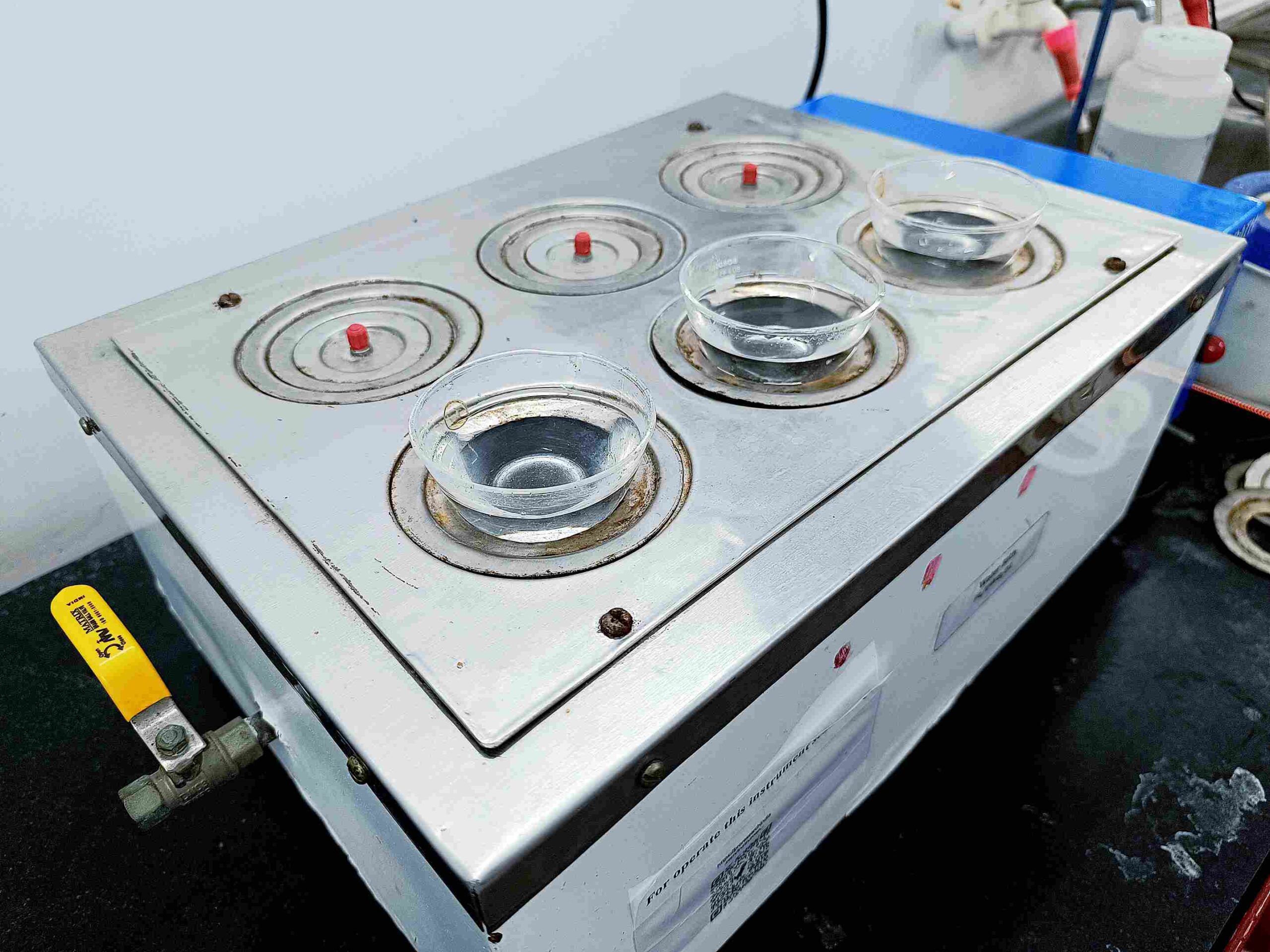
High viscosity causes excessive pressure and mechanical stress on fuel pumps and injectors. Viscosity tracking acts as a reliable indicator for detecting fuel contamination, improper biodiesel blending, or degraded fuel quality. Overall, Viscosity testing helps determine the abnormal changes in the fuel. By following this procedure, the Viscosity of sample can be determined accurately in a laboratory using the required equipment and glass wares. To understand the testing procedure you can check our real time photo attached with this writing or also you can reach to Pro Research & Testing Laboratory for the advance testing.
Frequently Asked Questions (FAQs) – Viscosity determination Test in Liquid fuel Sample:
Q. What is viscosity?
A. Viscosity is the resistance of liquid to flow.
Q. Why is viscosity tested in liquid fuel?
A. To check the fuel quality and determine the flow characteristics of the fuel.
Q. Which instruments is Used for viscosity testing?
A. Viscometer is commonly used for viscosity testing in fuel.
Q. What is the major handling mistake should be avoided during testing ?
A. The major handling mistake is to use a clean and dry calibrated viscometer.
Q. What is the temperature maintain during viscosity determination?
A. 40°C is maintained during viscosity determination.
How We Verified This Testing/Research Procedure :
This testing procedure is done under qualified analyst .Continually monitored by expertise.Repeatedly testing is always done to get accurate result.

Written by
Ankita Samanta (M.Sc Microbiology,Vidyasagar University)
Designation – Junior Microbiologist
Reviewed by
Anwesha Das (M.Sc Microbiology,BU)
Designation – Microbiologist
Verified By
Dr. Jyotirmoy Kumar Dey (Phd,Chemistry)
Designation – Senior/Chief Chemist
Experience – 25 Years +