
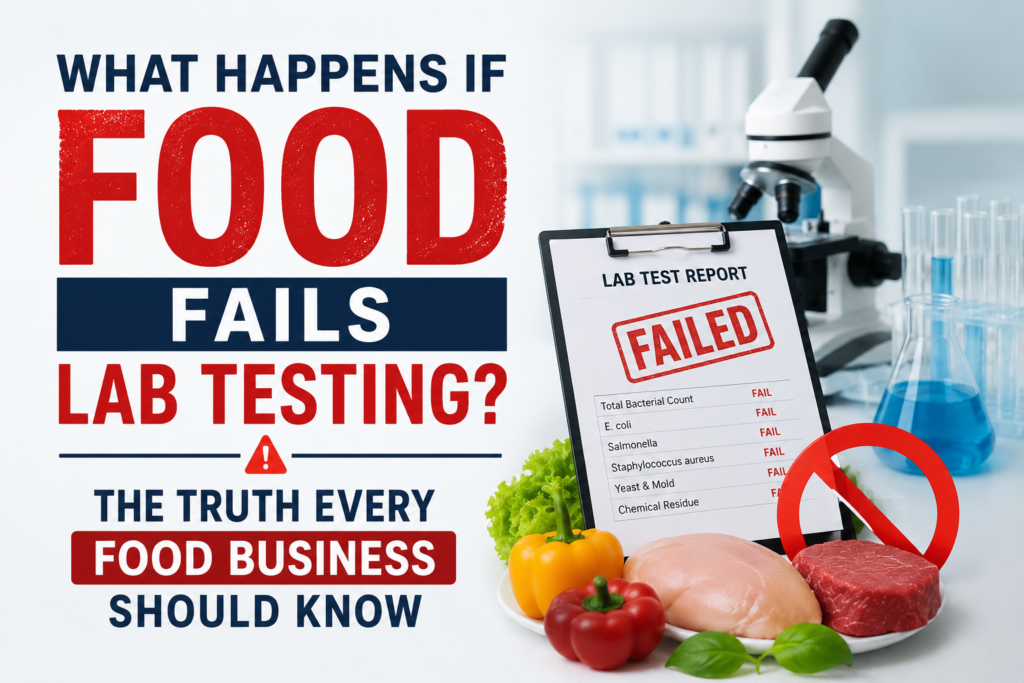
A failed food test sounds like bad news. But what if it is actually one of the best things that can happen to a food business? Imagine investing months of effort into developing a product, only to discover through laboratory testing that something is not right. Most businesses would see it as a setback. In reality, that single report could prevent a much bigger problem. It could stop an unsafe product from reaching consumers, prevent costly recalls, and protect years of hard-earned trust. According to the World Health Organization, unsafe food causes hundreds of millions of illnesses globally every year. This is why food testing matters. A failed test is not always the end of a product. Often, it is the first step toward making it safer, better, and fully compliant.
What Food Testing Failure Can Mean at a Glance
| Testing Issue Found | Possible Cause | Potential Risk |
| Bacterial Contamination | Poor hygiene or processing issues | Foodborne illnesses |
| Excess Chemical Residues | Improper ingredient control | Health concerns |
| Heavy Metal Presence | Contaminated raw materials | Long term health risks |
| Incorrect Nutritional Values | Labeling errors | Regulatory non compliance |
| Allergen | Cross contamination during production | Serious allergic reactions |
| Excess Preservatives | Formulation issues | Product rejection |
| Adulteration | Unauthorized ingredients | Consumer safety concerns |
| Quality Standard Failure | Inconsistent production process | Product recall risk |
What Does “Failing a Lab Test” Actually Mean?
When a food product fails laboratory testing, it means the sample did not meet one or more required safety, quality, or regulatory standards. This does not always mean the food is dangerous. Sometimes the issue may involve incorrect labeling, nutritional inaccuracies, or minor quality concerns. In other cases, however, the problem may involve harmful bacteria, pollutants, or allergens that could pose serious health risks. Labs compare test results against established standards and regulations. If the product falls outside acceptable limits, it receives a non compliant result. The purpose is simple. Identify problems before consumers are affected.
The Product May Be Stopped Before Reaching the Market
One of the most immediate consequences of a failed food test is that the product may be held back from distribution. Manufacturers, retailers, and regulatory authorities do not want unsafe or non compliant products reaching consumers. As a result, batches that fail testing are often isolated while further investigations take place. Although this may seem frustrating for businesses, it is actually a protective measure. Imagine the alternative. A harmful product reaches store shelves, customers consume it, and illnesses begin to appear. The financial and reputational damage would likely be far greater than a temporary delay. Sometimes stopping a product today prevents a disaster tomorrow.
Investigations Begin Behind the Scenes
A failed test result immediately raises an important question: “What went wrong?” Once a problem is identified, food manufacturers typically begin investigating the root cause. The issue could be linked to raw materials, supplier quality, storage conditions, production processes, packaging, transportation, or employee hygiene practices. This investigation helps businesses understand exactly where the problem originated. Rather than guessing, companies use laboratory findings to make evidence based decisions. The goal is not simply to identify the issue but to prevent it from happening again.
Contamination Is One of the Most Serious Findings
Among all possible testing failures, contamination is often the most concerning. Laboratories routinely test for harmful microorganisms such as Salmonella, E. coli, Listeria, and other pathogens that can cause foodborne illness. If contamination is detected, immediate action is usually required. The affected batch may be destroyed, production lines may be sanitized, and additional testing may be conducted to verify that the problem has been resolved. While these actions may involve costs, they are essential for protecting consumers and maintaining food safety standards.
Sometimes the Problem Is Not Safety but Compliance
Not every failed test involves dangerous contamination. Sometimes food products fail because they do not meet regulatory or labeling requirements. For example, a product label may claim a specific nutritional value that laboratory analysis cannot verify. The product may contain ingredient levels that differ from declared values, or it may exceed permitted limits for certain additives. In these situations, the product may still be safe to consume, but regulatory corrections are necessary before it can be sold legally. This is another reason why routine testing is so valuable. It helps businesses identify compliance issues before regulators do.
The Risk of Product Recalls
If a product has already entered the market and later fails testing, a recall may become necessary. Product recalls are among the most challenging situations a food business can face. Products may need to be removed from stores, distributors contacted, customers notified, and public statements issued. Beyond the financial impact, recalls can affect customer confidence and brand reputation. This is why many food companies invest heavily in preventive testing. Finding problems before products reach consumers is always easier than managing a recall afterward.
Customer Trust Can Be Affected
Food businesses depend on trust. Consumers expect the products they purchase to be safe, accurately labeled, and consistently high in quality. When food fails testing and becomes public knowledge, customer confidence can be affected. People naturally want reassurance that the brands they choose are taking food safety seriously. The good news is that transparency and corrective action can help rebuild trust. Businesses that respond responsibly often recover more effectively than those that attempt to hide problems. In today’s world, honesty is often one of the strongest reputation management tools available.
The Financial Impact Can Be Significant
Failed testing can lead to various financial consequences. Production delays, additional testing, product disposal, process improvements, supplier audits, and potential recalls all involve costs. For smaller businesses, these expenses can be challenging. However, the cost of ignoring food safety issues is usually much higher. Medical claims, legal disputes, regulatory penalties, lost sales, and damaged brand reputation can create long term consequences that far exceed the cost of corrective action. This is why proactive food testing should be viewed as an investment rather than an expense.
Every Failed Test Is an Opportunity to Improve
Here is something many people overlook. A failed laboratory test is not always a failure for the business. In many cases, it is a valuable learning opportunity. Testing helps businesses identify weaknesses in their systems, improve quality control procedures, strengthen supplier management, and refine production practices. Without testing, these issues might remain hidden until they cause much larger problems. Many successful food companies have improved their processes significantly because laboratory testing revealed areas that needed attention. Sometimes the best improvements begin with an unexpected result.
Why Does Routine Testing Matter?
Consumer expectations continue to rise. People want food that is safe, high quality, and produced responsibly. Regulators are also increasing their focus on food safety and compliance. Regular testing helps businesses stay ahead of these expectations. Instead of reacting to problems after they occur, companies can identify risks early and address them proactively. This not only protects consumers but also strengthens business performance and brand credibility. The most successful food businesses understand that testing is not just about finding problems. It is about preventing them.
Conclusion: A Failed Test Can Be a Valuable Warning
No food business wants to see a failed laboratory report. However, a failed test should not always be viewed as bad news. In reality, it often serves as an important warning system. It helps businesses identify risks, correct problems, improve processes, and protect consumers before harm occurs. Whether the issue involves contamination, labeling errors, quality inconsistencies, or regulatory compliance, laboratory testing provides the information needed to take corrective action. Food safety is not about being perfect. It is about being proactive. One of the most trusted food testing laboratories in Kolkata, i.e., Pro Research & Testing Laboratory help businesses identify potential issues early, maintain compliance, and strengthen product quality through reliable scientific analysis. Because in the food industry, discovering a problem before your customers do is always the better outcome.
FAQs
1. What does it mean when food fails lab testing?
It means the food product does not meet one or more required safety, quality, or regulatory standards established by authorities or industry guidelines.
2. Can food fail testing and still be safe to eat?
Yes. Some failures involve labeling inaccuracies or compliance issues rather than direct safety concerns. However, each case must be evaluated carefully.
3. What happens to food that fails testing?
The product may be held, investigated, re tested, corrected, recalled, or disposed of depending on the nature and severity of the issue.
4. Can a failed food test lead to a product recall?
Yes. If unsafe products have already reached consumers, a recall may be necessary to protect public health.
5. How can food businesses reduce the risk of failing lab tests?
Businesses can reduce risks through strong quality control practices, supplier verification, proper hygiene, employee training, and routine laboratory testing.