
Milk is rich in proteins, fat, lactose, vitamins, and minerals. However, due to increasing demand, milk adulteration has become a significant problem. One typical adulterant is urea, unlawfully added to milk to raise its protein content by increasing viscosity also match with natural solids-not-fat (SNF) level.Very small levels of urea are naturally found in milk as a byproduct. But too much urea that has been added intentionally can be harmful to our health.
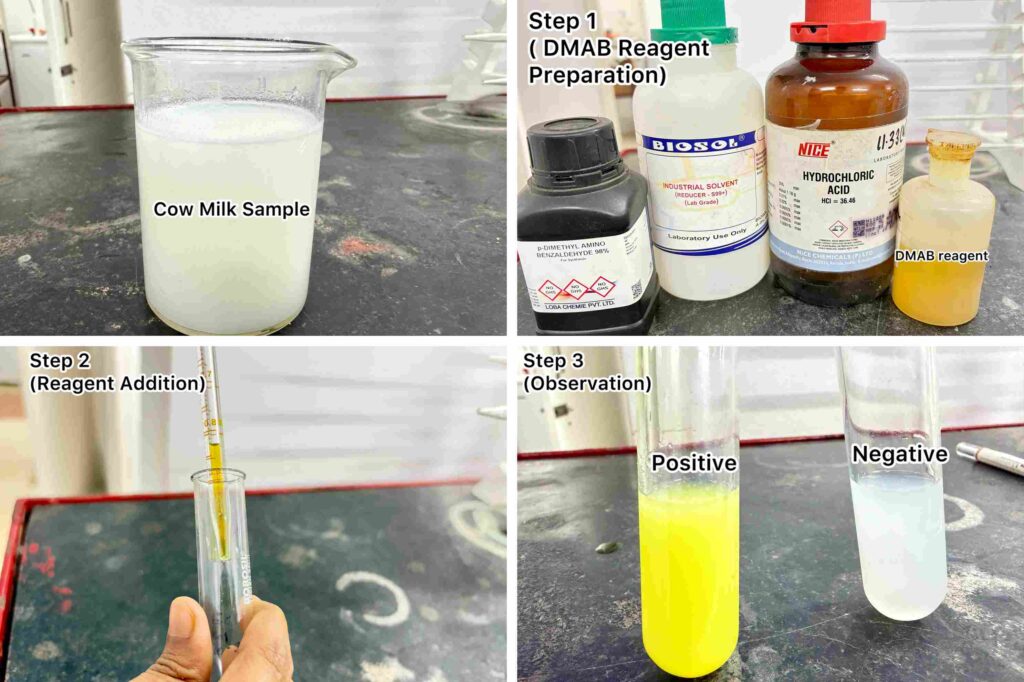
Here we take cow milk to test the adulteration.
Chemicals & Apparatus used in detection of Added Urea in Milk Sample
Chemicals :
- Hydrochloric Acid(HCl) – It provides the acidic medium required for the reaction between urea and DMAB (p-dimethylaminobenzaldehyde). The acidic condition enhances the chemical reaction, leading to the formation of a yellow-colored complex, which indicates the presence of urea.
- Ethyl alcohol -It acts as a solvent to dissolve the DMAB, providing a clear and stable solution.
- 1.6% p-dimethylaminobenzaldehyde (DMAB) -It reacts with urea under acidic conditions to produce a distinct yellow color.To prepare 1.6% p-dimethylaminobenzaldehyde dissolve 1.6 g DMAB in 100 ml ethyl alcohol and add 10ml concentrate HCl.Here we have used all the following chemicals/reagents of Researchlab company. You can use the same company or any other companies.
Aparatus:
- Test Tubes– To hold the sample.
- Pipettes (1ml & 10 ml) – To measure reagents precisely.
- Measuring Cylinder (100ml) – To measure the solvent (ethyl alcohol).
Testing Process of Added Urea adulteration in Milk
- Take 1ml of milk in a test tube.
- Add 1 ml of 1.6% DMAB reagent in it.
- Wait for few minutes & observe the result.
Observation
Distinct yellow colour is observed in milk containing added urea. Normal milk shows a slight yellow colour due to presence of natural urea.
Purpose of Testing for Added Urea in Milk
- To detect adulteration of milk with excess urea.
- To differentiate between natural urea content and added urea.
- To ensure milk meets food safety standards.
- To protect consumers from potential health risks.
- To maintain the nutritional quality and integrity of milk.
- To prevent economic fraud in the dairy industry.
- To support quality control in dairy processing plants.
Handling Mistakes to Be Avoided During Added Urea Detection Test in Milk
- Using unclean or contaminated glassware, which may affect test results. Proper cleaning Process described previously.
- Improper labeling of milk samples leading to mix-ups.
- Using expired or improperly stored reagents.
- Incorrect measurement of reagents or milk sample volume.
- Inadequate mixing of milk sample before analysis.
- Ignoring control samples or blank tests.
Conclusion of Testing of Added Urea in Milk Sample
Added urea testing is a crucial process that ensures food safety and quality. Urea is often added to milk for increasing the protein & the solids-not-fat (SNF) content. This testing is important to have effective detection processes to ensure the milk adulteration is identified. By following the above-mentioned method, you can easily test the added urea at any laboratory or manufacturing industry with the availability of the equipments and chemicals.This testing process ensures accurate results, which are crucial for quality control in various applications. Furthermore, if you can’t understand the procedure, you can check our real-time photo attached with this writing, which visually guides you through each step and enhances your understanding. Additionally, for those who prefer professional assistance or require more advanced testing, you can also reach out to Pro Research & Testing Laboratory for testing purposes.
FAQ on Added Urea Testing in Milk
1. What is added urea in milk?
Added urea is illegally mixed into milk to artificially increase its protein & solids-not-fat (SNF) content.
2. Why is testing for urea important?
It helps detect adulteration, ensures food safety, protects consumer health, and maintains the nutritional quality of milk.
3. What is DMAB reagent?
DMAB (p-dimethylaminobenzaldehyde) is a chemical used to detect urea in milk by forming a yellow-colored complex when urea is present.
4. What is the role of HCl in the test?
HCl provides an acidic medium required for the reaction between urea and DMAB, ensuring proper color development and accurate results.
5. Why is ethyl alcohol used in DMAB reagent?
Ethyl alcohol acts as a solvent to dissolve DMAB, improves reagent stability, prevents precipitation, and ensures effective reaction with urea.
6. Can this test detect natural urea?
Yes, but it is mainly used to identify excess urea that indicates adulteration, as milk naturally contains very small amounts of urea.
How We Verified This Testing/Research Procedure :
This testing is done under qualified analysts in our lab.Continually monitored by expertise.Repeatedly testing is always done to get accurate result.

Written by
Anwesha Das (M.Sc Microbiology,BU)
Designation – Microbiologist
Reviewed by
Riya Ghosh (M.Sc. Food Technology, MAKAUT)
Designation – Chemist
Verified By
Dr. Jyotirmoy Kumar Dey (Phd,Chemistry)
Designation – Senior/Chief Chemist
Experience – 25 Years +