
Aluminum is a metal that is frequently found in natural waters. It can get into drinking water through industrial discharge, soil runoff, or the use of aluminum salts in water treatment. The detection of excess aluminum is crucial because it can have an impact on water quality.
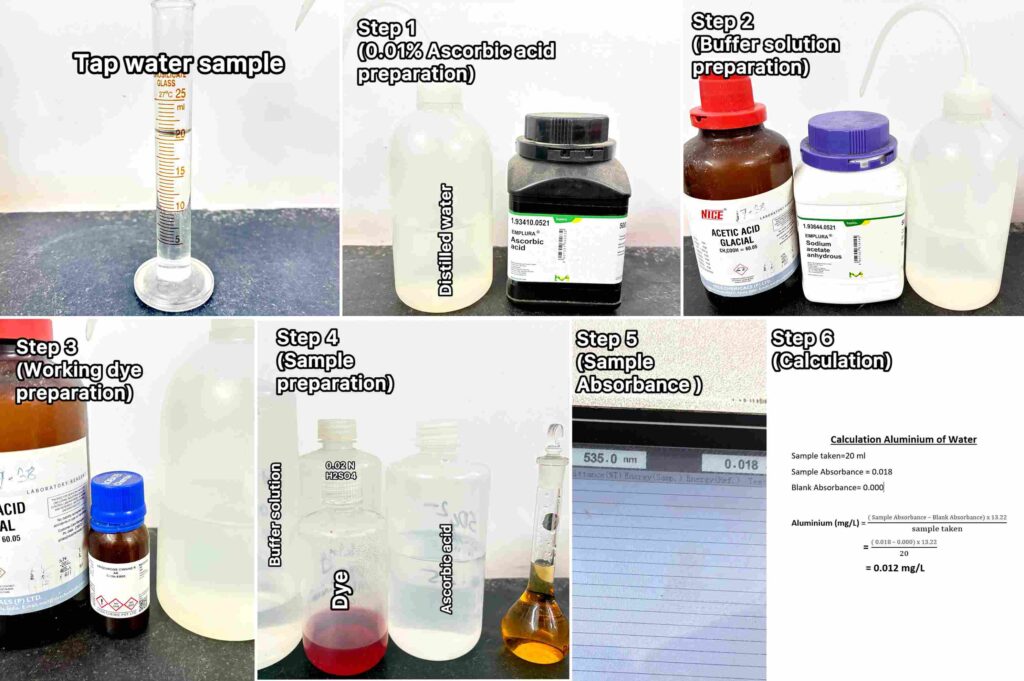
Aluminium reacts with Eriochrome Cyanine R dye in slightly acidic conditions to form a reddish-violet colored complex. The intensity of the color is directly proportional to the aluminium concentration and is measured using a spectrophotometer at 535 nm.Here we take tap water to test the aluminium.
Chemicals Required To Test Aluminium in Water
- Eriochrome Cyanine R reagent-Reacts with aluminium ions in acidic medium to form a reddish-violet coloured complex.For stock Eriochrome Cyanine R Dye Solution preparation dissolve 300 mg of dye in about 50 ml of distilled water. Adjust pH to about 2.9, with the help of 1 :1 acetic acid. Dilute with distilled water to 100 ml in a volumetric flask.Prepare Working dye solution by dilute 10 ml of stock dye solution to 100 ml distilled water in a volumetric flask.
- 1:1 acetic acid– To make indicator. To make 1:1 acetic acid,10 ml of acetic acid is diluted to 10 ml of distilled water.
- Buffer solution (acetate buffer)-Maintains the required acidic pH for proper colour development of the aluminium–dye complex.Dissolve 136 g of sodium acetate in distilled water, add 40 ml of 1 N acetic acid, and dilute to 1 Litre distilled water.
- Standard aluminium solution-Used to prepare calibration standards for comparison and accurate determination of aluminium concentration in the sample.At first prepare standard aluminium solution dissolve 8.791 g of aluminium potassium sulphate,AIK(S04)2.12H20 in distilled water and dilute to 1000 ml with water in a volumetric flask.Then dilute 10 ml of the stock aluminium solution to 1000 ml with distilled water in a volumetric flask for preparation of standard solution.
- Ascorbic acid (to remove interference)-Masks interference from iron and other metal ions by reducing them, ensuring selective reaction of aluminium with the dye.Here we have used all the following chemicals/reagents of Researchlab company. You can use the same company or any other companies.
- Sulphuric Acid(0.02 N) -Sulphuric acid is used to acidify water samples, keeping aluminium in a dissolved and stable form to prevent precipitation.Preparation described previously.
- Distilled water-Acts as a solvent and dilution medium, free from aluminium contamination.The conductivity of distilled water should be <5 μS/cm to prevent contamination.
Instruments / Glassware Required for Aluminium(Al) Analysis in Water
- Spectrophotometer-Measures the absorbance of the coloured aluminium–Eriochrome Cyanine R complex at 535 nm to determine aluminium concentration.
- Cuvettes-Hold the sample solution for accurate absorbance measurement in the spectrophotometer.
- Volumetric flasks(50 ml & 1000 ml)-Used to prepare solutions of precise and known volume for accurate analysis.
- pH paper-To check the pH of sample & reagents.
- Measuring cylinder(20 ml)-Transfers accurate and fixed volumes of samples and reagents.
- Pipettes(1 ml,5 ml & 10 ml )-Measures approximate volumes of liquids during reagent preparation.
Aluminium Testing Procedure of Water Sample
- Take 20 ml of the water sample in a volumetric flask.
- Add 10 ml 0.02N Sulphuric acid into it.
- Add 10 ml buffer solution to maintain the required pH(4.3-4.5).
- Add 5 ml working Eriochrome Cyanine R dye solution.
- Add 1 ml ascorbic acid to eliminate iron interference.
- Make up the volume up to 50 ml with distilled water and mix well.
- Allow the color to develop for 5–10 minutes.
- Measure absorbance at 535 nm against a blank sample.
Purpose of Aluminium Testing in Water Sample
- To determine the concentration of aluminium present in water.
- To monitor the efficiency of aluminium-based coagulants used in water treatment.
- To detect contamination from industrial discharge and natural sources.
- To maintain overall water quality and safety.
Handling Mistakes should avoided during Aluminium testing in Water Sample
- Using contaminated glassware may give falsely high aluminium results.(Washing procedure described previously)
- Improper pH control can prevent correct colour development.
- Delayed measurement after colour formation may reduce accuracy.
- Incorrect reagent concentration affects colour intensity.
- Not adding ascorbic acid can cause interference from iron.
- Using dirty or scratched cuvettes leads to absorbance errors.
- Inaccurate pipetting results in wrong aluminium concentration.
- Using old or improperly stored reagents reduces reliability.
Conclusion of Testing of Aluminium in Water
Aluminium detection in water using the Eriochrome Cyanine R method is a simple, sensitive, and reliable technique. Regular monitoring helps maintain safe water quality and prevents health and environmental risks.By following the above-mentioned method, you can easily test the Aluminium at any laboratory or manufacturing industry with the availability of the equipments and chemicals.This testing process ensures accurate results, which are crucial for quality control in various applications. Furthermore, if you can’t understand the procedure, you can check our real-time photo attached with this writing, which visually guides you through each step and enhances your understanding. Additionally, for those who prefer professional assistance or require more advanced testing, you can also reach out to Pro Research & Testing Laboratory for testing purposes.
FAQ – Aluminium Detection of Water Sample
Q1. Why is aluminium tested in water?
To ensure water safety and to check contamination from natural sources or water treatment chemicals.
Q2. Which method is commonly used for aluminium detection in water?
The Eriochrome Cyanine R spectrophotometric method is most commonly used.
Q3. What is the permissible limit of aluminium in drinking water?
As per BIS , the permissible limit ranges from 0.03 to 0.2 mg/L.
Q4. At which wavelength is aluminium measured?
Aluminium is measured at 535 nm using a spectrophotometer.
Q5. Why is ascorbic acid added during testing?
It removes interference from iron and other metals.
Q6. Can aluminium affect water taste?
Excess aluminium present in water can affect water taste while intaking .
Q7. Can aluminium be removed from water?
Yes, through proper filtration and optimized water treatment processes.
How We Verified This Testing/Research Procedure :
This testing is done under qualified analysts in our lab.Continually monitored by expertise.Repeatedly testing is always done to get accurate result.
Written by
Riya Ghosh (M.Sc. Food Technology, MAKAUT)
Designation – Chemist

Reviewed by
Anwesha Das (M.Sc Microbiology,BU)
Designation – Microbiologist
Verified By
Dr. Jyotirmoy Kumar Dey (Phd,Chemistry)
Designation – Senior/Chief Chemist
Experience – 25 Years +