
Arsenic is a naturally occurring element found in the earth’s crust, but it can enter water sources through both natural processes and human activities. In groundwater, arsenic often dissolves from mineral deposits.Industrial areas such as mining, pesticide use, and improper waste disposal can further elevate arsenic levels in surface and groundwater. Because arsenic is colorless, tasteless, and odorless when dissolved, contamination often goes unnoticed without proper testing. Long-term exposure to arsenic-contaminated drinking water poses serious health risks, including skin lesions, cardiovascular disease, and various cancers.
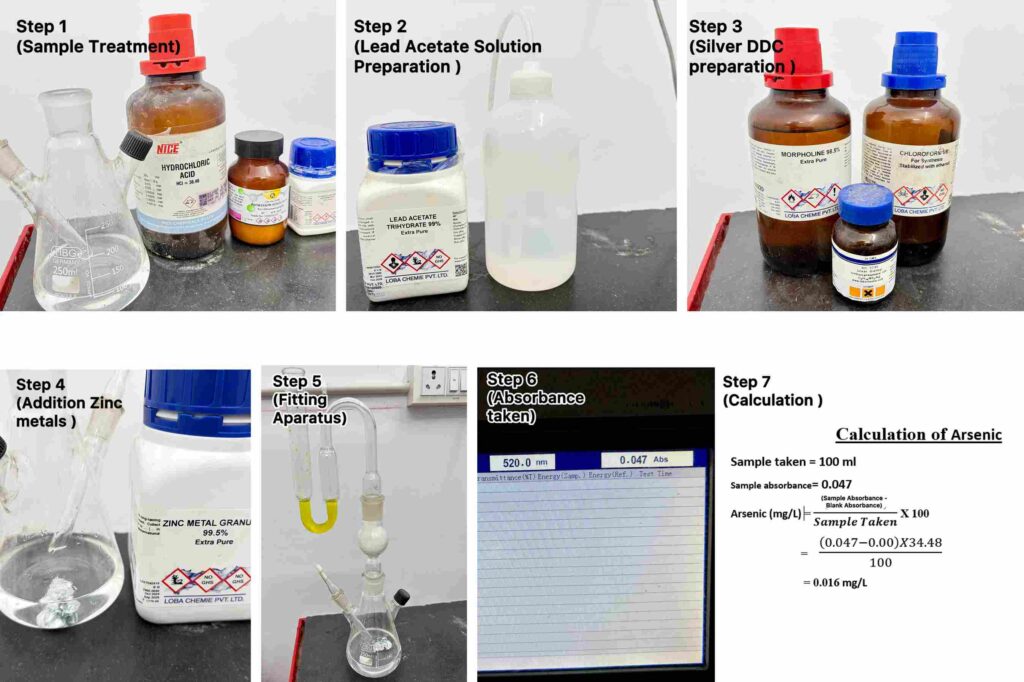
In our lab we determined Arsenic by Colorimetric Method which also known as Silver Diethyldithiocarbamate Method.By this method we can test arsenic in any type of water like Drinking Water, Groundwater,Surface Water,Waste-Water etc. Here we take Ground water to test this parameter.
Equipments,Instruments & Chemicals Used:
| Equipments,Instruments & Chemicals Used | Working Principle/ Role |
| Volumetric Flasks(100 ml) | Used to measure sample & prepare reagent. |
| Pipettes (5ml) | Used to measure and transfer small, accurate volumes of liquid. |
| Arsine generator, scrubber and absorption tube | Useful for mixing samples with reagents without spilling & for perform the whole test.Narrow neck reduces evaporation and splashing during mixing. |
| Silver Diethyldithiocarbamate (SDDC) | Primary colorimetric reagent that reacts with arsine gas to give a distinct color change, typically yellow.Arsine gas reacts with silver diethyldithiocarbamate to form a yellow-colored arsenic–SDDC complex. Dissolve 1 ml morpholine in 70 ml chloroform.Add 0.3 g silver diethyldithiocarbamate.Dilute to 100 ml with chloroform. Filter and store in a tightly closed brown bottle. |
| Concentrated Hydrochloric acid | Provides acidic medium for arsine generation.Helps liberate hydrogen gas (H₂) from zinc, which then reduces arsenic compounds to arsine gas |
| Stannous Chloride | Stannous chloride converts arsenic from the pentavalent form (As(V)) to the trivalent form (As(III)). |
| Potassium Iodide | Used as a reducing agent to convert arsenic that ensures that all arsenic in the sample is in a reactive form so the test measures total arsenic, not just As(III).Here we have used chemicals/reagents of Researchlab company. You can use the same company or any other companies. |
| Lead Acetate Solution | Removes interfering gases, especially hydrogen sulfide (H₂S).Lead acetate reacts with H₂S to form lead sulfide,preventing interference in the color reaction between arsine and Silver DDC.Prepare Lead Acetate Solution by Dissolving 10 gm of lead acetate in 100 ml distilled water. |
| Chloroform | Helps dissolve and stabilize the yellow arsenic–SDDC complex. |
| Zinc Metals | Acts as the primary reducing agent to generate arsine gas.Reacts with acid and arsenic compounds to generate arsine gas. As(III) + 3H₂ → AsH₃ (arsine gas) |
| Distilled Water | To prepare the reagents.The conductivity of distilled water should be <5 μS/cm to prevent contamination. |
| UV–Visible Spectrophotometer | The spectrophotometer measures how much light is absorbed by the color, which correlates with arsenic concentration. |
Procedure:
| Sample Treatment | Take 100 ml of sample. Add 5 ml Conc. Hydrochloric Acid, Pinch of Stannous Chloride & Potassium Iodide in it. |
| Preparation of scrubber and absorber | Take a non absorbent cotton in the scrubber was soaked with lead acetate solution. 5 ml Silver diethyldithiocarbamate solution was pipette into the absorber tube. |
| Arsine generation and measurement | 2-3 piece Zinc was added to generator and scrubber absorber assembly was connected immediately. All connection were fitted tightly. About 1.5 hour was allowed for complete evolution of arsine. The solution was directly poured from absorber into a 1 cm cell and absorbance was measured 520 nm. |
| Calculation | Arsenic (mg/L) = ( Sample Absorbance – Blank Absorbance) x 34.48/ Sample Taken |
What is the objective of Arsenic Testing ?
- To determine whether arsenic levels exceed safe drinking-water standards.
- To identify the presence and concentration of arsenic contamination.
- To assess potential health risks associated with long-term exposure.
- To detect changes in water quality over time through regular monitoring.
- To help locate possible natural or human-made sources of contamination.
- To guide the selection and effectiveness of water-treatment methods.
- To ensure compliance with water-quality regulations.
- To protect public health and support informed decision making in water management.
Handling Mistakes to Avoid During Arsenic Testing:
- Using glassware that contains trace metals or detergent residues-These residues can either react with arsenic or interfere with color formation.
- Not rinsing apparatus thoroughly after cleaning-Residual cleaning agents (especially alkaline detergents) neutralize acid or consume reagents.
- Allowing leakage in the arsine-generation system-Any leak lowers arsine exposure to the color reagent gives falsely low readings.
- Not reducing As(V) to As(III) completely-Incomplete reduction (insufficient KI ) underestimate of arsenic.
- Using degraded SDDC reagent or improperly stored reagent-SDDC oxidizes and loses sensitivity when exposed to light/air forms weak color.
- Ignoring proper ventilation and safety precautions-Arsine gas and reagents are hazardous, lack of ventilation affects both safety and test quality.
Conclusion :
Arsenic testing is an essential analytical procedure used to assess the safety and quality of drinking water. Through colorimetric method, dissolved arsenic is converted into measurable forms that allow accurate detection even at very low concentrations. The results help determine whether water meets health-based standards and guide necessary treatment or corrective actions. By following the above-mentioned method, you can easily test the Arsenic at any laboratory or manufacturing industry with the availability of the equipments and chemicals.This testing process ensures accurate results, which are crucial for quality control in various applications. Furthermore, if you can’t understand the procedure, you can check our real-time photo attached with this writing, which visually guides you through each step and enhances your understanding. Additionally, for those who prefer professional assistance or require more advanced testing, you can also reach out to Pro Research & Testing Laboratory for testing purposes.
FAQ:
1. What is the purpose of arsenic testing in water?
Arsenic testing determines whether the concentration of arsenic in drinking water is within safe limits, ensuring the water is suitable for human consumption and complies with regulatory standards.
2. Which colorimetric method is most commonly used for arsenic estimation?
The Silver Diethyldithiocarbamate (SDDC) method is one of the most commonly used colorimetric tests for arsenic in water.
3. Why is arsenic converted to arsine gas during testing?
Arsenic is converted to arsine gas (AsH₃) because arsine reacts specifically with color-forming reagents, allowing sensitive and selective detection.
4. What is the role of potassium iodide (KI) in this test?
KI reduces As(V) to As(III), ensuring that all arsenic is in the reactive form needed for arsine generation and accurate measurement.
5. Why is lead acetate used?
Lead acetate removes hydrogen sulfide (H₂S), which can interfere with the colorimetric reaction and cause false results.
6. What color indicates the presence of arsenic in the SDDC method?
A yellow color indicates the formation of the arsenic–SDDC complex, proportional to the arsenic concentration.
7. What factors can lead to inaccurate test results?
Leaks in apparatus, expired reagents, incomplete reduction of arsenic, interference from sulfides, contaminated glassware, and incorrect timing can all cause errors.
8. Why is preservation of water samples important?
Arsenic may adsorb onto container walls or change oxidation state. Preserving samples prevents loss or transformation of arsenic before analysis.
9. What is the limit for arsenic in drinking water?
The value for arsenic in drinking water is 10 µg/L (0.01 mg/L).
10. Why is the test performed in a well-ventilated area?
Arsine gas and some reagents used in the test are hazardous, so proper ventilation ensures safety and accurate results.
11. Can turbidity or colored water affect the test?
Yes. Turbidity or natural color can interfere with visual comparison in colorimetric tests, leading to misinterpretation.
12. Why is calibration important in arsenic testing?
Calibration using standard arsenic solutions ensures that color intensity or instrument response corresponds accurately to arsenic concentration.
How We Verified This Testing/Research Procedure :
This testing is done under qualified analysts in our lab.Continually monitored by expertise.Repeatedly testing is always done to get accurate result.

Written by
Anwesha Das (M.Sc Microbiology,BU)
Designation – Microbiologist
Reviewed by
Riya Ghosh (M.Sc. Food Technology, MAKAUT)
Designation – Chemist
Verified By
Dr. Jyotirmoy Kumar Dey (Phd,Chemistry)
Designation – Senior/Chief Chemist
Experience – 25 Years +