
Arsenic testing in food samples is performed to determine the presence and concentration of arsenic, a toxic heavy metal that may occur naturally or through environmental contamination. The analysis is essential to ensure food safety and compliance with regulatory limits.
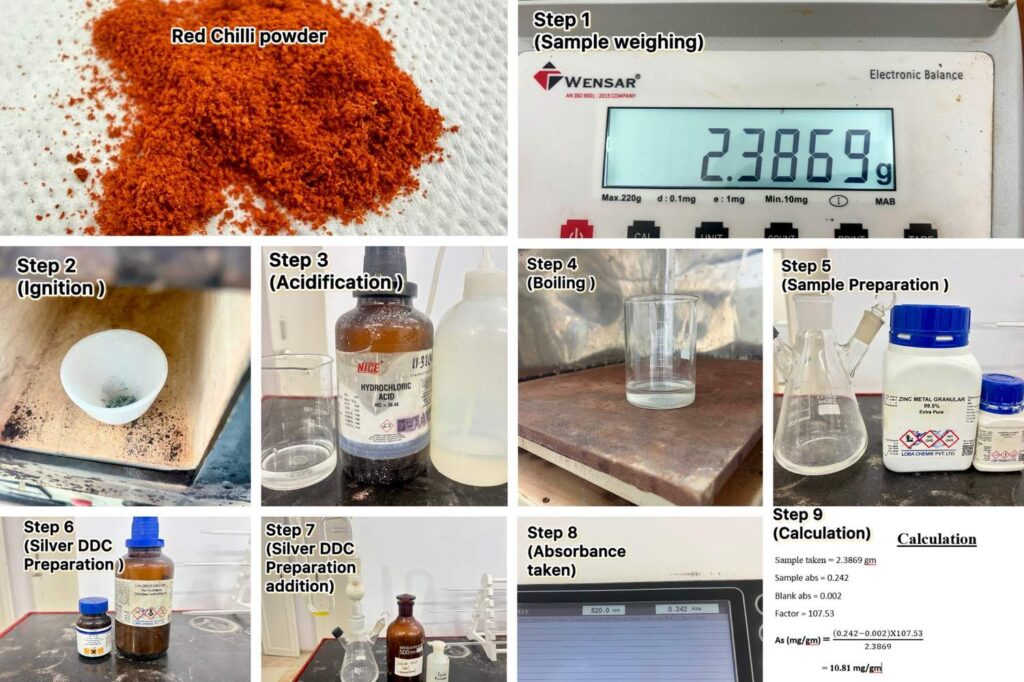
Here we take Spices Sample(Red Chilli Powder) to detect arsenic in our lab.
Chemical & Equipments Used during Arsenic Testing in Food
Equipments & instruments Used
| Analytical Balance(4-digit) | Used to measure very small amount of sample & ash. We use 4 digit balance for this testing. |
| Hot Air Oven | To dry(at 105°C) the crucible before starting the procedure. |
| Muffle Furnace | It incinerates the organic matter at high temperature turns the inorganic residue into ash. |
| UV–Visible Spectrophotometer | The spectrophotometer measures how much light is absorbed at 425nm wavelength by the color, which correlates with arsenic concentration. |
| Crucible | This high-heat resistant container made of silica, holds the food sample during incineration. |
| Tongs | To hold the hot crucible safely without direct contact. |
| Desiccator | It maintains moisture free environment to prevent rehydration of ash before weighing. Silica beads are used in the desiccator which absorbs the moisture from the crucible. the color of silica beads change from blue to pink detects that the silica beads has to be replaced by the moisture free beads. |
| Volumetric Flasks(100 ml) | Used to measure sample & prepare reagent. |
| Pipettes (5ml) | Used to measure and transfer small, accurate volumes of liquid. |
| Arsine generator, scrubber and absorption tube | Useful for mixing samples with reagents without spilling & for perform the whole test.Narrow neck reduces evaporation and splashing during mixing. |
Chemical Used
| Silver Diethyldithiocarbamate (SDDC) | Primary colorimetric reagent that reacts with arsine gas to give a distinct color change, typically yellow.Arsine gas reacts with silver diethyldithiocarbamate to form a yellow-colored arsenic–SDDC complex. Dissolve 1 ml morpholine in 70 ml chloroform.Add 0.3 g silver diethyldithiocarbamate.Dilute to 100 ml with chloroform. Filter and store in a tightly closed brown bottle. |
| Concentrated Hydrochloric acid | Provides acidic medium for arsine generation.Helps liberate hydrogen gas (H₂) from zinc, which then reduces arsenic compounds to arsine gas |
| Potassium Iodide | Used as a reducing agent to convert arsenic that ensures that all arsenic in the sample is in a reactive form so the test measures total arsenic, not just As(III).Here we have used chemicals/reagents of Researchlab company. You can use the same company or any other companies. |
| Stannous Chloride | Stannous chloride converts arsenic from the pentavalent form (As(V)) to the trivalent form (As(III)). |
| Lead Acetate Solution | Removes interfering gases, especially hydrogen sulfide (H₂S).Lead acetate reacts with H₂S to form lead sulfide,preventing interference in the color reaction between arsine and Silver DDC.Prepare Lead Acetate Solution by Dissolving 10 gm of lead acetate in 100 ml distilled water. |
| Chloroform | Helps dissolve and stabilize the yellow arsenic–SDDC complex. |
| Zinc Metals | Acts as the primary reducing agent to generate arsine gas.Reacts with acid and arsenic compounds to generate arsine gas. As(III) + 3H₂ → AsH₃ (arsine gas) |
| Distilled Water | To prepare the reagents.The conductivity of distilled water should be <5 μS/cm to prevent contamination. |
Method Followed in our lab to Test Arsenic In Food Sample
| Step 1 (Weighing Of Sample) | Weigh 2gm-10gm of sample in dry preweight crucible. |
| Step 2 (Ignition Of Sample) | Ignite it properly through muffle furnace to make it ash. Detailed procedure described previously. |
| Step 3 (Arsenic Analysis) | Treat the sample with required chemicals & set the aparatus for arsenic test.Detailed Procedure described previously. Take the absorbance & Note the value. |
| Step 4 (Calculation) | Arsenic (mg/L) = ( Sample Absorbance – Blank Absorbance) x 107.53/ Sample Taken |
Why Arsenic Testing is important in Food Sample?
Protects Human Health:
- Detects harmful levels of arsenic in food.
- Reduces the risk of acute and long-term arsenic poisoning.
- Helps prevent diseases linked to arsenic exposure, including cancer, cardiovascular disease, and neurological disorders.
Ensures Food Safety:
- Confirms that food products are safe for consumption.
- Identifies contaminated raw materials and finished products.
- Prevents unsafe food from reaching consumers.
Meets Regulatory Requirements:
- Ensures compliance with national and international food safety standards.
- Supports adherence to maximum allowable arsenic limits set by food safety authorities.
Identifies Environmental Contamination:
- Detects arsenic contamination originating from soil, irrigation water, pesticides, or industrial pollution.
- Helps trace contamination sources and implement corrective actions.
Supports Quality Control:
- Monitors arsenic levels during food production and processing.
- Demonstrates a commitment to food quality and safety.
- Verifies the effectiveness of contamination control measures.
- Ensures consistency in product safety.
Handling Mistakes to Avoid During Arsenic Analysis in Food:
- Using glassware that contains trace metals or detergent residues-These residues can either react with arsenic or interfere with color formation.Proper cleaning Process described previously.
- Not rinsing apparatus thoroughly after cleaning-Residual cleaning agents (especially alkaline detergents) neutralize acid or consume reagents.
- Allowing leakage in the arsine-generation system-Any leak lowers arsine exposure to the color reagent gives falsely low readings.
- Not drying the crucible properly before ashing leads to over-estimation of ash due to leftover moisture.
- Contaminating the crucible or sample (with dust, spilled material) increases ash weight, causing false results.
- Using a wet or dirty crucible adds extra weight or contaminants, affecting accuracy.
- Overheating in muffle furnace (>700°C) can cause loss of volatile minerals (e.g. iron), leading to underestimation.
Conclusion of Arsenic Test in Food Sample:
Arsenic testing in food samples is essential for protecting public health and ensuring food safety. It helps detect harmful contamination, ensures compliance with regulatory standards, supports quality control, and builds consumer confidence.By following the above-mentioned method, you can easily test the Arsenic at any laboratory or manufacturing industry with the availability of the equipments and chemicals.This testing process ensures accurate results, which are crucial for quality control in various applications. Furthermore, if you can’t understand the procedure, you can check our real-time photo attached with this writing, which visually guides you through each step and enhances your understanding. Additionally, for those who prefer professional assistance or require more advanced testing, you can also reach out to Pro Research & Testing Laboratory for testing purposes.
Frequently Asked Questions (FAQs):
Q1. What is arsenic?
Answer: Arsenic is a naturally occurring toxic element found in soil, water, and rocks. It can enter the food chain through environmental contamination.
Q2. Why is arsenic testing important in food samples?
Answer: Arsenic testing helps detect harmful contamination, ensures food safety, protects consumer health, and ensures compliance with food safety regulations.
Q3. What are the health effects of arsenic exposure?
Answer: Long-term exposure to arsenic can cause skin disorders, cardiovascular disease, neurological problems, kidney and liver damage, and an increased risk of certain cancers.
Q4. How often should food samples be tested for arsenic?
Answer: Testing frequency depends on the type of food, regulatory requirements, production volume, and potential risk of contamination.
Q5. Which colorimetric method is most commonly used for arsenic estimation?
Answer: The Silver Diethyldithiocarbamate (SDDC) method is one of the most commonly used colorimetric tests for arsenic in food.
Q6. What factors can lead to inaccurate test results?
Answer: Leaks in apparatus, expired reagents, incomplete reduction of arsenic, interference from sulfides, contaminated glassware, and incorrect timing can all cause errors.
How We Verified This Testing/Research Procedure :
This testing is done under qualified analysts in our lab.Continually monitored by expertise.Repeatedly testing is always done to get accurate result.

Written by
Anwesha Das (M.Sc Microbiology,BU)
Designation – Microbiologist
Reviewed by
Riya Ghosh (M.Sc. Food Technology, MAKAUT)
Designation – Chemist
Verified By
Dr. Jyotirmoy Kumar Dey (Phd,Chemistry)
Designation – Senior/Chief Chemist
Experience – 25 Years +