
Water hardness is primarily caused by the presence of dissolved calcium and magnesium ions, carbonates, bicarbonates, chlorides and sulphates,which naturally enter water as it moves through mineral-rich soils and rocks. Calcium hardness refers to the concentration of calcium ions, usually originating from limestone, gypsum, or other calcium-containing minerals. It is the main contributor to scale formation, especially when water is heated, because calcium precipitates easily as calcium carbonate. Magnesium hardness, on the other hand, comes from minerals such as dolomite and magnesite. Here we have tested the parameters with borewell water.
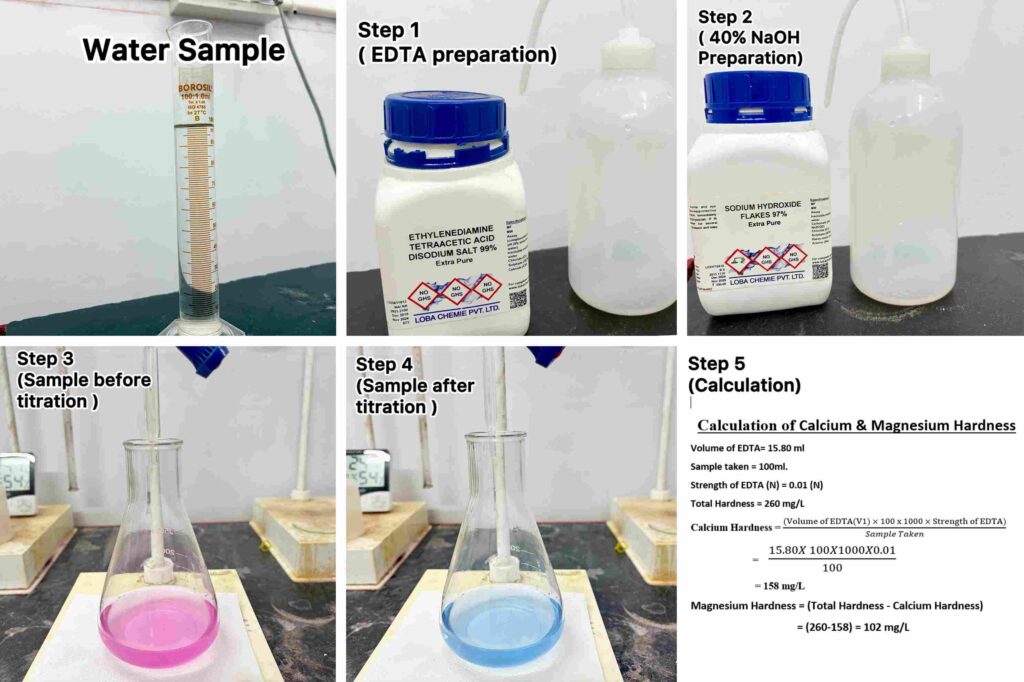
Instruments, Glassware, and Chemicals Used during test :
Instruments and Glassware Used
- Burette (50 ml)- For precise titration of EDTA solution.
- Pipette (5 ml/50 ml)- For accurate NaOH & sample measurement.
- Conical Flask (250 ml) – For mixing the sample with reagents during titration.
- Beaker (500 ml)- For preparing solutions.
- Measuring Cylinder (100 ml) – For measuring distilled water.
- Volumetric Flask (1000 ml) – To prepare reagents.
- 4 digit Analytical Balance – To measure the weight of reagent.
- pH-meter- To check whether the pH of the sample is 12 after mixed with NaOH solution.
Chemicals Used
- Ethylenediaminetetraacetic acid(EDTA) Solution (0.01 M)– Complexing agent that reacts with Ca²⁺ and Mg²⁺ ions.EDTA binds with Ca²⁺ and Mg²⁺, breaking the indicator-metal complex.Preparation described previously.
- Patton & Reeder Indicator– Forms a wine-red complex with Ca²⁺ and Mg²⁺, signaling that all hardness-causing ions have been complexed by EDTA.Here we have used all the following chemicals/reagents of Researchlab company. You can use the same company or any other companies.
- 40% sodium hydroxide solution-Adjusts pH for accurate titration. Preparation described previously
- Distilled Water –To make the titrant.The conductivity of distilled water should be <5 μS/cm to prevent contamination
- Calcium Carbonate & Hydrochloric Acid – Calcium carbonate (CaCO₃) is poorly soluble in water, so direct dissolution in water is not possible.Dilute hydrochloric acid (HCl) is added to dissolve CaCO₃ by converting it into soluble calcium chloride (CaCl₂), which is fully soluble in water, allowing accurate preparation of a standard calcium solution.Standardization Process described previously.
Procedure :
| Parameter | Process | Calculation |
| Calcium Hardness Testing | 1. Take 100 ml (according to sample type) of the water sample into a 250 ml conical flask.If the titre value of the sample came very less in 100 ml sample,it has chance to get error result then the sample should be taken 250 ml or more. 2.Add 5 mL of NaOH to maintain correct pH (pH 12) for titration. 3.Add a pinch of Patton-reeder indicator. The solution turns wine red. 4.Titrate with EDTA solution slowly from a burette until the color changes from wine red to blue (end point) | Note the burette reading (ml of EDTA used) at the endpoint.Use the formula Calcium Hardness (as CaCO₃ in mg/L) = (Volume of EDTA(V1) × 100 x 1000 × Strength of EDTA) / Sample Volume (V) |
| Magnesium Hardness Testing | Magnesium hardness=(Total Hardness – Calcium Hardness) |
Importance of Calcium Hardness & Magnesium Hardness Testing :
- To prevent scale formation in boilers, heaters, pipes, and industrial equipment.
- To select suitable water treatment or softening methods.
- To improve the efficiency of plumbing and heating systems.
- To ensure water is suitable for household use, including cleaning, cooking, and bathing.
- To check the effectiveness of soaps and detergents, which perform poorly in hard water.
- To maintain proper water quality for industrial processes (e.g., cooling systems, textiles, chemical manufacturing).
- To ensure aquatic health in aquariums, pools, and natural habitats.
- To monitor compliance with water quality standards and regulations.
- To prevent operational issues caused by mineral deposits and ensure cost-effective maintenance.
What can hamper the result accuracy?
- Using dirty or contaminated glassware, which can alter test results.
- Not rinsing equipment with sample water before use, leading to dilution or contamination.
- Incorrect sample volume, which affects the accuracy of titration results.
- Adding reagents in the wrong order, causing improper reactions or incomplete color changes.
- Not properly mixing the sample after each reagent addition.
- Using expired or degraded reagents, which may give false readings.
- Allowing air bubbles in pipettes or burettes, affecting measurement accuracy.
- Incorrect endpoint detection, such as misinterpreting the color change during titration.
- Touching the inside of containers or lids, which may introduce contaminants.
- Not maintaining a consistent temperature, as hardness readings can vary with temperature changes.
- Using metal containers that may react with hardness ions, altering results.
- Ignoring proper calibration of instruments, such as pH meters or titration equipment.
- Delaying analysis after collecting the sample, which can allow chemical changes in the water.
Conclusion :
The determination of calcium and magnesium hardness in water is essential for assessing overall water quality and ensuring its suitability for domestic, industrial, and environmental applications. Accurate testing helps identify potential issues such as scale formation, reduced soap efficiency, and the need for appropriate water treatment methods.By following the above-mentioned method, you can easily test the Calcium Hardness & Magnesium Hardness at any laboratory or manufacturing industry with the availability of the equipments and chemicals.This testing process ensures accurate results, which are crucial for quality control in various applications. Furthermore, if you can’t understand the procedure, you can check our real-time photo attached with this writing, which visually guides you through each step and enhances your understanding. Additionally, for those who prefer professional assistance or require more advanced testing, you can also reach out to Pro Research & Testing Laboratory for testing purposes.
FAQ:
1. Why are calcium and magnesium important in hardness testing?
Calcium and magnesium are the primary minerals that contribute to total hardness, so measuring them helps determine the overall quality of water.
2. How does hard water affect daily use?
Hard water reduces soap lathering, leaves residues on dishes and surfaces, and causes scale buildup in appliances and pipes.
3. Is hard water harmful to health?
No, hard water is not harmful to health. In fact, calcium and magnesium are essential minerals. However, hard water can cause practical and mechanical issues.
4. What is the difference between calcium hardness and total hardness?
Calcium hardness measures only calcium ions, while total hardness includes both calcium and magnesium ions.
5. How can hard water be treated or softened?
Hard water can be treated using ion exchange softeners, reverse osmosis, or chemical softening methods that remove or reduce mineral content.
6. What causes variation in water hardness?
Hardness varies based on the geological composition of the area. Water that passes through limestone or mineral-rich rocks typically has higher hardness.
7. Why is accurate testing important in industries?
Incorrect hardness levels can cause scaling, reduce efficiency, and damage equipment such as boilers, cooling towers, and heaters, making accurate testing essential.
8. How often should hardness be tested?
Testing frequency depends on usage. Households may test occasionally, while industries often test daily or weekly to maintain system performance.
How We Verified This Testing/Research Procedure :
This testing is done under qualified analysts in our lab.Continually monitored by expertise.Repeatedly testing is always done to get accurate result.

Written by
Anwesha Das (M.Sc Microbiology,BU)
Designation – Microbiologist
Reviewed by
Riya Ghosh (M.Sc. Food Technology, MAKAUT)
Designation – Chemist
Verified By
Dr. Jyotirmoy Kumar Dey (Phd,Chemistry)
Designation – Senior/Chief Chemist
Experience – 25 Years +