
Turmeric is a widely used spice valued for its color, flavor, and medicinal properties. Due to its high demand and commercial value, turmeric powder is sometimes adulterated with artificial coloring agents to enhance its bright yellow appearance.
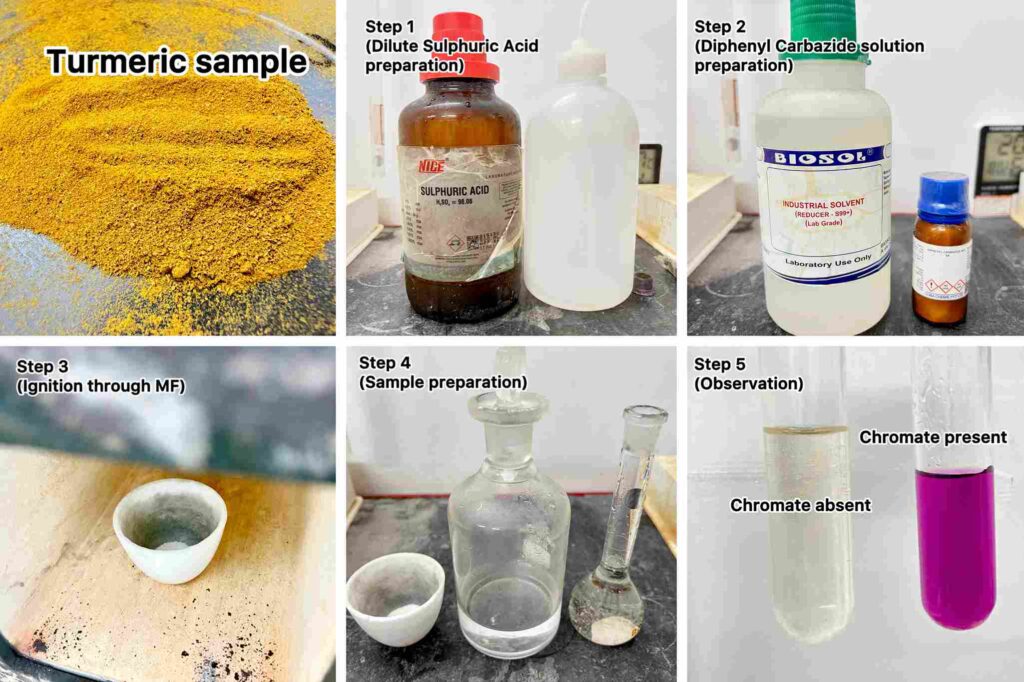
To ensure food safety and protect public health, The Diphenylcarbazide (DPC) method is a simple, sensitive, and widely used colorimetric test it is essential to test turmeric for the presence of chromate.
Chemicals Used in Chromate Testing of Turmeric Sample
- Dilute Sulphuric Acid(1 : 7)– Provides the acidic medium required. Add 10 ml sulphuric acid in 70 ml distilled water.
- Diphenylcarbazide Solution– 0.2 percent in ethyl alcohol.Diphenylcarbazide reacts with hexavalent chromium (Cr⁶⁺) in acidic medium to form a pink–violet colored complex, indicating the presence of chromate.
- Distilled Water – To make dilute Sulphuric Acid .The conductivity of distilled water should be <5 μS/cm to prevent contamination.
Apparatus Used in Chromate Testing of Turmeric Sample
- Weighing Balance(4-digit)-Accurately weighs the sample used in the test.
- Test tube-To hold the solution during the test.
- Muffle Furnace-Used to ash the organic matter in the food sample, leaving behind inorganic residue for analysis.
Procedure of Chromate Test in Turmeric
- Take 2 gm sample in a crucible & ash of it.
- Take the ash in a test tube,dissolve the ash in 4 to 5 ml of dilute sulphuric acid.
- Add 1 ml of diphenylcarbazide solution.
- The presence of chromate is indicated by the production of violet colour.
What is the importance of Chromate Test in Turmeric?
Chromate testing helps ensure the safety, quality, and authenticity of turmeric used for food and medicinal purposes.
- To detect hexavalent chromium (Cr⁶⁺) as an indicator of lead chromate adulteration
- To prevent long-term health hazards such as lead poisoning and chromium toxicity
- To monitor food adulteration practices in markets and supply chains
- To ensure compliance with food safety standards and regulations
- To support quality assurance programs in spice processing industries
- To maintain consumer confidence in turmeric and turmeric products
- To differentiate natural turmeric color from artificial coloring agents
- To provide a rapid screening method before confirmatory instrumental analysis
Handling Mistakes which should be avoided during chromate testing
- Using old or degraded diphenylcarbazide reagent-Leads to weak or no color development
- Improper acidic conditions-Results in poor or unstable color formation.
- Contaminated glassware-Can cause false positive or inaccurate results.
- Incomplete filtration of turmeric extract-Suspended particles interfere with color observation.
- Incorrect measurement of reagents-Excess or insufficient reagent alters color intensity.
- Delay in observing color change-The pink–violet color may fade with time.
Conclusion
Chromate testing of turmeric using the Diphenylcarbazide (DPC) method is a simple, sensitive, and effective way to detect hexavalent chromium, which may indicate adulteration with lead chromate. The appearance of a pink–violet color confirms the presence of Cr⁶⁺. This test helps ensure food safety, quality, and consumer protection. However, positive results should be confirmed by advanced instrumental methods for accuracy.By following these method, you can easily test the chromate of spice products at laboratory & also manufacturing industry with availability of the equipments. If you can’t understand the procedure you can check our real time photo attached with this writing or also you can reach to Pro Research & Testing Laboratory for the advance testing.
FAQ about Chromate Test in Turmeric
1. What is the purpose of this test?
To detect hexavalent chromium (Cr⁶⁺), indicating possible lead chromate adulteration in turmeric.
2. Which reagent is used?
1,5-Diphenylcarbazide (DPC), which forms a pink–violet complex with Cr⁶⁺ in acidic conditions.
3. How is a positive result identified?
Appearance of violet color indicates the presence of hexavalent chromium.
4. Can natural turmeric color interfere with the test?
The yellow of turmeric may slightly affect observation, but the pink-violet complex of Cr⁶⁺–DPC is clearly distinguishable.
5. Why is this test important?
It ensures food safety, protects consumers from toxic adulterants, and helps maintain quality control in turmeric products.
6. Can this test measure the amount of chromate?
No, it is qualitative.
7. Why is lead chromate added to turmeric?
To enhance the yellow color and make turmeric appear more attractive, though it is illegal and harmful.
How We Verified This Testing/Research Procedure :
This testing procedure is done under qualified analyst .Continually monitored by expertise.Repeatedly testing is always done to get accurate result.

Written by
Riya Ghosh (M.Sc. Food Technology, MAKAUT)
Designation – Chemist
Reviewed by
Anwesha Das (M.Sc Microbiology,BU)
Designation – Microbiologist
Verified By
Dr. Jyotirmoy Kumar Dey (Phd,Chemistry)
Designation – Senior/Chief Chemist
Experience – 25 Years +