
For Chemical Section
Clean glasswares are essential to prevent cross-contamination and chemical interference, which can give false results. The process of glassware cleaning for chemical analysis is as follows.
Chemicals used in cleaning process of glasswares after chemical testing
- Dilute Hydrochloric acid(HCL)- For washing purposes. Take 10 ml of hydrochloric acid in 100 ml distilled water.
- Chromic acid(10%)- For washing purposes. Take 10 gm potassium dichromate in 100 ml 1:1 sulphuric acid (H2SO4).
- Methylene blue & Chloroform- Used to test the glasswares if it is detergent residue free or not. Add 0.1 gm methylene blue powder in 100 ml distilled water.
Glasswares Washing Method
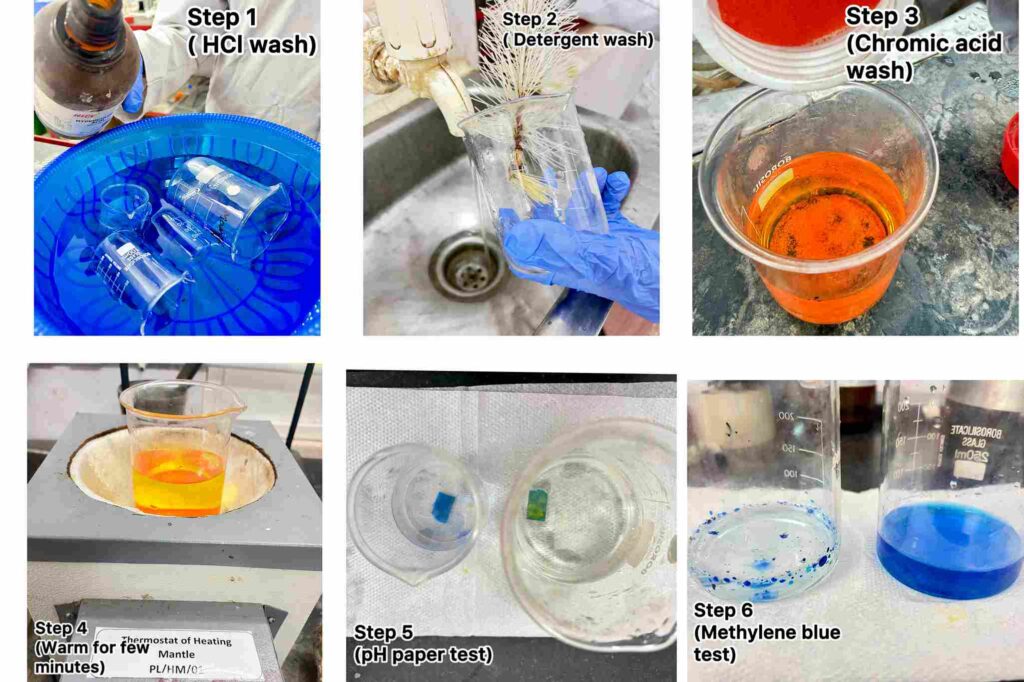
The used glasswares are at first rinsed thoroughly with dilute HCL to remove any inorganic stains.(see step 1 in picture)
│
▼
Now thoroughly rinsed and washed with tap water to remove acid residue.
│
▼
Next washed with detergent to remove any organic stains followed by using soft water to remove all detergent residues.(see step 2 in picture)
│
▼
Under extreme situation where the stains cannot be washed in a single wash, add hot chromic acid solution can be used prior to detergent, for cleaning gritty organic stins.(see step 3 & 4 in picture)
│
▼
For all treatment, finally washed with water.
│
▼
Finally the glasswares are washed 5 to 6 times with hot distilled water and 3 times with cool distilled water and kept in clean dry place/stand.
How to check whether the glasswares used in Chemical Testing are free from contaminants or not?
- Checking by pH paper on pouring distilled water in specific glasswares and comparison from the rinsing water should be neutral.(see step 5 in picture)
- Checking any detergent residue by methylene blue test when washing from the rinsed distilled water should be negative. If the methylene blue solution come with the contact of chloroform layer with presence of detergent residue, it will take the methylene blue colour. If the layer is separated ,it is confirmed that the glassware is residue free.(see step 6 in picture)
Importance of glasswares cleaning after working of Chemical Test
- Prevents Contamination: Eliminates trace residues that cause side reactions or false results.
- Ensures Accuracy: Allows for uniform drying to prevent volumetric measurement errors.
- Protects Integrity: Removes impurities that could interfere with sensitive analytical signals.
- Enhances Safety: Avoids dangerous, unintended reactions between residues and new chemicals.
Precautions to be taken during the cleaning process of glasswares used in Chemical Test
- Use mask while handling acids to avoid inhalation of toxic fumes.
- Glasswares should be handled with care.
- Always add acid to water to prevent splashing.
- Do not apply heavy pressure that could scratch the glass & increase the risk of breakage.
FAQ
1. What is the importance of glassware cleaning?
Clean glasswares are essential to prevent cross-contamination and chemical interference, which can give false results.
2. Is there any process to check whether the glasswares are free from detergent residue?
Yes there are 2 ways to verify the glasswares i.e. one is checking by pH paper and other by chloroform-methylene blue indicator.
3. What is the process to clean hard stains?
To remove hard stains, hot chromic acid solution is used followed by detergent wash.
4. Why distilled water is used for final washing?
Tap water might contains other metals which may interfere further, so that distilled water is used to remove any unusual interference.
5. What are the precautions to be taken while handling acids?
Always use gloves & masks while handling acid to prevent burn & inhalation of toxic fumes.