
Food-grade packaging materials/food-safe packaging/ food-contact packaging often use inks, dyes, coatings, or printed designs for branding and product information. When these materials come into contact with acidic or alkaline foods, there is a risk that colourants may migrate (leach) into the food, posing health risks and violating regulatory standards. This test evaluates the chemical stability of coloured surfaces and whether any migration occurs under simulated acidic and alkaline conditions.
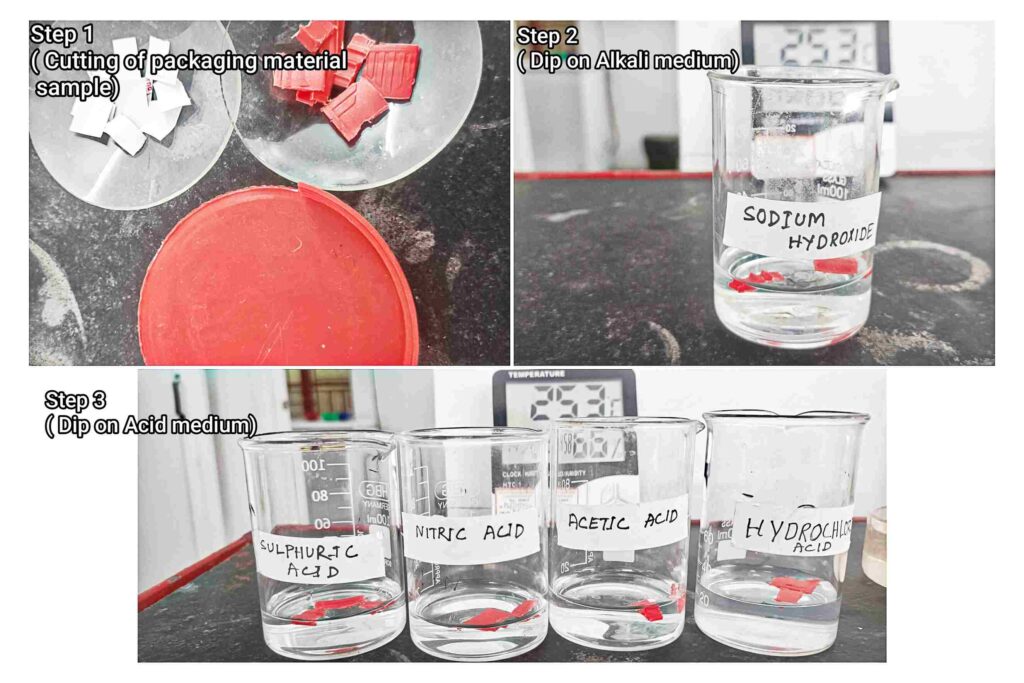
Here we are discussing about the detailed procedure of Colour Migration or stability test in Acid & Alkali of Food Grade Packaging Material done in Pro Research & Testing Laboratory.
Glassware & Equipments Used during Colour Migration or stability test in Acid & Alkali of Food Grade Packaging Material-
- Beaker(100ml)- To hold the sample with medium during the testing.
- Measuring Cylinder(50ml)- To make desired concentration of acid & alkali.
- 4-digit analytical balance-For accurate weighing of NaOH.
Chemical used during Colour Migration or stability test in Acid & Alkali of Food Grade Packaging Material-
- Hydrochloric acid(10%)-Used to check chemical resistance tests. To make 10% HCL, dilute 5 ml HCL in 45 ml of distilled water.
- Sulphuric acid(10%)-Used to check chemical resistance tests.To make 10% H2SO4, dilute 5 ml H2SO4 in 45 ml of distilled water.
- Nitric acid(10%)-It shows artificial colour migration.To make 10% HNO3, dilute 5 ml HNO3 in 45 ml of distilled water.
- Acetic Acid(10%)-Standard food stimulant for acidic foods(pickles,juices etc) in colour migration testing.To make 10% CH3COOH, dilute 5 ml CH3COOH in 45 ml of distilled water.
- Sodium Hydroxide(10%)- Standard simulant for alkaline food (baking soda, baking powder etc) contact testing.To make 10% NaOH, dilute 5 gm NaOH in 45 ml of distilled water.
- Distilled Water- Use to make diluted acid and alkali.The conductivity of distilled water should be <5 μS/cm to prevent contamination.
Procedure of Colour Migration or stability test in Acid & Alkali of Food Grade Packaging Material-
| Sample Preparation: | Cut into small pieces of the packaging material like the printed or colored surface is in contact with the stimulant. |
| Exposure to Simulants | Immerse the sample in acidic stimulants (10% HCL,H2SO4,CH3COOH,HNO3) and in alkaline stimulant (10% NaOH). Keep the beakers in room temperature maintained 25±2°C for 2 hours. Observe the results. |
| Post-Exposure Observation | Remove samples and observe for colour changes, fading of colour into the solution. |
| Interpret Results: | If the solution remains clear and colourless, no migration has occurred. Visible colour in solution indicates colour migration. |
Purpose of the Colour Migration or stability Test–
- To acess the test for prevention of toxic colourant leaching into food.
- To stimulate acidic and alkaline food contact conditions.
- To maintain product quality, safety, and brand reputation.
- To help in selecting safe materials for different food products.
- To avoid chemical contamination, taste or appearance alteration through testing guidance
- To guide packaging and risk assessment in production. through colour migration tests under various conditions
Handling Mistakes should be avoided during the test of Colour Migration or stability –
- Using incorrect stimulant concentration or temperature -Incorrect stimulant may not stimulate real food contact accurately.
- Insufficient contact time during testing-Partial contact may miss potential colour leaching.
- Not testing both acidic and alkaline conditions-Testing in only one medium misses potential migration risks for the untested food type.
- Using dirty or stained beakers-Residual stains can mimic colour migration or cause interference.Proper cleaning Process described previously.
- Contaminated or reused stimulant-Previous tests may contaminate simulant, showing false colouration.
- Not using calibrated glasswares- Not using calibrated glassware can make wrong concentration which may lead to false results.
Conclusion for the test of Colour Migration or stability-
The colour migration or stability test in acid and alkali ensures that food packaging materials/food-grade containers are safe, stable, and legally compliant. It helps protect consumers, enables safe material selection, and ensures product safety throughout the shelf life of packaged food.By following the above-mentioned method, you can easily test the colour migration or stability at any laboratory or manufacturing industry with the availability of the equipments & chemicals.This testing process is crucial for quality control in various applications. Furthermore, if you can’t understand the procedure, you can check our real-time photo attached with this writing, which visually guides you through each step and enhances your understanding. Additionally, for those who prefer professional assistance or require more advanced testing, you can also reach out to Pro Research & Testing Laboratory for testing purposes.
Frequently Asked Questions about the test of Colour Migration or stability-
1.Why is color migration testing important?
Ans-To understand the stability of the applied colour and to take necessary steps to prevent any toxic chemicals from migrating into food, ensure consumer safety , and comply with food safety regulations.
2.What types of packaging materials require this test?
Ans-All printed, colored, or coated food packaging materials, including plastic films, laminated pouches, coated papers, metal foils, etc
3.What are the test conditions (time and temperature)?
Ans-Common conditions are 25±2°C for 2 hours.
4.How is color migration detected?
Ans-By visual observation of color change in stimulants.
5.What does a “pass” result mean in this test?
Ans-No visible color leaching or measurable migration occurred, indicating the packaging is safe and stable for food contact.
6.What happens if color migration is detected?
Ans-The packaging fails the test; it must be replaced, as it poses a food contamination risk and is not compliant with safety regulations.
7.How often should this test be done?
Ans-During product development, before market release,for every new batch of printed packaging, or when materials/inks change and also as part of routine quality control.
How We Verified This Testing/Research Procedure :
This testing procedure is done under qualified analyst .Continually monitored by expertise.Repeatedly testing is always done to get accurate result.

Written by
Riya Ghosh (M.Sc. Food Technology, MAKAUT)
Designation – Chemist
Reviewed by
Anwesha Das (M.Sc Microbiology,BU)
Designation – Microbiologist
Verified By
Dr. Jyotirmoy Kumar Dey (Phd,Chemistry)
Designation – Senior/Chief Chemist
Experience – 25 Years +