
Colour is an important physical parameter used to assess the quality of water and one of the first characteristics noticed by consumers. The presence of colour in water may result from natural substances such as dissolved organic matter, acids leached from soil and vegetation, or from various sources including industrial effluents, sewage discharge, and agricultural waste.
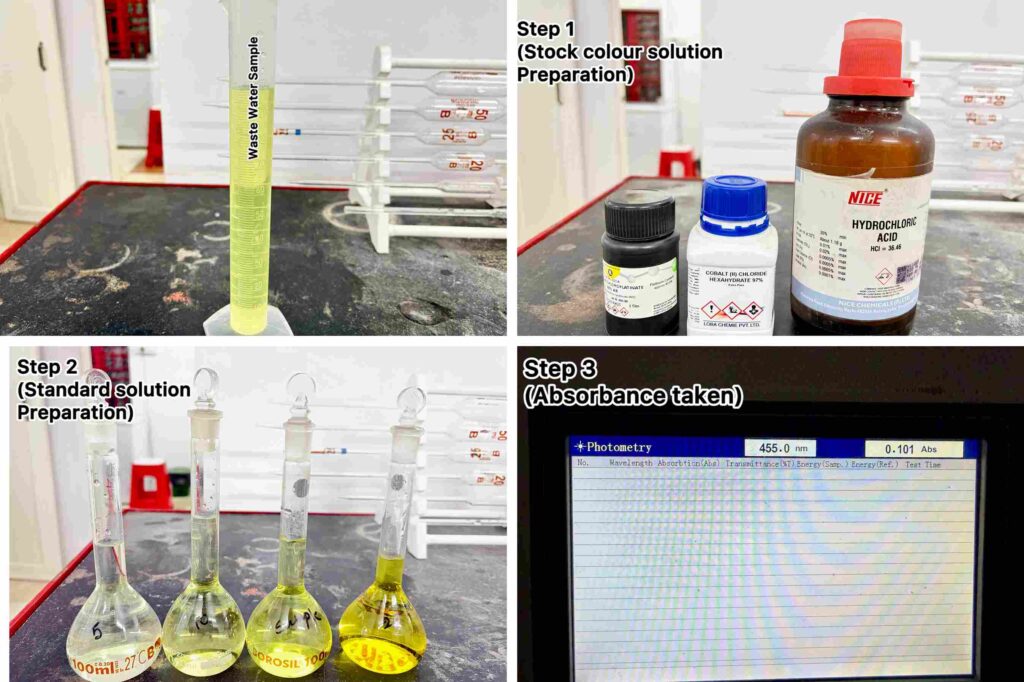
The colour of water is determined by comparing the absorbance of the water sample with that of standard colour solutions prepared using potassium chloroplatinate and cobalt chloride. The measurement is carried out using a spectrophotometer at a specified wavelength, and the colour is expressed in Hazen units. Here we have used Waste Water.
Apparatus used in this colour testing of water
- Spectrophotometer capable of measuring at 455 nm.
- Volumetric flasks-Used to measure sample & prepare reagent.
- Pipettes-Used to measure and transfer small, accurate volumes of liquid.
- Filter paper- To filter the sample.
Reagents used in this colour testing of water
- Stock Colour Solution (500 Hazen Units)
- Dissolve 1.246 g potassium chloroplatinate (K₂PtCl₆)
- Add 1.000 g cobalt chloride (CoCl₂·6H₂O)
- Add 100 mL concentrated hydrochloric acid
- Dilute to 1 litre with distilled water
- Standard Colour Solutions
- Prepare a series of standards (e.g., 5, 10, 20 Hazen units) by diluting the stock solution with distilled water.
- Distilled Water (colour-free) for blank preparation.The conductivity of distilled water should be <5 μS/cm to prevent contamination.
Procedure for colour test in water
- Switch on the spectrophotometer and allow it to warm up.
- Set the wavelength of the spectrophotometer to 455 nm.
- Fill a clean cuvette with distilled water and use it as a blank to zero the instrument.
- Measure the absorbance of each standard colour solution at 455 nm and record the readings.
- Fill another cuvette with the water sample and measure its absorbance at the same wavelength.
- Determine the colour of the sample in Hazen units.
- Match the absorbance of sample with standard.If the sample colour exceeds the range of standards, dilute the sample with distilled water.
Purpose of Colour Testing in Water Samples
- Assessment of Quality:To evaluate the visual acceptability of water for drinking and domestic use.
- Detection of Contamination:To identify the presence of dissolved organic matter, metals, or industrial and sewage pollutants.
- Compliance with Standards:To ensure water quality meets limits prescribed by Indian Standards (IS) and other regulatory guidelines.
- Monitoring Water Treatment Efficiency:To check the effectiveness of treatment processes such as coagulation, filtration, and disinfection.
- Protection of Aquatic Life:To assess potential impacts on aquatic ecosystems caused by reduced light penetration due to colour.
- Early Warning of Pollution:To detect changes in water quality that may indicate pollution or environmental degradation.
Handling Mistakes in Color Test of Water Samples
- Improper Cleaning of Glassware:Dirty or stained cuvettes can give false colour readings.
- Use of Turbid Samples:Failure to filter turbid water samples may interfere with accurate colour measurement.
- Incorrect Preparation of Standards:Errors in weighing or dilution of potassium chloroplatinate standards affect calibration accuracy.
- Fingerprints on Cuvettes:Touching optical surfaces can cause light scattering and incorrect absorbance values.
- Wrong Wavelength Setting:Setting the spectrophotometer at an incorrect wavelength leads to inaccurate results.
- Poor Instrument Calibration:Not zeroing the spectrophotometer with a blank before measurement causes systematic errors.
- Use of Old or Contaminated Reagents:Degraded reagents may alter the colour intensity of standards.
Conclusion
Colour testing of water using potassium chloroplatinate is a simple and reliable method for assessing quality characteristics of water. Proper sample handling, correct preparation of standards, and careful instrument calibration are essential for obtaining valid results.By following the above-mentioned method, you can easily test the colour at any laboratory or manufacturing industry with the availability of the equipments and chemicals.This testing process ensures accurate results, which are crucial for quality control in various applications. Furthermore, if you can’t understand the procedure, you can check our real-time photo attached with this writing, which visually guides you through each step and enhances your understanding. Additionally, for those who prefer professional assistance or require more advanced testing, you can also reach out to Pro Research & Testing Laboratory for testing purposes.
Frequently Asked Questions (FAQ) – Colour Testing of Water
1. What is meant by colour in water?
Colour refers to the presence of dissolved substances in water that impart a visible tint, usually due to organic matter, metals, or industrial pollutants.
2. Why is potassium chloroplatinate used in colour testing?
Potassium chloroplatinate is used to prepare standard colour solutions on the Hazen scale, which is the reference standard recommended by Indian Standards.
3. What unit is used to express colour in water?
Colour is expressed in Hazen units.
4. Which Indian Standard specifies the method for colour testing?
Colour testing of water is specified in IS 3025: Part 4.
5. Why is the wavelength set at 455 nm in spectrophotometric method?
455 nm corresponds to the maximum absorbance of Pt–Co colour standards, ensuring accurate and sensitive measurement.
6. Can turbid water be tested directly for colour?
No. Turbid samples must be filtered first, as suspended particles can interfere with colour measurement.
7. What is the acceptable limit of colour in drinking water as per IS?
As per IS 10500, the acceptable limit is 5 Hazen units, and the permissible limit in the absence of an alternate source is 15 Hazen units.
8. Why is a blank used in spectrophotometric analysis?
A blank (distilled water) is used to zero the instrument and eliminate background absorbance.
9. What should be done if the sample colour is higher than the standard range?
The sample should be diluted with distilled water, and the final colour value should be calculated using the dilution factor.
10. How often should colour standards be prepared?
Standards should be prepared fresh or periodically as recommended to avoid errors due to reagent degradation.
How We Verified This Testing/Research Procedure :
This testing is done under qualified analysts in our lab.Continually monitored by expertise.Repeatedly testing is always done to get accurate result.

Written by
Anwesha Das (M.Sc Microbiology,BU)
Designation – Microbiologist
Reviewed by
Riya Ghosh (M.Sc. Food Technology, MAKAUT)
Designation – Chemist
Verified By
Dr. Jyotirmoy Kumar Dey (Phd,Chemistry)
Designation – Senior/Chief Chemist
Experience – 25 Years +