
Curcumin testing of turmeric is an essential analytical process used to determine the amount of curcumin, the primary bioactive compound responsible for responsible for its distinct yellow-orange color. This testing plays a crucial role in evaluating the quality, purity, and potency of turmeric samples.
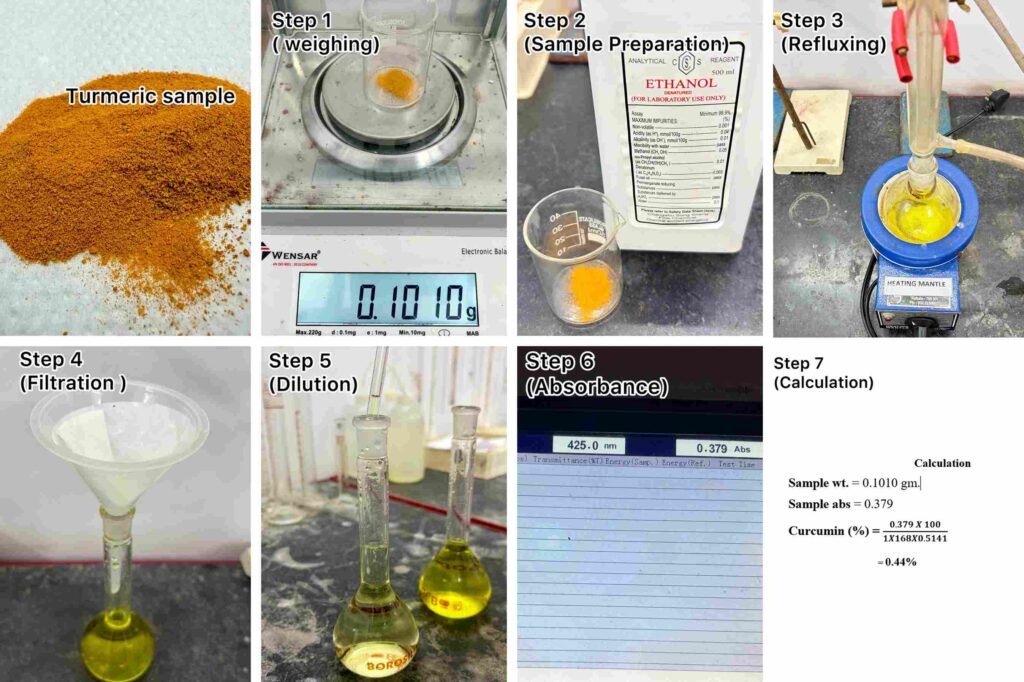
We have taken turmeric powder for this test.
Chemical & Equipments Used During Testing of Curcumin Content of Turmeric Sample:
Equipments Used
- Spectrophotometer(425 nm)- By measuring the absorbance of your sample at this specific wavelength i.e,425 nm, you can calculate the exact concentration of curcumin using Beer-Lambert’s Law.
- Volumetric Flask(100 ml)- Used for precise dilution.
- Pipette(10 ml)- Used for accurate liquid transfer.
- Heating Mantle- Provides a controlled, flameless heat source.
- Flat bottom flask(250 ml) & Condenser-Used to hold sample with solvent under reflux condition.
- Filter paper- Used to filter the sample solution after reflux.
- Weigh Balance (4-digit)- To measure turmeric sample precisely.
Chemical used:
Ethyl alcohol- Acts as solvent to extract curcumin .
Procedure to Follow While Doing Curcumin Testing of Turmeric:
| Sample Preperation | 0.1 gm sample weighed and transferred in flat bottom flask. |
| Reflux | Add 50 ml ethyl alcohol into it and reflux for 1.5 hour. |
| Cooling & filtration | After reflux let the solution to cool and filter into 100 ml volumetric flask. Volume make up to marked. |
| Dilution | Take 10 ml and volume make up to 100 ml volumetric flask with ethyl alcohol. |
| Absorbance | Take absorbance at 425 nm. |
| Calculation | Curcumin (%) = ( a X 100) / (l X A X m) a = absorbance of extract at 425 nm, I = cell length in em, A = absorptivity, m = mass in g of sample. |
Why Curcumin Testing is Important for Turmeric?
- Measures quality – shows how much curcumin is present.
- Checks purity – detects adulteration or fake additives.
- Ensures effectiveness – confirms health benefits and potency .
- Maintains consistency – same quality across batches.
- Meets regulations – required for food, pharma, and export standards.
- Determines pricing – higher curcumin creates higher market value.
- Supports safe usage – accurate dosage in supplements.
- Improves processing – helps optimize extraction and manufacturing.
What Types of Error Can be Avoided During Curcumin Detection of Turmeric?
- Improper sampling leads to inaccurate results
- Wrong weighing causes incorrect measurement
- Incomplete extraction results in low curcumin detection
- Impure solvents distort results.
- Calculation errors give wrong final values.
- Interference causes inaccurate readings.Using unclean or wet glassware, leading to contamination.Proper cleaning Process described previously.
Conclusion of Curcumin Determination Of Turmaric Sample:
Curcumin testing in turmeric is essential to ensure quality, purity, and effectiveness. It helps verify the actual curcumin content, detect adulteration, maintain consistency, and meet regulatory standards. Accurate testing ultimately supports safe consumption, fair pricing, and reliable use in food, pharmaceutical, and commercial applications.By following these method,you can easily test the fat content at any laboratory or manufacturing industry with availability of the equipments & chemicals.If you can’t understand the procedure you can check our real time photo attached with this writing or also you can reach to Pro Research & Testing Laboratory for the testing purposes
FAQ Related to Curcumin Testing Of Turmaric Sample:
1. What is curcumin testing in turmeric?
It is the process of measuring the amount of curcumin, the main active compound, present in a turmeric sample.
2. Why is curcumin testing important?
It ensures quality, purity, effectiveness, and compliance with industry standards.
3. What are the common method used for testing?
Spectrophotometry method is widely used technique to detect curcumin.
4. What is the ideal curcumin content in turmeric?
As per Indian Standard the ideal curcumin percentage sholud be min 2%.
5. How can adulteration be detected?
Through lab testing methods that identify impurities or synthetic additives.
6. What errors can occur during testing?
Sampling errors, improper extraction, instrument issues, and calculation mistakes.
7. How is curcumin extracted for testing?
Using suitable solvents like ethanol under controlled conditions.
8. Who requires curcumin testing?
Food industries, pharmaceutical companies, exporters, and quality control laboratories.
9. What is Beer-Lambert’s Law?
The Beer-Lambert Law states that the absorbance of a solution is directly proportional to its concentration and the path length of the light through it. The spectrophotometer follows the rule while measuring absorbance of a solution.
How We Verified This Testing/Research Procedure :
This testing is done under qualified analysts in our lab.Continually monitored by expertise.Repeatedly testing is always done to get accurate result.
Written by
Riya Ghosh (M.Sc. Food Technology, MAKAUT)
Designation – Chemist

Reviewed by
Anwesha Das (M.Sc Microbiology,BU)
Designation – Microbiologist
Verified By
Dr. Jyotirmoy Kumar Dey (Phd,Chemistry)
Designation – Senior/Chief Chemist
Experience – 25 Years +