
Dehydrated food is a kind of food from that the water content is eliminated by drying process. It is useful to store the foods for long term usage as its extreme low moisture helps to prevent the growth of bacteria, yeast and mould so the shelf life of the food extends long than the normal foods.Here we take dehydrated pachan sample .
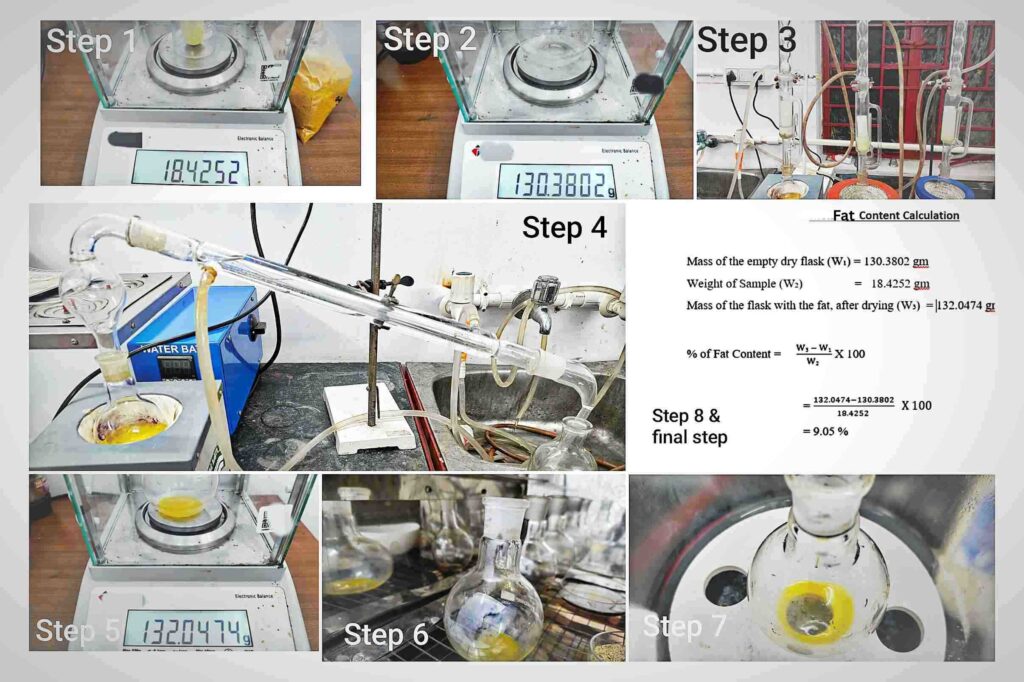
We determine the fat content for solid food items by Soxhlet method. Here we will briefly discuss about how to determine fat content of dehydrated food item by Soxhlet method which we do in our lab.
Equipments & Instruments used during the test of Fat for Dehydrated Food Sample
- Heating Mantle- This instrument provides constant heat to boil the solvent.
- Flat-Bottom Flask – It is used to collect and hold the solvent with fat.
- Soxhlet Extractor-A specialized apparatus that continuously extract the fat from sample using solvent.
- Extraction Thimble(Cellulose Thimble)- This thimble is made of cellulose,holds the sample during extraction and also acts as filtered membrane so that only fat residue can release from the sample using solvent without leaking the sample.
- Condenser- It is attached on top of the extractor that condenses solvent vapour back into liquid through the sample.
- Splash Head Condenser – It operates between the flask and the condenser while recovering the ether.
- Recovery Funnel – It attached with the condenser while recovering the petroleum ether.
- Desiccator- It allows to cool the flask with extracted fat sample without interference of moisture.
- Weigh Balance- It is used to weigh the sample and the flask.
- Hot-Air-Oven- Typically set at 85°C to remove moisture before and after the extraction.
Chemical Used While Testing Fat for Dehydrated Food Sample-
- Petroleum Ether- It is a non-polar solvent.It is used to dissolve the fat compound in it. It is ideal for soxhlet extraction that helps to extract fat from sample without damaging it.
Procedure To Test Fat Content of Dehydrated Food –
| Step1 | Dry(at 105°C) the sample for 2-3 hours in the oven to remove moisture. |
| Step 2 | Weigh the dry sample and place it in the extraction cellulose thimble. |
| Step 3 | Assemble the Soxhlet apparatus with the solvent (petroleum ether) and start heating at 70°C-80°C temperature. |
| Step 4 | Allow the system to run for several cycles (usually 10-12 hours). |
| Step 5 | After 12 hours of extraction, evaporate the solvent(petroleum ether) to get the fat residue by recovery process. |
| Step 6 | Dry the flask with fat residue until the constant weight. |
| Step 7 | Cool the flask in a desiccator. |
| Step 8 | Calculate with the below formula to determine fat content. |
| Step 9 | Repeat the procedure at least 5 times for accurate result. |
Calculation for Testing of Fat Content in Dehydrated Food–
Fat Content( %)=[ ( mass of the flask with the fat, after drying – mass of the empty dry flask)/ Sample taken for the test]×100
Purpose of Fat Content Determination of Dehydrated Food-
Fat in dehydrated food refers to the lipid (oil or fat) content that remains in the food after its water has been removed through drying processes. Despite dehydration, fats are not removed, as they are not water-soluble and remain stable in the food.The purpose of determining fat content in dehydrated food is important for several nutritional, quality, and regulatory reasons like-
- Nutritional Labeling-Fat is a major macronutrient, and accurate fat content is essential for nutritional labeling.
- Quality purpose- Fat content affects the texture, flavor, and mouthfeel of dehydrated food.
- Shelf Life and Stability – High fat levels can lead to rancidity over time, especially in dehydrated products stored for long period.
Handling mistakes to avoid during testing of Fat in Dehydrated Food–
- Incomplete drying of sample re-absorbs moisture in the sample can cause inaccurate fat yield and solvent boiling issues.
- Inaccurate weighing of empty thimble, flasks, or samples causes errors in fat calculation.
- Discontinuous supply of cold water can cause solvent loss i.e. petroleum ether which may evaporate during extraction process,leading to inaccurate results.
- Incomplete fat extraction yields lower fat content values.
- Weighing hot flasks can cause mass reading errors.
- Residual grease or previous sample residue can affect fat weight.
Conclusion of Fat Testing of Dehydrated Food-
The Soxhlet extraction method is a reliable and widely used technique for determining the fat content in dehydrated food samples. Through the continuous solvent extraction process(typically using petroleum ether),allows for the efficient and complete recovery of fat from the sample.Soxhlet extraction provides precise and reproducible results for fat content, crucial for nutritional labeling and quality control of dehydrated products.As dehydrated foods contain minimal moisture,fat extraction is more efficient,avoiding interference from water during the process.But still while doing the test the handling mistakes should be avoided and repeatability of the procedure is also important for exact results.By following these method,you can easily test the fat content at any laboratory or manufacturing industry with availability of the equipments & chemicals.If you can’t understand the procedure you can check our real time photo attached with this writing or also you can reach to Pro Research & Testing Laboratory for the testing purposes.
FAQ On Fat Testing of Dehydrated Food-
1.How fat content is measured in dehydrated foods?
Ans: Commonly by the Soxhlet Extraction Method.
2.Can dehydrated food go rancid due to fat?
Ans: Yes. Unsaturated fats are prone to oxidation, causing off-flavors and reduced shelf life.
3. Is fat content labeling mandatory in dehydrated foods?
Ans:Yes as high fat levels can lead to rancidity over time so accurate fat content is essential for nutritional labeling.
4.Does dehydration affect the fat content?
Ans: No, dehydration removes water but does not chemically affect the fat.
5.Can we use any polar solvent rather than petroleum ether?If not why we use petroleum ether?
Ans: No, we cannot use any other polar solvent because petroleum ether is a non-polar solvent.It is ideal for soxhlet extraction that helps to extract fat from sample without damaging it.
6.Why we analyse fat content in dehydrated food?
Ans: The purpose of determining fat content in dehydrated food is important for several nutritional, quality, and regulatory reasons.
7. Can I do this test in any laboratory or manufacturing units?
Ans:Yes,by following above mentioned method,you can easily test the fat content at any laboratory or manufacturing industry with availability of the equipments & chemicals.If you can’t understand the procedure you can check our real time photo attached with this writing or also you can reach to Pro Research & Testing Laboratory for the testing purposes.
How We Verified This Testing/Research Procedure :
This testing procedure is done under qualified analyst .Continually monitored by expertise.Repeatedly testing is always done to get accurate result.

Written by
Riya Ghosh (M.Sc. Food Technology, MAKAUT)
Designation – Chemist
Reviewed by
Anwesha Das (M.Sc Microbiology,BU)
Designation – Microbiologist
Verified By
Dr. Jyotirmoy Kumar Dey (Phd,Chemistry)
Designation – Senior/Chief Chemist
Experience – 25 Years +