
Saponification is the process of converting fats and oils into soap and glycerol .In easy way unsaponifiable matter means to the portion of fats and oils that cannot be converted into soap when treated with alkali. Determining unsaponifiable matter is crucial for assessing purity, detecting adulteration, and determining oil quality.
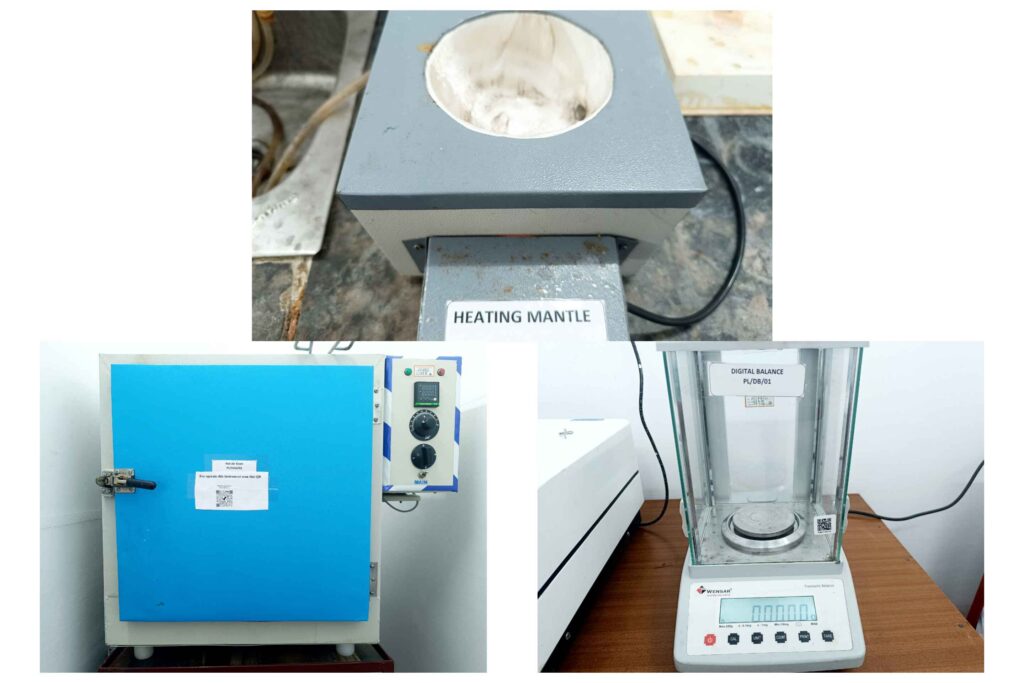
Chemicals & Apparatus Required In Testing Of Unsaponifiable Matter in Oil Sample:
Chemicals
- Alcoholic Potassium Hydroxide Solution : Alcoholic KOH (potassium hydroxide dissolved in ethanol) is used in saponification, particularly for measuring the saponification value. Dissolve 7 to 8 g of potassium hydroxide in an equal quantity of distilled water, and add sufficient aldehyde-free ethyl alcohol make up to 100 ml. Allow to stand overnight, decant the clear liquid and keep in a bottle closed tightly.
- Ethyl Alcohol: Ethyl alcohol (ethanol 95%) primarily acts as a solvent and medium for the saponification reaction in determining unsaponifiable matter.
- Phenolphthalein Indicator Solution : It acts as a pH indicator to confirm that the extract is washed until it is no longer alkaline. Dissolve 1gm of phenolphthalein in 100 ml of ethyl alcohol.
- Petroleum Ether : Petroleum Ether is used as a non-polar solvent to extract unsaponifiable substances.
- Aqueous Alcohol : Aqueous alcohol (containing 10 % of ethyl alcohol) is essential in determining unsaponifiable matter in oils and fats to act as a solvent for saponification. Add 10ml ethyl alcohol in 90 ml distilled water.
- Standard Sodium Hydroxide Solution : Standard Sodium Hydroxide ( approximately 0.02 N) solution, typically, is used to titrate the free fatty acids present in the extracted crude unsaponifiable matter. Preparation described previously.
- Acetone : It is used primarily as a solvent to remove residual water and trace impurities from the dried extract.
- Distilled Water: Acts as a solvent .The conductivity of distilled water should be <5 μS/cm to prevent contamination.
Apparatus
- Flat-Bottomed Flask(250 ml) & Reflux Condenser: Used for Preparation of Sample. It allows the mixture of sample and alcoholic potassium hydroxide solution to be boiled gently for 1 hour to ensure all fats and oils are fully converted into soap.
- Separating Funnels(500ml): The funnel is used to separate the ether layer containing the unsaponifiable components from the aqueous soap solution.
- Pipettes(5 ml):Ensure the accurate volumetric measurement of reagents.
- Hot air oven(85°C): To remove the moisture & clean dry the sample .
- Desiccator: It is help for the cooling process that prevent reabsorption of moisture.
- Weigh balance(4-digit)– Helps to measure proper weight.
- Heating Mantle : To heat the reaction mixture
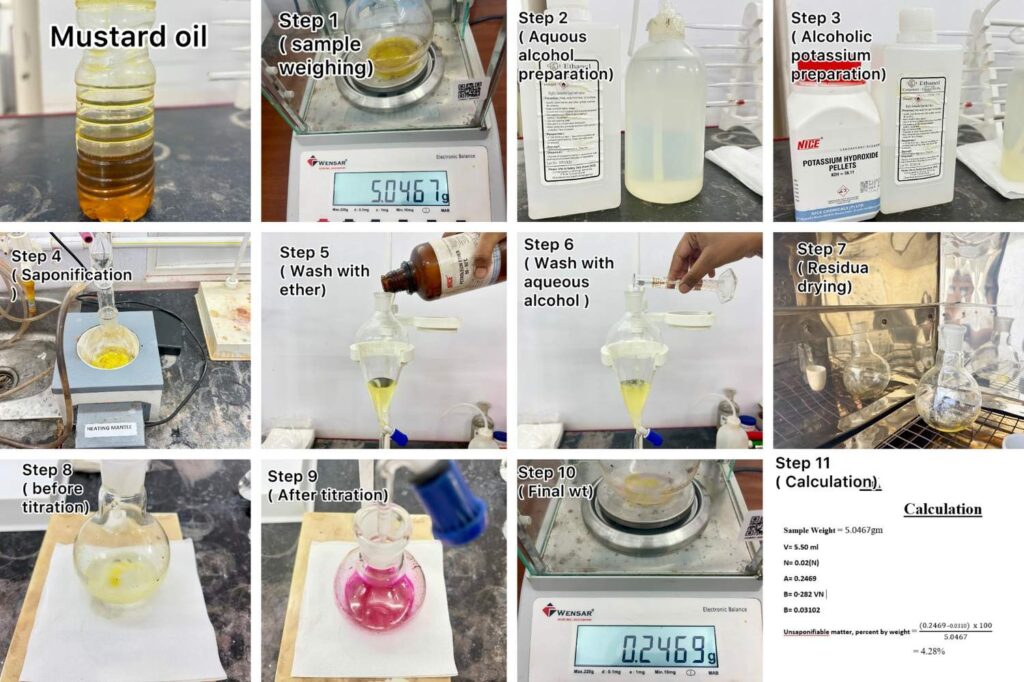
Method Followed To Test Unsaponifiable Matter Of Oil Sample:
| Steps | Description |
| Saponification | Weigh 5 gm of the sample into the flask.Add 50 ml of alcoholic potassium hydroxide solution. Boil gently under a reflux condenser for one hour. |
| Separation | Wash the condenser with about 10 ml of ethyl alcohol. Cool the mixture and transfer to a separating funnel. Add 50 ml of water to the separating funnel. Add of 50 ml of petroleum ether. Insert the stopper and shake for one minute . Allow to settle until both the layers are clear. Transfer the lower layer containing the soap solution to another separating funnel, and repeat the ether extraction at least six times more using 50 ml of petroleum ether for each extraction. |
| Collection | Collect all the ether extracts in a separating funnel. Wash the combined extracts in the funnel three times with 25ml of aqueous alcohol. Add few drops of phenolphthalein indicator solution. Again wash the ether layer successively with 20 ml of water until the wash water no longer turns pink . Then place the flask into a Hot air oven (85°C for about one hour). Cool in a desiccator. |
| Titration | After weighing, take up the residue in 50 ml of warm neutral ethyl alcohol. Add a few drops of phenolphthalein indicator solution . Titrate with standard sodium hydroxide solution. |
Calculation:
Weight in g or the fatty acids in the extract = B= 0·282 VN
where,
Y = volume in ml of standard sodium hydroxide solution, and
N = normality of standard sodium hydroxide solution.
Unsaponifiable matter, percent by weight = (A-B)X100 / W
where
A = Weight in g of the residue
B = weight in g of the fatty acids in the extract
and
W = weight in g
Purpose Of Unsaponifiable Matter analysis of Oil Sample :
- Identifies mineral oils or low-quality oils added to high-quality vegetable oils.
- Assesses the purity and extent of processing or refining.
- Identifies valuable components like fat-soluble vitamins, which affect the unsaponifiable content.
- To define the characteristics of oils, fats, and waxes.
Handling mistakes should avoided during Determination of Unsaponifiable matter Of Oil Sample:
- Inadequate Sample Preparation: Inadequate sample preparation provides inaccurate result.
- Contamination between sample: Using a improperly cleaned bottle and dried form previous can cause incorrect measurement.
- Inappropriate drying of bottle: Any extra water on the outside of the bottle provide inaccurate result.
- Impure Reagents : Use fresh, standardized chemicals only.Degraded reagents can give false result.
- Titration errors: Use proper indicator and titrate carefully. Excess indicator may cause improper colour change.
- Dirty glassware: Using dirty or wet glassware can introduce contamination. Proper cleaning Process described previously.
Conclusion Of Unsaponifiable Matter Testing Of Oil Sample:
The determination involves saponifying the oil with potassium hydroxide, extracting the non-saponified fraction with solvents (like ether), and weighing the residue. The amount of unsaponifiables can help detect adulterated products.By following the above-mentioned method, you can easily test the Unsaponifiable Matter at any laboratory with the availability of the equipments and chemicals .This testing process ensures accurate results, which are crucial for quality control in various applications. Furthermore, if you can’t understand the procedure, you can check our real-time photo attached with this writing, which visually guides you through each step and enhances your understanding. Additionally, for those who prefer professional assistance or require more advanced testing, you can also reach out to Pro Research & Testing Laboratory for testing purposes.
FAQ- Testing for Determination Of Unsaponifiable Matter Of oil Sample:
- What is Saponification?
A. Saponification is the process of converting fats and oils into soap and glycerol. - What is the purpose for determination of Unsaponifiable matter of oil sample?
A. Determines the degree of purity and processing of the oil. - What is the use of Alcoholic Potassium Hydroxide Solution?
A. Alcoholic KOH (potassium hydroxide dissolved in ethanol) is used for measuring the saponification value.. - What are common sources of error?
A. Improper titration, inaccurate sample weight and use of impure reagents. - What is the use of Standard Sodium Hydroxide Solution?
A. Standard Sodium Hydroxide Solution is a strong alkali that is essential in the saponification process, which is the chemical reaction that transforms oils and fats into soap .
How We Verified This Testing/Research Procedure :
This testing procedure is done under qualified analyst .Continually monitored by expertise.Repeatedly testing is always done to get accurate result.

Written by
Ankita Samanta (M.Sc Microbiology,Vidyasagar University)
Designation – Junior Microbiologist
Reviewed by
Riya Ghosh (M.Sc. Food Technology, MAKAUT)
Designation – Chemist
Verified By
Dr. Jyotirmoy Kumar Dey (Phd,Chemistry)
Designation – Senior/Chief Chemist
Experience – 25 Years +