
Honey is a natural sweet substance produced by honeybees from the nectar of plants. The Fiehe’s test is a simple qualitative chemical test used to detect the presence of Hydroxymethylfurfural (HMF) in honey. HMF is formed due to biochemical process where reaction between formic acid from bees and furfural which is formed due to biodegradation of traces of fermented sucrose. Fresh and unprocessed honey contains little or no HMF.
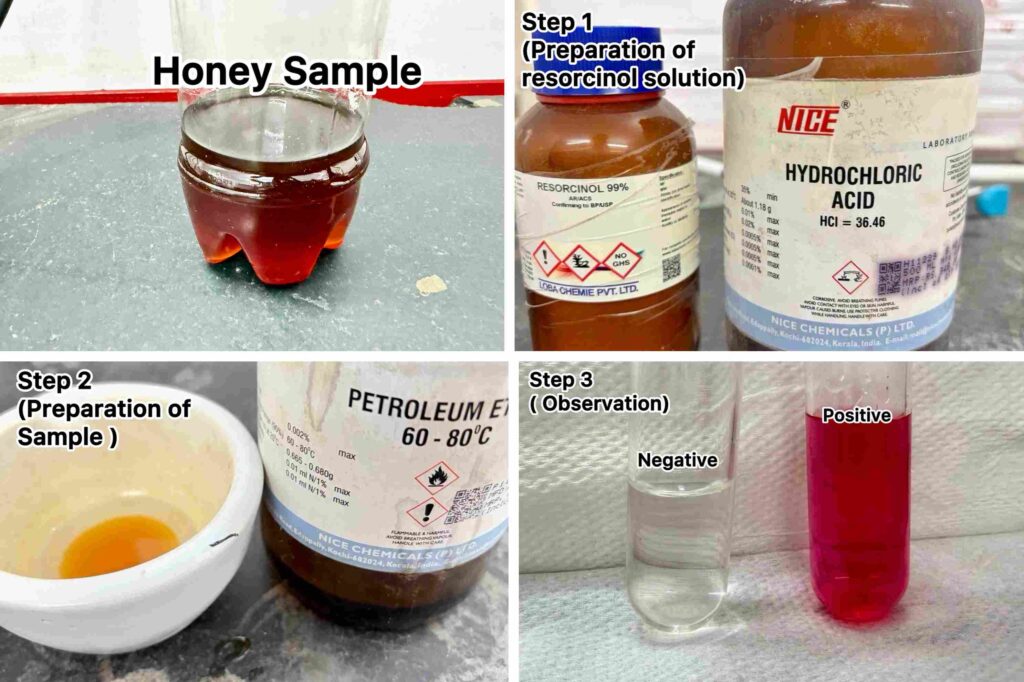
Here we have used processed honey.
Chemicals Required in Fiehe’s Testing of Honey
- Resorcinol (1% solution) – Reacts with HMF to form red-colored complex.Dissolve 1gm resublimed resorcinol in 100 ml hydrochloric acid.
- Concentrated Hydrochloric Acid (HCl) – Provides acidic medium for the reaction.
- Petroleum ether– To dissolve honey sample.
Apparatus Required in Fiehe’s Testing of Honey
- Test tube – Used to carry out the chemical reaction.
- Pipette / Dropper – Measures and transfers reagents accurately.
- Pestle-mortar – For sample preparation and handling.
Procedure of Fiehe’s Test in Honey
- Transfer 5 g of the honey sample into a mortar, using a pestle, mix the honey with 10 ml of ether.
- Decant the ether extract into a test tube. Repeat the extraction twice in the same manner and collect the extract in the same dish.
- Allow the extracts to evaporate to dryness at room temperature.
- Add a large drop of freshly prepared resorcinol solution.
Result of Fiehe’s Test
Cherry-red color appears → Positive Fiehe test ( adulterated honey).
No red color → Negative test (fresh honey).
Importance of Fiehe’s Test in Honey Sample
- This test is important to detect the presence of Hydroxymethylfurfural (HMF) which is a toxic compound produced during the reaction of dead bees & the formic acid (naturally present in bees).
- To assess the freshness of honey.
- To detect prolonged or improper storage of raw honey.
- It is the primary detection test.
Handling Mistakes should avoid during Fiehe’s Test in Honey
- Using old or improperly prepared resorcinol reagent.
- Taking improper quantity of honey sample.
- Inadequate mixing of reagents.
- Allowing excess reaction time, leading to false color development.
- Performing the test in strong light or high temperature, affecting color intensity.
- Using contaminated or wet glassware.
Conclusion of Fiehe’s Test in Honey
The Fiehe’s test provides a rapid qualitative indication of honey quality by detecting the presence of Hydroxymethylfurfural (HMF). A cherry-red color confirms that the honey has HMF content. Absence of color indicates that the honey is fresh, properly handled, and of good quality. This test is useful as a quick screening method before more precise quantitative HMF determination.By following these method, you can easily Fiehe test of any honey products at laboratory & also manufacturing industry with availability of the equipments & chemicals. If you can’t understand the procedure you can check our real time photo attached with this writing or also you can reach to Pro Research & Testing Laboratory for the advance testing.
FAQ
Q: What does the Fiehe’s test detect?
A: It detects Hydroxymethylfurfural (HMF) in honey, which indicates overheating, storage, or adulteration.
Q: Is the Fiehe’s test quantitative?
A: No, it is qualitative; it only shows the presence or absence of HMF.
Q: What does a cherry-red color indicate?
A: A cherry-red color indicates high HMF content, suggesting biodegradation of traces of fermented sucrose.
Q: Can fresh honey give a positive Fiehe’s test?
A: Normally, fresh honey gives a negative test (no red color). A positive result may occur if reagents are old or the procedure is not followed correctly.
Q: What are common mistakes in the Fiehe’s test?
A: Using wrong reagent concentrations, improper mixing, incorrect order of addition, or contaminated glassware.
Q: Why is concentrated HCl used in the test?
A: It provides an acidic medium necessary for HMF to react with resorcinol to form the red complex.
Q: How fast does the color appear?
A: The cherry-red color usually develops within 1–2 minutes.
How We Verified This Testing/Research Procedure :
This testing procedure is done under qualified analyst .Continually monitored by expertise.Repeatedly testing is always done to get accurate result.

Written by
Riya Ghosh (M.Sc. Food Technology, MAKAUT)
Designation – Chemist
Reviewed by
Anwesha Das (M.Sc Microbiology,BU)
Designation – Microbiologist
Verified By
Dr. Jyotirmoy Kumar Dey (Phd,Chemistry)
Designation – Senior/Chief Chemist
Experience – 25 Years +