
Free residual chlorine is the portion of chlorine that remains in water after the disinfection process and is available to inactivate harmful microorganisms.The iodometric method is a reliable and widely used titrimetric technique for determining free residual chlorine in drinking water and treated water supplies, ensuring effective disinfection and compliance with water quality standards.
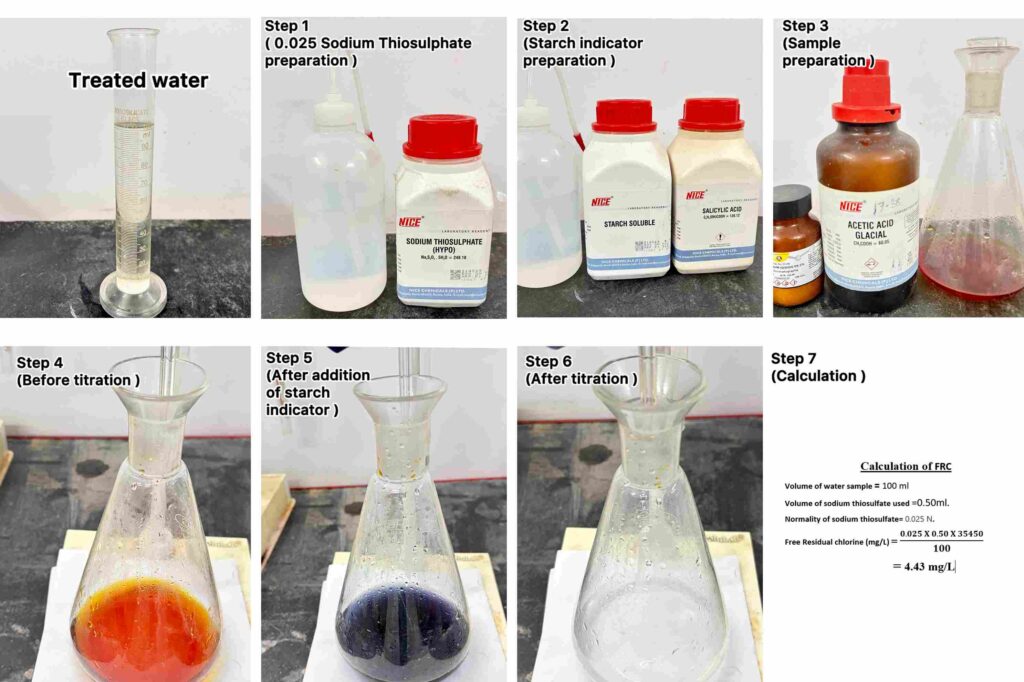
Free chlorine oxidizes potassium iodide (KI) under acidic conditions to liberate iodine (I₂). The liberated iodine is then titrated with standard sodium thiosulfate solution using starch as an indicator. Here we have tasted Treated Water.
Cl₂ + 2KI → 2KCl + I₂
Chemicals Required
- Potassium Iodide (KI)-Reacts with free chlorine in acidic medium to liberate iodine, which is proportional to the chlorine present.
- Glacial Acetic Acid – Provides acidic conditions necessary for free chlorine to oxidize iodide ions effectively.Here we have used the following chemicals/reagents of Researchlab & Nice company. You can use the same company or any other companies.
- Sodium Thiosulfate Solution-Reduces liberated iodine back to iodide during titration; the volume used indicates the amount of free residual chlorine.Preparation described previously.
- Starch Indicator Solution– Forms a blue-colored complex with iodine, helping to detect the end point of the titration.Preparation described previously.
- Distilled Water-Used for reagent preparation and dilution without introducing impurities that may interfere with the reaction.The conductivity of distilled water should be <5 μS/cm to prevent contamination.
Glassware Used
- Burette(50ml)-Allows controlled and accurate delivery of sodium thiosulfate solution during titration.
- Pipette(1ml)-Measures and transfers a fixed and accurate volume of reagents.
- Conical Flask with stopper (250ml)– Provides sufficient space for mixing reagents and performing titration without spillage.
- Measuring Cylinder(100ml)- Used for measuring approximate volumes of water.
Procedure
| Sample taken | Take a measured volume of water sample (usually 100 mL) in a conical flask. |
| Acidification | Add 1 mL of acetic acid to acidify the sample. |
| Addition of KI | Add excess (1 gm) potassium iodide solution. |
| Mixing | Close the flask and mix gently; iodine will be liberated, giving a yellow-brown color. |
| Initial titration | Titrate immediately with standard sodium thiosulfate solution until the color becomes pale yellow. |
| Addition of indicator | Add 1–2 drops of starch indicator; the solution turns blue. |
| Endpoint Detection | Continue titration until the blue color just disappears (end point) |
| Calculation | Residual chlorine(mg/L) =( V1 X N x 35450) /V2 . V1 = Volume of sodium thiosulfate used (mL) N = Normality of sodium thiosulfate V2 = Volume of water sample (mL) |
Purpose of Free Residual Chlorine Testing (Iodometric Method)
- To confirm the presence of adequate residual chlorine for effective disinfection of water.
- To ensure drinking water safety by preventing microbial contamination.
- To monitor the efficiency of water treatment and chlorination processes.
- To verify compliance with drinking water quality standards and regulations.
- To avoid excess chlorine that may cause taste, odor, or health concerns.
- To maintain hygienic conditions in water distribution systems.
Handling Mistakes
- Delaying titration after adding potassium iodide, leading to loss of liberated iodine.
- Adding starch indicator at the beginning instead of near the end point, causing inaccurate results.
- Performing the test in direct sunlight, which can decompose iodine.
- Using unstandardized or improperly stored sodium thiosulfate solution.
- Incomplete acidification of the sample, resulting in poor iodine liberation.
- Contaminated or wet glassware affecting titration accuracy.
- Overshooting the end point due to rapid titration near completion.
Conclusion
The iodometric method is a reliable and accurate technique for determining free residual chlorine in water. By measuring the amount of iodine liberated and titrated with sodium thiosulfate, this method helps assess the effectiveness of water disinfection. Proper handling, timely titration, and correct reagent use ensure precise results, making the iodometric method suitable for routine water quality monitoring and regulatory compliance. Furthermore, if you can’t understand the procedure, you can check our real-time photo attached with this writing, which visually guides you through each step and enhances your understanding. Additionally, for those who prefer professional assistance or require more advanced testing, you can also reach out to Pro Research & Testing Laboratory for testing purposes
Frequently Asked Questions (FAQ)
Q1. What is free residual chlorine?
It is the amount of chlorine remaining in water after disinfection, present as dissolved chlorine, hypochlorous acid, and hypochlorite ion.
Q2. Why is the iodometric method used for chlorine estimation?
Because it is accurate, simple, and based on a well-defined redox reaction.
Q3. Why potassium iodide is added during the test?
Potassium iodide reacts with free chlorine to liberate iodine, which is measured by titration.
Q4. Why starch indicator is added near the end point?
Adding starch early forms a stable complex with iodine, which may cause titration errors.
Q5. What is the end point of the titration?
The disappearance of blue color indicates the end point.
Q6. Can this method be used for wastewater samples?
It is mainly used for drinking and treated water; high organic content may interfere.
Q7. What precautions are essential for accurate results?
Immediate titration, proper acidification, clean glassware, and standardized reagents.
How We Verified This Testing/Research Procedure :
This testing procedure is done under qualified analyst .Continually monitored by expertise.Repeatedly testing is always done to get accurate result.

Written by
Riya Ghosh (M.Sc. Food Technology, MAKAUT)
Designation – Chemist
Reviewed by
Anwesha Das (M.Sc Microbiology,BU)
Designation – Microbiologist
Verified By
Dr. Jyotirmoy Kumar Dey (Phd,Chemistry)
Designation – Senior/Chief Chemist
Experience – 25 Years +