
Gluten is a group of proteins found mainly in wheat, barley, rye, and related grains, and it plays an important role in giving dough its elasticity, helping bread rise, and creating the chewy texture found in many baked goods. While gluten is harmless for most people, it is a serious concern for individuals with celiac disease, for whom even small amounts can trigger an autoimmune reaction that damages the small intestine.Here we are testing Gluten in Flour(Maida).
Instruments ,glasswares used in this testing
- 0.45 micron sieve-It ensures that the sample is free from unwanted particles or impurities, helping achieve uniform and accurate test results.
- Hot Air Oven(105°C)-This controlled dry heat removes moisture from wet gluten to produce dry gluten, allowing accurate measurement of gluten content based on constant weight.
- Evaporating Dish-It holds the gluten during drying in the hot air oven.
- 4 digit Weight Balance-It allows precision measurement which essential for accurate gluten calculations.
- Distilled Water-Pure distilled water ensures that no external chemicals interfere with gluten formation, extraction, or washing.The conductivity of distilled water should be <5 μS/cm to prevent contamination.
Procedure of this testing
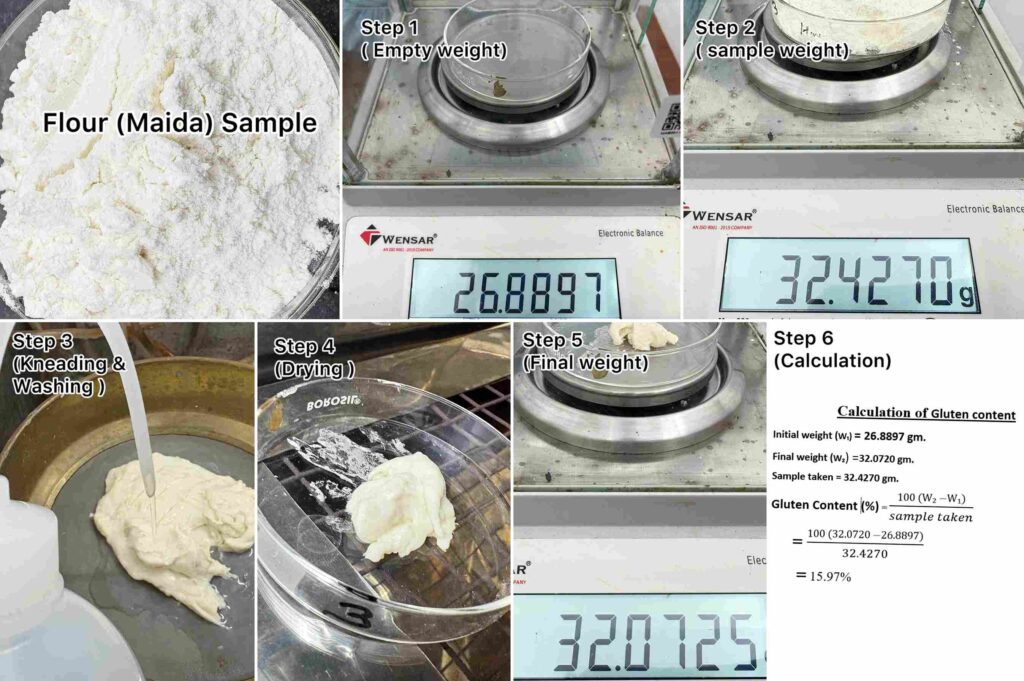
| Dough preparation | Weigh 20 gm- 30 gm of sample in a clean preweighed evaporating dish. Add a small quantity of water and mix well to form a soft dough. Allow the dough to rest for 10–15 minutes to enable gluten formation. |
| Washing | Place the dough in a sieve. Wash the dough gently under slow running distilled water, kneading it continuously. Continue washing until the starch is completely removed and the water runs clear. |
| Drying in Hot Air Oven | A sticky, elastic, rubber-like mass remains after washing. Place the left residue into the hot air oven & drying until complete removal of water content. Take the final weight upto constant. |
| Calculation | Gluten % =100(W2 -W1)/Sample taken |
Why is gluten test essential?
The purpose of gluten testing is to evaluate the quality and functional properties. Gluten is the protein component that gives dough elasticity, strength.
- Assess Dough Quality and Performance:Gluten content indicates how the dough will form, stretch, and rise. Higher gluten leads to stronger, more elastic dough, while lower gluten results in softer, more tender products.
- Ensure Compliance With Quality Standards:Testing ensures the product meets the required specifications as per Standard .
- Monitor Raw Material Consistency:Gluten testing ensures consistency, important for manufacturers and consumers.
- Detect Adulteration or Quality Degradation:Abnormal gluten levels can indicate blending with lower-quality grains or improper processing.
How to Prevent Result Errors in Gluten Testing?
- Using Incorrect Sample Size:Using too little or too much sample can lead to inaccurate gluten yield.Always follow the exact sample weight specified in the testing method.
- Inadequate Mixing of Dough:Improper dough mixing either too short or too long affects gluten development.Mix until the dough is uniform and elastic.
- Incorrect Washing Technique:Over-washing removes gluten; under-washing leaves starch behind.Wash slowly and consistently to isolate gluten properly.
- Using Water at the Wrong Temperature:Water that is too hot or too cold affects gluten formation.Use water at the recommended temperature (usually room temperature,25°C-27°C).
- Poor Sample Storage:Moisture absorption or drying of sample before testing alters results.Store samples in airtight, moisture-proof containers.
- Contamination of Samples:Mixing samples or using unclean equipment can cause wrong readings.Use clean tools and label all samples clearly.
- Not Drying Gluten Fully Before Weighing:For dry gluten percentage, incomplete or excessive drying leads to errors.Dry to constant weight at the recommended temperature.
- Ignoring Instrument Calibration:Uncalibrated balances, ovens, or timers cause inaccurate measurements.Calibrate equipment regularly.
- Recording Errors or Incomplete Documentation:Missing data, wrong units, or transcription mistakes affect final results.Record all weights, times, and conditions carefully.
Conclusion
Gluten testing is an essential part of quality assessment in foods like bread/pasta/cereals/biscuits/cakes, ensuring that the product meets established standards and performs reliably in its intended food applications. By accurately determining gluten levels, manufacturers can maintain consistency, detect adulteration, and produce food with the right functional properties for consumers.Effective gluten testing ultimately supports product quality, safety, and consumer trust.By following these method, you can easily test the gluten of any food products at laboratory & also manufacturing industry with availability of the equipments. If you can’t understand the procedure you can check our real time photo attached with this writing or also you can reach to Pro Research & Testing Laboratory for the advance testing.
FAQ on Gluten Testing
1. What is gluten testing?
Gluten testing is a laboratory procedure used to determine the amount and quality of gluten proteins in food. It helps assess dough strength and ensure compliance with quality standards.
2. Why is gluten testing important?
It determines whether the food will produce good-quality dough and baked products.
3. What factors affect gluten test accuracy?
Water temperature, dough mixing time, washing technique, equipment calibration, sample moisture, and handling mistakes.
4. What mistakes should be avoided during gluten testing?
Avoid incorrect sample weights, poor mixing, over- or under-washing, contamination, wrong drying conditions, and incomplete documentation.
5. How does gluten content impact quality?
Higher gluten gives stronger, more elastic dough (as an example chapati, roti, breads etc). Lower gluten produces softer textures suitable for some bakery items.
6. Can gluten testing detect adulteration?
Yes. Abnormally low or inconsistent gluten levels may indicate mixing with low-protein grains or poor-quality grains.
How We Verified This Testing/Research Procedure :
This testing is done under qualified analysts in our lab.Continually monitored by expertise.Repeatedly testing is always done to get accurate result.

Written by
Anwesha Das (M.Sc Microbiology,BU)
Designation – Microbiologist
Reviewed by
Riya Ghosh (M.Sc. Food Technology, MAKAUT)
Designation – Chemist
Verified By
Dr. Jyotirmoy Kumar Dey (Phd,Chemistry)
Designation – Senior/Chief Chemist
Experience – 25 Years +