
Organic matter in turmeric refers to the naturally occurring carbon-based compounds. It mainly includes carbohydrates, proteins, fibers, essential oils, and pigments such as curcuminoids, which give turmeric its distinctive yellow color and medicinal value. These organic constituents influence the quality, flavor, aroma, and therapeutic properties of turmeric. Assessing the organic matter content helps in determining purity, freshness, and possible adulteration, ensuring that the turmeric meets food safety and quality standards.
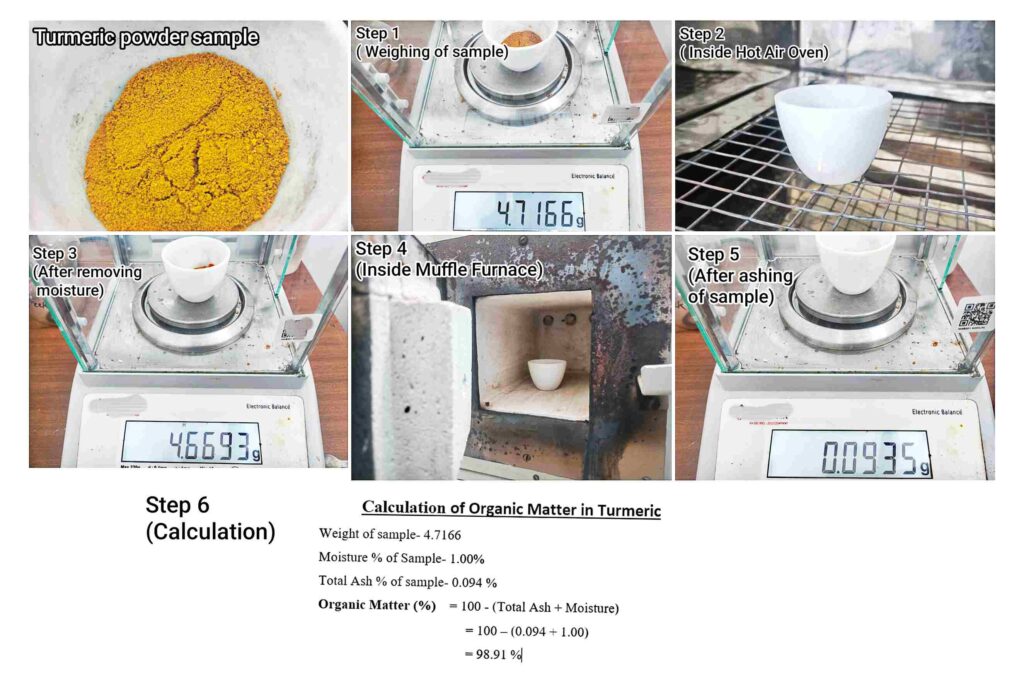
By following the described testing method our lab certified that the product is whether organic or not.
Instruments Used in Organic Matter in Turmeric:
- Analytical Balance– Used to measure very small amount of sample & ash. We use 4 digit balance for this testing.
- Silica Crucible– This high-heat resistant container made of silica, holds the food sample during incineration.
- Hot Air Oven– To dry (at 105°c) the crucible before starting the procedure.
- Muffle Furnace– It incinerates the organic matter at high temperature (600°c-700°c) turns the inorganic residue into ash.
- Tongs-To hold the hot crucible safely without direct contact.
- Desiccator– It maintains moisture free environment to prevent rehydration of ash before weighing. Silica gel are used in the desiccator which absorbs the moisture from the crucible. the color of silica gel change from blue to pink detects that the silica gel has to be replaced by the moisture free beads.
Procedure of Organic Matter Testing in Turmeric :
| Ignition of Sample | Weigh 5-6 gm of sample, Keep it in hot air oven to remove moisture. ( moisture procedure described previously). After then ignite it in muffle furnace. Detailed procedure described previously. |
| Calculation | Calculate by using following formula Organic Matter (%) = 100- (Total Ash + Moisture) |
Purpose of Organic Matter Test in Turmeric :
- To assess the quality and purity of turmeric by determining its natural organic content.
- To claim the product is organic or not.
- To detect adulteration with inorganic compounds (starch, synthetic dyes).
- To evaluate freshness since organic matter decreases with prolonged storage or poor handling.
- To ensure turmeric meets food safety and quality standards as per regulatory requirements.
- To support research and product development in spices and herbal formulations.
Handling Mistakes to Avoid during Organic Matter Testing of Turmeric
- Inaccurate weighing of the sample → Leads to incorrect percentage calculation.
- Using wet or moist sample → Moisture skews the organic matter result. Always use a dry, homogenized powder.
- Using contaminated glassware → Traces of chemicals can react with reagents and alter readings.Proper cleaning Process described previously.
- Overheating → Overheating in muffle furnace (>700°C) can cause loss of volatile minerals (e.g. iron), leading to underestimation.
- Under-heating or incomplete combustion → Improper ignition leaves unburned organic matter, giving lower ash values.
- Disruption→ Opening the muffle furnace while hot causes temperature drop and may crack crucibles or disrupt combustion.
- Safety→ Always use tongs to hold the hot crucible unless it may lead to severe burn.
Conclusion from Organic Matter Test in Turmeric & other products
From the organic matter content, we can conclude the purity, quality, and authenticity of turmeric.High organic matter generally indicates good quality, rich in natural compounds like curcuminoids, oils, and fibers.Low organic matter may suggest adulteration, excessive inorganic impurities, or degradation due to poor storage.It essentially tells us how much of the turmeric or other product is composed of natural plant-derived substances versus non-organic or foreign materials.Here we describe the process for turmeric sample but by following the above-mentioned method, you can easily test the organic matter in any other products also at any laboratory or manufacturing industry with the availability of the equipments.This testing process is crucial for quality control in various applications. Furthermore, if you can’t understand the procedure, you can check our real-time photo attached with this writing, which visually guides you through each step and enhances your understanding. Additionally, for those who prefer professional assistance or require more advanced testing, you can also reach out to Pro Research & Testing Laboratory for testing purposes.
FAQ – Organic Matter Testing of Turmeric
Q1: What is “organic matter” in turmeric?
Organic matter in turmeric refers to plant-based components (like fiber, starch, and other natural residues) derived from turmeric itself or from unwanted plant material.
Q2: Why is organic matter tested in turmeric?
To determine the purity and quality of turmeric powder and ensure it meets food safety and regulatory standards.
Q3: What does low organic matter indicate?
Low organic matter can suggest poor processing, contamination with other plant materials, or adulteration.
Q4: How is organic matter measured in turmeric?
It’s usually determined by a laboratory method involving drying, weighing, and ashing of the sample.
Q5: Can high organic matter affect taste or shelf life?
Yes. Higher organic matter can increases flavor quality by increasing curcumin and may promote slower spoilage due to natural microflora.
Q6. Can this test method is applicable for other products to detect organic matter?
Yes. this test method is applicable for all the products to detect the product is organic.
Q7.How can you claim your product is purely organic in your packaging?
By following the above-mentioned method, the organic matter is tested to claim that the product is organically satisfied or you can also reach out to Pro Research & Testing Laboratory for testing purpose or any other details.
How We Verified This Testing/Research Procedure :
This testing/research is done under qualified analysts in our lab.Continually monitored by expertise.Repeatedly testing is always done to get accurate result.

Written by
Anwesha Das (M.Sc Microbiology,BU)
Designation – Microbiologist
Reviewed by
Riya Ghosh (M.Sc. Food Technology, MAKAUT)
Designation – Chemist
Verified By
Dr. Jyotirmoy Kumar Dey (Phd,Chemistry)
Designation – Senior/Chief Chemist
Experience – 25 Years +