
Iodine Value is a measure of the degree of unsaturation (double bonds) present in fats or oils. For ghee, which mainly contains saturated fatty acids, the iodine value is usually low. Testing Iodine Value helps check purity, quality, and adulteration by detecting unwanted unsaturated oils.
Iodine value is determined by allowing iodine or iodine-generating reagents to react with the double bonds present in fat. The amount of iodine absorbed is measured by titrating the excess iodine with sodium thiosulfate.Here we are testing Iodine value of cow ghee sample.
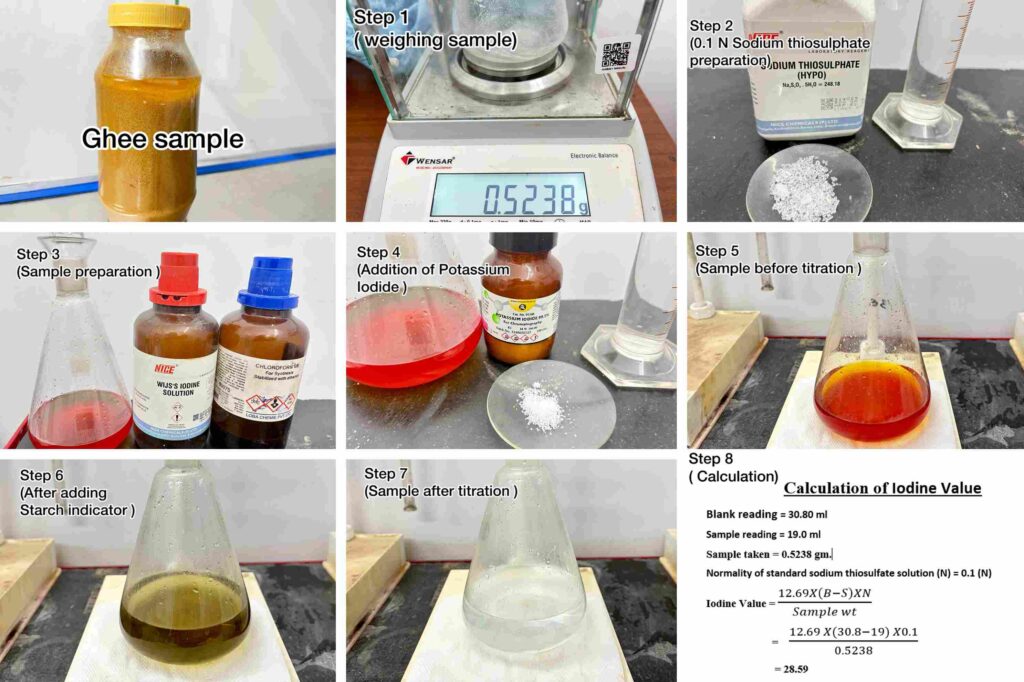
REAGENTS REQUIRED & THEIR WORKING PRINCIPLES:
- Wijs solution (Iodine monochloride in acetic acid)-Provides iodine monochloride that reacts with double bonds in ghee to measure unsaturation.
- Chloroform or carbon tetrachloride (solvent for dissolving ghee)-Acts as a solvent to fully dissolve ghee for proper reaction with reagents.
- Potassium iodide (KI) solution-Releases free iodine from excess iodine reagent for titration. To make the solution add 10 gm KI in 90 ml distilled water.Here we have used all the following chemicals/reagents of Researchlab company. You can use the same company or any other companies.
- Sodium thiosulfate (0.1N)-Titrates the free iodine to determine how much iodine was absorbed by the ghee. Preparation described previously.
- Starch indicator-Forms a blue complex with iodine to clearly show the titration endpoint. Preparation described previously.
- Distilled water-To prepare dilution water,standard Solution & reagent.The conductivity of distilled water should be <5 μS/cm to prevent contamination.
APPARATUS REQUIRED:
- Iodine Flask(500ml)- Used to mix and react ghee with reagents in a closed, light-protected container.
- Burette(50 ml) –Delivers sodium thiosulfate accurately during titration.
- Pipettes (25ml)-Measures and transfers precise volumes of reagents like Wijs solution and KI.
- Measuring Cylinder(100 ml)-Used for measuring larger volumes of water or solvents.
- 4 digit Analytical balance –to weigh ghee and reagents with high accuracy.
TESTING PROCEDURE:
| Sample preparation | Melt ghee gently and ensure it is clear. Accurately weigh about 0.2-0.5 g of ghee into a dry iodine flask. |
| Dissolution | Add 15 mL chloroform and swirl to dissolve the sample completely. |
| Addition of Wijs solution | Add 25 mL Wijs solution. Keep the flask in the dark for 30 minutes to avoid light reactions. |
| Reaction with KI | After 30 min, add 10 mL of potassium iodide solution. |
| Dilution | Add 200 mL distilled water to the mixture. |
| Titration | Titrate the liberated iodine with 0.1 N sodium thiosulfate until the solution turns pale yellow. |
| Starch indicator Addition | Add 2 drops of starch solution. Continue titration until the blue color disappears. |
| Blank titration | Perform the same procedure without ghee to get blank reading |
| Calculation | Iodine Value = {12.69 X (B-S) X N }/ W B = Blank reading S = Sample reading N = Normality of sodium thiosulfate W = Weight of ghee (in grams) 12.69 = Iodine equivalent factor |
PURPOSE OF TESTING:
- To confirm whether the ghee is pure or mixed with cheaper oils.
- To check the freshness and stability of ghee.
- To monitor quality during storage, as unsaturated fats oxidize faster.
- To compare ghee quality with industry and regulatory standards.
- To help manufacturers maintain consistent product quality.
- To detect rancidity risk, since higher unsaturation leads to quicker spoilage.
- To support quality control in dairy laboratories.
- To ensure the product is safe and suitable for consumption.
HANDLING MISTAKES:
- Not keeping the reaction away from light, causing iodine to evaporate or decompose.
- Using wet or dirty glassware, which affects the accuracy of titration.
- Incorrect weighing of ghee, leading to wrong iodine value.
- Using old or expired Wijs solution, reducing reaction efficiency.
- Not dissolving the ghee completely before adding reagents.
- Allowing the sample to stand too long before titration, causing iodine loss.
- Adding too much or too little starch indicator, affecting the endpoint visibility.
- Doing titration too fast, missing the correct endpoint.
- Using air bubbles in burette readings, leading to volume errors.
CONCLUSION:
Iodine value testing of ghee is essential to determine unsaturation levels and detect adulteration. A lower or normal iodine value indicates pure ghee, while a higher value suggests the presence of vegetable oils.By following these method, you can easily test the Iodine value of any ghee at laboratory & also manufacturing industry with availability of the equipments & chemicals. If you can’t understand the procedure you can check our real time photo attached with this writing or also you can reach to Pro Research & Testing Laboratory for the advance testing.
FAQ:
- What does a very low iodine value mean in ghee?
It means the ghee is highly saturated and usually pure, with no added vegetable oils. - Can iodine value detect small amounts of adulteration?
Yes, even a small amount of unsaturated vegetable oil can increase the iodine value. - Why is Wijs solution used in this test?
Wijs solution reacts quickly and accurately with double bonds, giving reliable iodine values. - Why is the test done in the dark?
Because light can break down iodine, leading to lower and incorrect readings. - What happens if the ghee is not melted properly?
Incomplete melting can cause poor mixing with reagents, affecting results. - Is this test required in industry?
Yes, it is used in quality control of dairy and fat-based food products. - .What is the ideal value of Iodine value for pure ghee?
Typically the normal range of Iodine value for pure ghee is 25 – 38. We recommend Iodine value in ghee should be 25-30. - .Can you test Iodine value of other ghee by this method?
Yes, you can test the Iodine value of any ghee like cow ghee,gawa ghee,desi ghee,buffalo ghee,yak ghee etc. by this procedure or you can reach out to Pro Research & Testing Laboratory for further details.
How We Verified This Testing/Research Procedure :
This testing is done under qualified analysts in our lab.Continually monitored by expertise.Repeatedly testing is always done to get accurate result.
Written by
Riya Ghosh (M.Sc. Food Technology, MAKAUT)
Designation – Chemist

Reviewed by
Anwesha Das (M.Sc Microbiology,BU)
Designation – Microbiologist
Verified By
Dr. Jyotirmoy Kumar Dey (Phd,Chemistry)
Designation – Senior/Chief Chemist
Experience – 25 Years +