
Nitrates are compounds made of nitrogen and oxygen that are commonly found in water. They can enter water sources through fertilizers used in agriculture, animal waste, sewage. Although small amounts of nitrates occur naturally, high nitrate levels can be harmful to both humans and the environment. In drinking water, excessive nitrates can be dangerous to infants, while in rivers and lakes they can cause problems such as algal blooms, which reduce oxygen levels and harm aquatic life.
Here we test the nitrate in Drinking Water Sample.
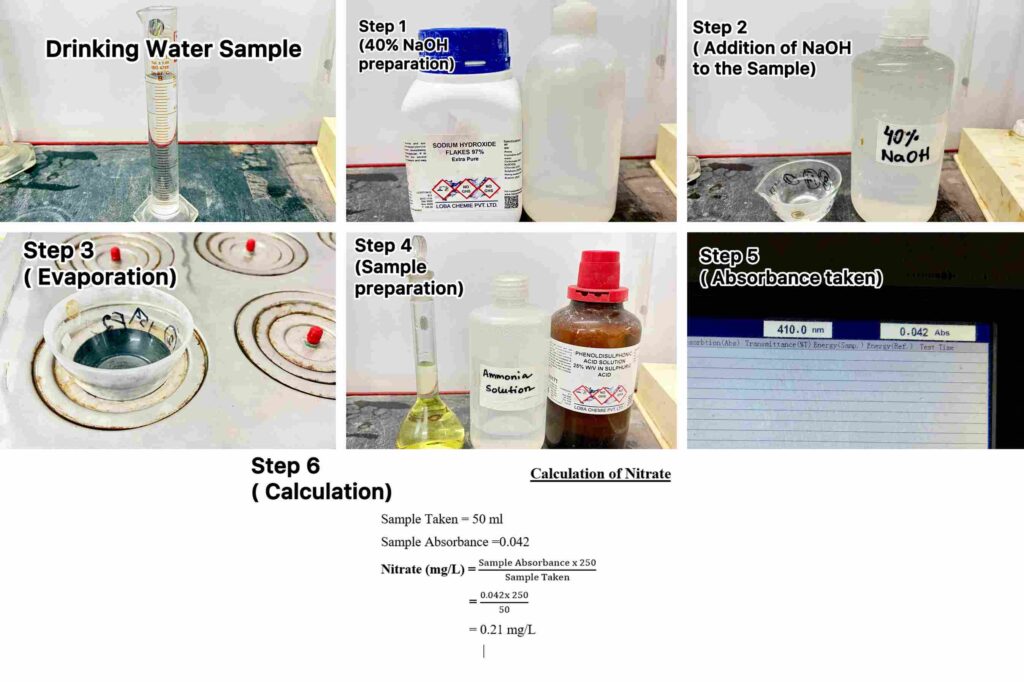
Chemicals Used
- Phenoldisulphonic acid-Used in nitrate testing to react with nitrate ions and form a nitro compound, which produces a yellow color in alkaline medium.
- 40 % Sodium Hydroxide – Used to create a strongly alkaline medium, which is necessary for certain chemical reactions.Dissolve 40 gm NaOH in 100 ml Distilled water.
- Ammonia Solution– It raises the pH of the reaction mixture.An alkaline medium is required for proper color formation.
- Distilled water: Used as a control or for cleaning glassware because it contains no nitrates that could affect results.The conductivity of distilled water should be <5 μS/cm to prevent contamination.
Glassware Used
- Evaporating dish(100 ml) – It holds the water sample during heating and collects the residue after evaporation for weighing.
- Water- bath(100°C)– In a water bath, warm water utilizes to distribute temperature uniformly to samples for incubation
- Measuring cylinder(50 ml)-Measures accurate volumes of water samples or reagents to ensure reliable results.
- Pipette(10 ml)- Allows precise addition of small amounts of reagents to the water sample.
Instruments Used
- Spectrophotometer(410 nm)-Measures how much light is absorbed by the colored solution; higher absorption indicates higher nitrate concentration.
Procedure
Take 50 ml water sample in a evaporating dish.
│
▼
Add 5 mL 40% NaOH & evaporate the water by placed the dish on Water Bath.
│
▼
After complete evaporation add 4 ml Phenoldisulphonic acid & 10 ml ammonia solution.
│
▼
Take a 100 ml volumetric flask & transfer it.Make the volume upto with distilled water
│
▼
Take the absorbance at 410 nm & note the value.
Calculation
Nitrate (mg/L) = Sample Absorbance x 250/ Sample Taken
Purpose of the testing
- To determine the concentration of nitrates present in water samples.
- To assess the quality and safety of water for drinking and everyday use.
- To identify possible sources of water pollution, such as agricultural runoff or sewage.
- To evaluate the potential environmental impact on aquatic ecosystems.
- To compare measured nitrate levels with recommended safety standards.
Handling mistakes that should be avoided during nitrate testing
To obtain accurate results, the following mistakes should be avoided:
- Incomplete evaporation of the sample-Moisture left in the sample can dilute the reaction and reduce color intensity.
- Overheating during evaporation-Excessive heating may decompose nitrate, leading to low results.
- Using impure or contaminated glassware-Residual nitrates or chemicals can give false readings.
- Adding phenoldisulphonic acid to a wet residue-The residue must be completely dry for proper nitration.
- Incorrect amount of alkali (NaOH)-Too little alkali gives weak color; too much may distort color intensity.
- Not allowing sufficient time for color development-Immediate reading can cause inaccurate estimation.
- Exposure to strong light for long periods-Prolonged exposure may fade the yellow color.
Conclusion
The nitrate testing of the given water sample helps determine the presence and concentration of nitrate ions. In the phenoldisulphonic acid method, the development of a yellow color after alkalization confirms the presence of nitrate in the sample.Testing water for nitrates is important because it helps determine water quality and identify possible pollution. By measuring nitrate concentrations, can monitor the impact of human activities on water systems and ensure that water is safe to use. By following these method, you can easily test the nitrate of water at laboratory & also manufacturing industry with availability of the equipments & chemicals. If you can’t understand the procedure you can check our real time photo attached with this writing or also you can reach to Pro Research & Testing Laboratory for the advance testing.
FAQ
1. Why is nitrate tested in water?
To check water quality, since excess nitrate is harmful to human health, especially for infants.
2. Which method is commonly used?
The phenoldisulphonic acid method is commonly used for nitrate testing.
3. What is the role of phenoldisulphonic acid?
It reacts with nitrate to form a nitro compound that produces a yellow color in alkaline medium.
4. Why is NaOH or ammonia added?
To make the solution alkaline and develop the yellow color.
5. What does a yellow color indicate?
Presence of nitrate ions in the water sample.
6. How is nitrate concentration determined?
By comparing the color intensity visually or using spectrophotometer.
How We Verified This Testing/Research Procedure :
This testing is done under qualified analysts in our lab.Continually monitored by expertise.Repeatedly testing is always done to get accurate result.

Written by
Anwesha Das (M.Sc Microbiology,BU)
Designation – Microbiologist
Reviewed by
Riya Ghosh (M.Sc. Food Technology, MAKAUT)
Designation – Chemist
Verified By
Dr. Jyotirmoy Kumar Dey (Phd,Chemistry)
Designation – Senior/Chief Chemist
Experience – 25 Years +