
Wastewater generated from domestic, commercial, and industrial activities often contains significant amounts of oil and grease. These substances originate from sources such as food processing units, restaurants, petroleum industries and households. Oil and grease are not single compounds but a mixture of fats, oils, waxes, and hydrocarbons that are insoluble or only slightly soluble in water.
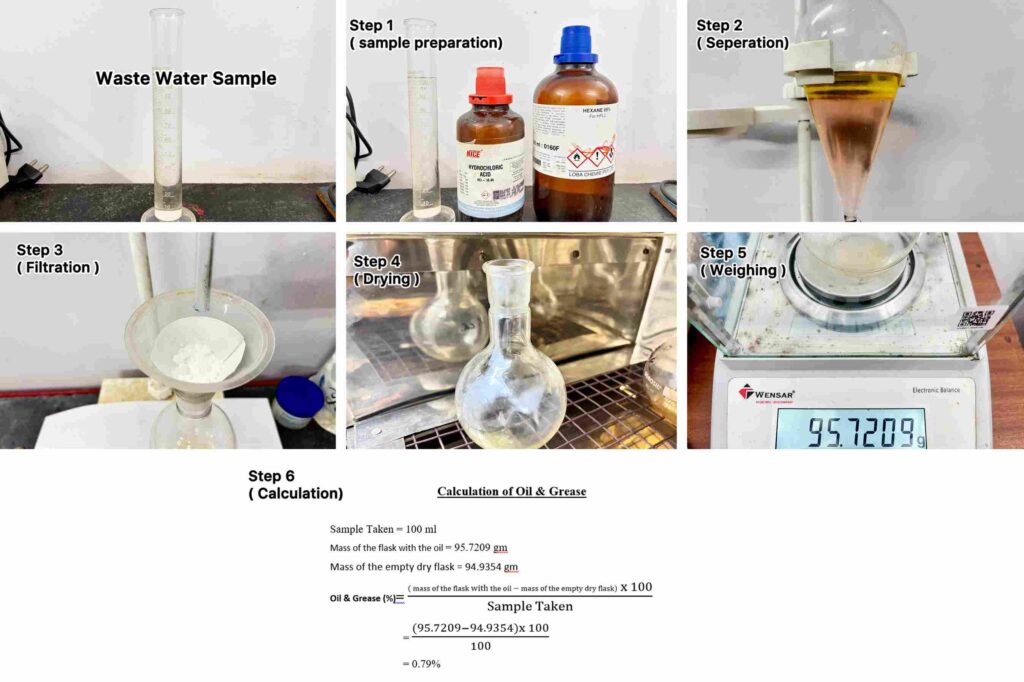
Oil and grease testing is commonly carried out using standardized analytical methods such as solvent extraction technique. Here we have used ETP water sample.
Apparatus Instrument & Glasswares Used
- Analytical Balance(4-digit):Measures the mass of oil and grease residue.
- Separatory funnel(250ml): Separates oil and grease into an organic solvent.
- Hot air oven(85°C): Evaporates solvent at controlled temperature leaving oil and grease residue.
- Desiccator: Prevents moisture absorption of residue before final weighing.
- Measuring cylinder(100ml): Measures accurate volumes of sample and solvent using graduated markings.
- Pipette(1ml): Transfers a fixed, accurate volume of liquid by suction.
- Flat Bottom Flask(250 ml)– For collecting oil content.
Chemicals Used
- Hydrochloric acid (HCl): Acidifies the sample (pH < 2) to break emulsions and improve oil and grease extraction.
- n-Hexane: Acts as a non-polar solvent to dissolve and extract oil and grease from wastewater.
- Anhydrous sodium sulfate (Na₂SO₄): Removes residual moisture from the solvent extract before evaporation.
- Filter paper-Acts as medium to separate undissolved particles from solution by filtration.
Procedure
- Measure a known volume of the sample (usually 100 mL) and transfer it into a separating funnel.
- Collect the wastewater sample in a clean glass bottle and add 1 ml hydrochloric acid to acidify it.
- Add 25 ml of n-hexane to the separating funnel.
- Shake the funnel vigorously for 2–3 minutes, periodically releasing pressure.
- Allow the layers to separate and collect the solvent layer in a clean beaker.
- Repeat the extraction two more times to ensure complete oil and grease recovery.
- Combine all solvent extracts and pass them through anhydrous sodium sulfate to remove moisture.
- Transfer the dried extract to a pre-weighed flask.
- Evaporate the solvent using hot air oven.
- Calculate oil and grease concentration from the weight difference and sample volume.
Calculation
Oil & Grease(%)=[ ( mass of the flask with the oil – mass of the empty dry flask)/ Sample taken for the test]×100
Purpose of Testing
- To determine the concentration of oil and grease present in wastewater.
- To assess the potential impact of wastewater on treatment plants.
- To ensure compliance with environmental discharge standards.
- To identify pollution from industrial or commercial sources.
- To prevent clogging, operational problems, and environmental pollution.
- As per CPCB or any other pollution board it is mandatory to check concentration of oil or grease % in wastewater to evaluate treatment procedure.
Handling Mistakes
- Sample not acidified leads to emulsion formation and poor extraction.
- Spillage during transfer results in analyte loss and low readings.
- Inadequate shaking causes incomplete extraction and lower recovery.
- Collecting solvent too early allows water contamination and inaccurate weighing.
- Moisture not removed adds extra mass and overestimation.
- Overheating extract causes oil loss and underestimation.
- Weighing without desiccator absorbs moisture and gives higher weight.
- Contaminated glassware leaves extra residue and false high readings.
- Leaving solvent exposed causes loss of volatiles and underestimation.
Conclusion
Oil and grease testing determines the presence and concentration of oily contaminants in the sample.The results indicate whether the sample meets regulatory standards and helps assess potential environmental impact.By following these method, you can easily test the Oil & Grease at environmental science laboratory or any laboratory & also manufacturing industry with availability of the equipments & chemicals. If you can’t understand the procedure you can check our real time photo attached with this writing or also you can reach to Pro Research & Testing Laboratory for the testing purposes.
FAQ
1.What is oil and grease testing?
It is an analysis used to measure the amount of petroleum-based and fatty substances present in wastewater.
2. Why is oil and grease testing important?
High oil and grease levels can clog pipes, reduce treatment efficiency, and harm aquatic life if discharged untreated.
3.Which method is commonly used for testing?
The most common method is solvent extraction.
4.What types of oil and grease are detected?
The test detects hydrocarbons, fats, oils, waxes, and other similar substances.
5.What causes high oil and grease levels in wastewater?
Sources include industrial effluents, food processing waste, vehicle washing, and improper disposal of oils.
6.How can oil and grease be reduced in wastewater?
Using oil traps, grease interceptors, proper waste disposal, and effective treatment processes.
How We Verified This Testing/Research Procedure :
This testing is done under qualified analysts in our lab.Continually monitored by expertise.Repeatedly testing is always done to get accurate result.
Written by
Riya Ghosh (M.Sc. Food Technology, MAKAUT)
Designation – Chemist

Reviewed by
Anwesha Das (M.Sc Microbiology,BU)
Designation – Microbiologist
Verified By
Dr. Jyotirmoy Kumar Dey (Phd,Chemistry)
Designation – Senior/Chief Chemist
Experience – 25 Years +