
Peroxide value(PV) testing is a crucial analytical method for determining the level of oxidation in oils and fats. It measures the amount of peroxide compounds, mostly hydroperoxides, that are created during the initial stages of lipid peroxidation when oils react with oxygen.The importance of peroxide value testing lies in its ability to detect early oxidative changes before visible spoilage or rancid odors develop.
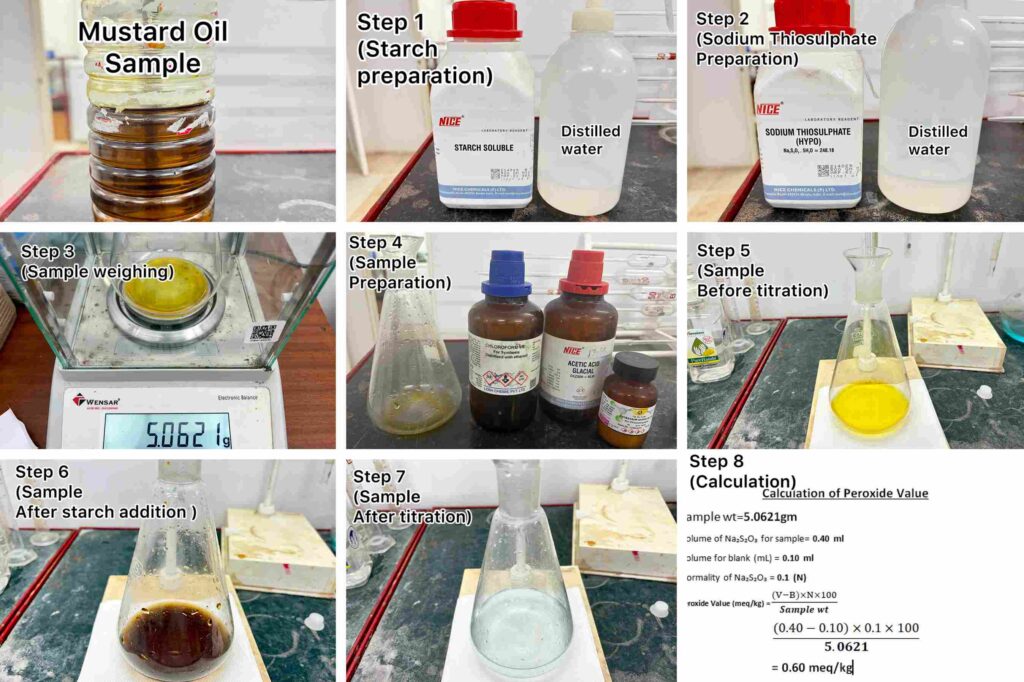
Here We take Mustard oil to peroxide test.
Chemicals & Glasswares used in the Testing of Peroxide Value in Oil & Fat sample
Chemicals:
- Mix Solvent (Chloroform & Glacial Acetic Acid ) -Glacial Acetic acid acts as a solvent for the oil sample.It provides an acidic medium necessary for the reaction.It helps dissolve both oil and other reagents uniformly.Chloroform is a non-polar solvent to dissolve the oil completely.It ensures proper interaction between oil and reagents.To prepare mix solvent mix chloroform with acetic acid in 2:3 ratio.
- Potassium Iodide (KI):Reacts with peroxides in the oil.Liberates iodine (I₂) from iodide ions:
Peroxides + KI → I₂ (liberated iodine)
- 0.1N Sodium Thiosulfate (Na₂S₂O₃):Standard titrant used to measure liberated iodine. Preparation described previously.
I₂ + Na₂S₂O₃ → NaI + Na₂S₄O₆
- Starch Indicator: Forms a blue complex to clearly show the titration endpoint. Preparation described previously.
- Distilled Water:It is used to prepare dilution water,standard Solution & reagent,added after reaction to dilute the mixture.The conductivity of distilled water should be <5 μS/cm to prevent contamination.
Glasswares:
- Stopper Flask(500ml)- Used to mix and react oil with reagents in a closed, light-protected container.
- Burette(50 ml) –Delivers sodium thiosulfate accurately during titration.
- Pipette(1ml)-Measures and transfers precise volumes of reagent like KI.
- Measuring Cylinder(100 ml)-Used for measuring larger volumes of solvents(Acetic Acid & Chloroform).
- 4 digit Analytical balance –To weigh oil and reagents with high accuracy.
Analytical procedure for Peroxide Value determination in Oil & Fat sample
Weigh 5 gm of Mustard Oil Sample
↓
Add Glacial Acetic Acid + Chloroform in 3:2 ratio.Swirl to dissolve oil completely
↓
Add pinch of KI .Keep in Dark (1 minute) with occasionally shaking
↓
Add Distilled Water (30 mL)
↓
Titrate against Na₂S₂O₃
↓
After solution turns into pale yellow color,add Starch Indicator.
↓
Continue Titration.Titrate until the colour changes from blue to Colorless.
↓
Note Volume Used & Calculate Peroxide Value.Perform a blank (without sample)
Calculation of Peroxide Value
Peroxide Value (meq/kg)=(V−B)×N×100/W
Where
- V = Volume of Na₂S₂O₃ for sample (mL)
- B = Volume for blank (mL)
- N = Normality of Na₂S₂O₃
- W = Weight of sample (g)
Significance of Peroxide Value Test in Oil & Fat sample
Peroxide value (PV) testing plays a crucial role in evaluating the quality and stability of oils and fats, especially in food and industrial applications.
- Assessment of Freshness and Quality:Peroxide testing helps determine whether an oil is fresh or has started to oxidize. Low PV indicates good quality, while high PV suggests deterioration and the onset of rancidity.
- Detection of Rancidity:Rancidity affects taste, smell, and safety of oils. PV testing allows early detection before noticeable off-flavors develop, helping prevent consumption of spoiled products.
- Shelf Life Evaluation:Peroxide value is tested to estimate how long an oil can be stored without significant degradation. It helps in setting expiration dates and improving storage conditions.
- Quality Control in Food Industry: PV testing is a standard parameter for ensuring edible oils meet safety and regulatory standards.
- Monitoring Processing and Storage Conditions:Peroxide value indicates how factors like heat, light, and oxygen exposure affect oil stability during processing, packaging, and storage.
- Consumer Safety:Oxidized oils may produce harmful compounds. Regular peroxide testing ensures that oils are safe for consumption and reduces potential health risks.
Care should be taken during the Peroxide value testing
- Avoid exposure to air and light, Oxygen and UV light can artificially increase peroxide formation. Keep samples in dark, airtight containers.
- Test as soon as possible after sampling to prevent further oxidation.
- Use fresh and properly standardized reagents, especially sodium thiosulfate.
- Potassium iodide (KI) should be freshly prepared to avoid oxidation.
- Perform the test in low-light conditions because iodine is light-sensitive.
- Maintain consistent timing after adding reagents—delays can alter results.
- Add starch indicator only near the endpoint, not at the beginning.
- Carefully observe the color change (blue → colorless) for accurate endpoint detection.
- Conduct the test at room temperature(20°C–25°C); extreme temperatures affect reaction rates.
- Avoid moisture contamination,water can interfere with the reaction.
- Use dry, clean, and grease-free glassware.Proper cleaning Process described previously.
- Rinse with solvent (not water) before use to avoid contamination.
- Always run a blank determination with the sample.Perform tests in duplicate or triplicate for reliability.
Summary of the Peroxide Value Analysis of the Oil & Fat Sample
Peroxide value testing is a crucial method for determining the extent of oxidation in oils and fats. Accurate results depend on careful handling of samples, use of fresh reagents, protection from light and air, and precise titration technique. By following proper precautions and maintaining controlled conditions, reliable and reproducible measurements of peroxide value can be obtained, ensuring correct assessment of oil quality and stability.By following these method, you can easily test the Peroxide value of any Oil & Fat at laboratory & also manufacturing industry with availability of the equipments & chemicals. If you can’t understand the procedure you can check our real time photo attached with this writing or also you can reach to Pro Research & Testing Laboratory for the advance testing.
FAQs on Oil and Fat Peroxide Value Testing
- What is peroxide value?
It is the measure of peroxides and hydroperoxides formed during the initial stage of oxidation in oils and fats. - What does peroxide value indicate?
It indicates the extent of primary oxidation and early rancidity in oils and fats. - Why is peroxide value important?
It helps determine the freshness, quality, and storage stability of oils and fats. - What is the principle of peroxide value determination?
Peroxides oxidize iodide ions to iodine, which is then titrated with sodium thiosulfate. - Why is potassium iodide used?
It reacts with peroxides to liberate iodine. - Why is starch added near the endpoint?
To avoid formation of a stable complex early, which can delay endpoint detection. - Why is the reaction carried out in the dark?
To prevent decomposition or loss of iodine due to light. - Why is blank titration necessary?
To correct errors caused by impurities in reagents. - Why should KI solution be fresh?
Old KI may contain iodine, giving falsely high results. - What does a high peroxide value indicate?
The oil or fat is oxidized and may be rancid. - Can peroxide value decrease over time?
Yes, due to breakdown of peroxides into secondary oxidation products. - Can you test Peroxide value of any oil & fat by this method?
Yes, you can test the Peroxide value of any Oil & Fats like cow ghee,gawa ghee,Sunflower oil, Refined oil,cosmetics and lubricants etc. by this procedure or you can reach out to Pro Research & Testing Laboratory for further details
How We Verified This Testing/Research Procedure :
This testing is done under qualified analysts in our lab.Continually monitored by expertise.Repeatedly testing is always done to get accurate result.
Written by
Anwesha Das (M.Sc Microbiology,BU)
Designation – Microbiologist

Reviewed by
Riya Ghosh (M.Sc. Food Technology, MAKAUT)
Designation – Chemist
Verified By
Dr. Jyotirmoy Kumar Dey (Phd,Chemistry)
Designation – Senior/Chief Chemist
Experience – 25 Years +