
The Reichert-Meissl (RM) value of ghee is a measure of the amount of volatile water-soluble fatty acids,present in the fat. It is an important quality parameter used to detect adulteration and to assess the purity and authenticity of ghee. Pure ghee, especially from cow or buffalo milk, contains a high RM value due to its natural fatty acids. Adulteration with vegetable oils lowers the RM value, helping in quality control during production and regulation. We have taken cow ghee for the test.
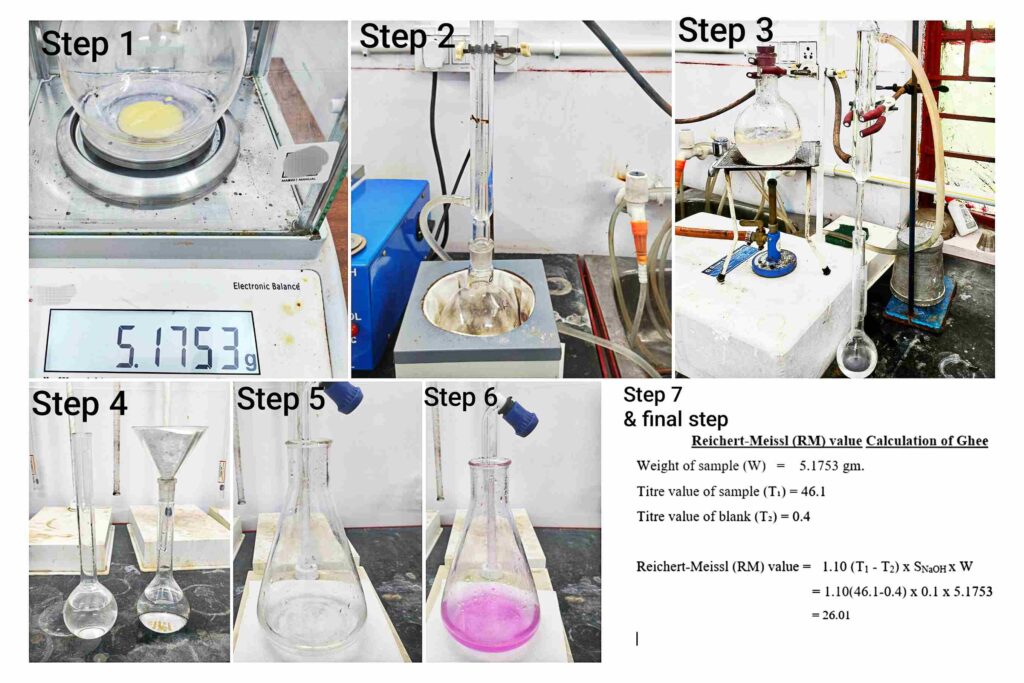
Here we discuss about the detailed procedure about the testing followed in our Lab – ProResearch Testing & Laboratory.
Instruments, Glassware, and Chemicals Used in RM Value Test of Ghee :
Instruments:
- 4 digit Analytical balance – For weighing ghee sample & reagent.
- Heating Mantle -It provides consistent heat (approx 35°C-45°C) during saponification(amount of fatty ester content).
- Bunsen burner – Generate heat during distillation to complete in specific time( approx 20 minutes).
- Water Tap – Provide constant water supply during saponification and distillation to maintain the temperature of condenser.If water flow discontinued then condenser become heated & sample will well out from the condenser.
Glasswares:
- Measuring cylinders (50 ml) -To measure reagent.
- Volumetric Flask – Used as receiver.The receiver shall be a flask with two graduation on the neck, one at 100 ml and the other at 110 ml.
- Pipette (2ml ) : To measure 50% NaOH
- Reflux condenser – For controlled boiling and condensation.
- Flat bottom flask (500 mL) – For carrying out saponification and distillation.
- Still Head – A rubber stopper, fitted below the bulb of the longer arm of the stillhead, and used for connecting it to the flask.It ensures efficient & loss free vapour.
- Burette (50 mL) – For titration purpose.
- Conical flask (250 mL) – For titration reaction.
- Glass Beads – It helps in smooth & controlled boiling. Use to avoid sudden violent bumping of the liquid.
- Funnel along with Wattman 1 Filter Paper – Use to remove impurities,solid residues that may interfere during titration.
Chemicals :
- Glycerol (20 gm) – Use during saponification,ensures that all fats are broken down,freeing the volatile fatty acids that are needed for distillation & titration.,
- 50 % Sodium Hydroxide(NaOH)– Convert ghee into soap and glycerol so that the volatile fatty acids can be later separated and measured. Add 50 gm NaOH in 100 ml of distilled water.
- 0.1 N NaOH – It is used to titrate the distillate containing volatile fatty acids, quantify the amount of volatile fatty acids by neutralizing them. To prepare add 4 gm NaOH in 1000 ml distilled water.
- Dilute(1:1) Sulphuric acid – Liberate volatile fatty acids by acidifying the soap solution, enabling their distillation and measurement in the RM value test. Add 25 ml Sulphuric acid in 25 ml of distilled water.
- Ethyl Alcohol -To run blank sample.
- Phenolphthalein Indicator -Helps in detecting the end point (faint pink color) in titration.To prepare phenolphthalein Indicator add 5 gm Phenolphthalein powder in 95 ml ethyl alcohol.
- Distilled Water -Used to prepare reagent.It is also used to dilute the saponified mixture before acidification.The conductivity of distilled water should be <5 μS/cm to prevent contamination.
Procedure of RM Value Test of Ghee :
| Steps | Details |
| Saponification | Weigh 5 gm ghee sample. Add 20 gm glycerol & 2 ml 50% NaOH solution in it. Reflux under heat condition for 30 minutes. After saponification wash the condenser with hot distilled water. |
| Distillation | After saponification add 50 ml 1:1 H2SO4 to the mixture and heat gently (assure that the solution don’t turn black while distillation.If it turns black stop the heat and add some water and reheat.If some black particle transfer into receiver it become contaminated which can lead to error result.) |
| Filtration | After approx 20 minutes turn off the heat and filter the distillate fatty acid with whatman 1 filter paper to get only soluble fatty acid which is mainly RM Value of ghee. |
| Titration | Take 100 ml of distillate fatty acid into a conical flask & titrate against 0.1 N NaOH.by using phenolphthalein indicator until it become colorless to pink which indicates the end point.Note the titre value & calculate by following formula. For blank(without sample) titre value titrate ethyl alcohol against 0.1 NaOH solution. |
Calculation of RM Value Test of Ghee:
Reichert-Meissl value = 1.10 ( T1 – T2) x SNaOH x W
Where, T1 = Titre value of sample
T2 = Titre value of blank
W = Weight of sample
SNaOH = Strength of NaOH
Purpose of RM Value Test of Ghee :
RM value is a key chemical indicator in food quality control laboratories for verifying the authenticity of dairy fat. Besides this it helps-
- To check purity and quality of ghee by measuring the content of volatile soluble fatty acids.
- To detect adulteration with cheaper oils that have lower RM values.
- To differentiate between genuine milk fat and non-dairy fats or oils.
- To ensure compliance with food standards like FSSAI specifications.
- To maintain consumer safety and trust by verifying product authenticity.
- To assist in standardization and labeling in dairy processing industries.
Handling Mistakes to Avoid During RM Value Test of Ghee :
- Incorrect weighing of ghee sample Leads to wrong RM value calculation.
- Incomplete saponification results in low release of fatty acids. Ensure proper boiling under reflux for 30 mins.
- Loss of distillate vapors volatile acids may escape. Ensure tight condenser connections and efficient cooling.
- Using contaminated or old glassware can introduce impurities and affect results. Always use clean, dry glassware.
- Use controlled heat via heating mantle otherwise overheating during distillation may decompose fatty acids or cause bumping.
- Incorrect titration endpoint detection leads to inaccurate volume. Add NaOH dropwise near endpoint and observe color change.
- Improper acid addition too fast acid addition may cause charring or bumping. Add sulfuric acid slowly with stirring.
- Not using freshly prepared reagents old or degraded reagents affect reaction efficiency. Use freshly prepared NaOH and acid.
- Ignoring temperature control fluctuating temperatures during reflux or distillation affect recovery of volatile acids so maintain uniform heat.
Conclusion of RM Value Test of Ghee :
The RM value test is a reliable chemical method for measuring volatile soluble fatty acids in ghee. RM value as per required amount shows pure milk fat, while a low value indicates non-dairy fats or oils. This test is essential for quality control, authentication, and regulatory compliance in the dairy industry. Proper handling and accurate execution of the procedure are crucial to obtain reliable results. Using the method described above, you can easily conduct the RM Value test in any lab,factory or other locations equipped with the necessary machineries and chemicals.This testing process provides accurate results,which are crucial for quality control in various fields. Additionally, if you find the procedure difficult to follow, you can refer to the real-time photo included with this text,which illustrates each step and simplifies understanding.Furthermore,if you require professional assistance or more advanced testing, feel free to reach out to Pro Research & Testing Laboratory for your testing requirements.
FAQ of RM Value Test of Ghee :
Q1. What is the ideal RM value for pure ghee?
A: The RM value for pure cow ghee is typically 24–28, and for buffalo ghee, it is around 28–35. Lower values may indicate adulteration.We recommend ideal RM value of ghee is 26-32.
Q2. Why is the RM value important?
A: It helps detect adulteration and assess the purity and quality of ghee based on its content of volatile soluble fatty acids.
Q3. Can vegetable oils affect the RM value of ghee?
A: Yes, most vegetable oils have zero or very low RM values, so their addition significantly lowers the ghee’s RM value.
Q4. Why is NaOH & glycerol used in this test?
A: NaOH & glycerol is used for saponification, which breaks down fat into glycerol and soap, releasing volatile fatty acids.
Q5. Why is distillation done in RM value testing?
A: Distillation helps separate and collect the volatile fatty acids after acidification, which are then measured via titration.
Q6. Why maintaining time & heat is important during distillation?
A: By maintaining time & heat are assure that the solution don’t turn black while distillation.If it turns black stop the heat and add some water and reheat.If some black particle transfer into receiver it become contaminated which can lead to error result.
How We Verified This Testing/Research Procedure :
This testing is done under qualified analysts in our lab.Continually monitored by expertise.Repeatedly testing is always done to get accurate result.

Written by
Anwesha Das (M.Sc Microbiology,BU)
Designation – Microbiologist
Reviewed by
Riya Ghosh (M.Sc. Food Technology, MAKAUT)
Designation – Chemist
Verified By
Dr. Jyotirmoy Kumar Dey (Phd,Chemistry)
Designation – Senior/Chief Chemist
Experience – 25 Years +