
High-quality protein, vitamins, and calcium, all essential for the development of health,are found in milk and milk products, which are extremely nutritious. Adulteration of milk is a major problem in modern times.When chemicals like sodium chloride (NaCl) are added to milk to cover up the dilution of water in the milk, the quality of milk is reduced. To hide the adding of water into milk products, salt is added to increase thickness and Solid Non Fat concentration.
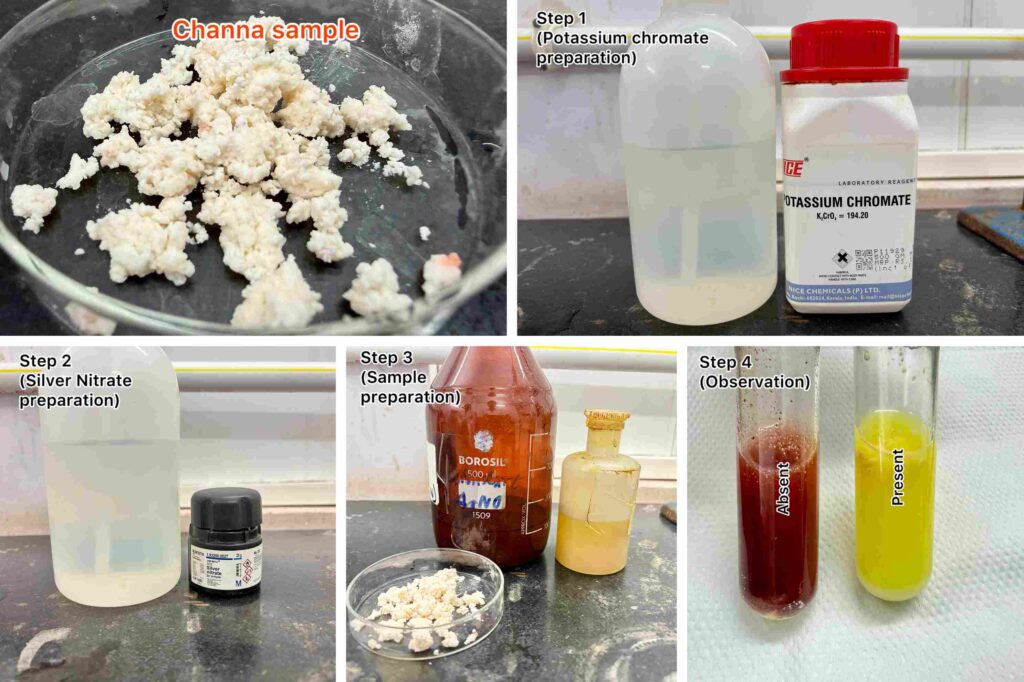
Here we take channa to test the adulteration.
Glasswares & Chemicals used in detection of Sodium Chloride (Nacl) in Milk and Milk products
Glasswares
- Test Tube– To hold the sample.
- Pipette(1ml)– For proper measurement of reagents.
Chemicals
- 0.1N Silver nitrate solution (AgNO3) – Used to react with the chloride in salt to form a visible colour change.Preperation described previously.
- 10% Potassium chromate (K2CrO4) solution – This solution acts as an indicator which helps to change the colour of the solution.Preperation described previously.
- Distilled water– Used to prevent contamination and prepare reagent.The conductivity of distilled water should be <5 μS/cm to prevent contamination.
Testing Method of Sodium Chloride (NaCl) adulteration in Milk & Milk products
Take approximate 5 gm of channa in a clean test tube.
│
▼
Then added 1.0 ml of 0.1 N silver nitrate solution (10%) and mix this mixture properly.
│
▼
After that 0.5 ml of 10% potassium chromate solution added.
│
▼
Then mixed well this preparation and observe colour change.
Observation
- If the sample turns into chocolate-brown that indicates absence of dissolved chloride in channa.
- The appearance of yellow colour indicates the presence of dissolved chloride which shows positive result.
Purpose of Testing for Adding Sodium Chloride (Nacl) in Milk and Milk products
- Detection of adulteration– It is used to detect fraudlant addition of salt which helps to hide of adding water in raw milk.
- Maintaining correct density– It ensures that milk products are not heavy and consists of proper density and Solid-Non-Fat content.
- Shelf life and preservative role– To act as natural shield that stops bad bacteria from growing which prevents channa or any milk products from spoiling.
- Prevent economic fraud :To protect consumers by detecting the unlawful addition of NaCl to enhance volume and density.
- Regulatory compliance : To ensure milk producets must be meet food safety standards.
Handling mistakes must be avoided during Sodium Chloride (NaCl) analysis
- Improper mixing solution leads to inaccurate result.
- Contaminated glassware leads to entry of unwanted chloride which provides false-positive result.Proper cleaning Process described previously
- Using inaccurately prepared silver nitrate and potassium chromate solution affects on accuracy.
- Silver nitrate is highly light sensitive and storing it in clear bottles for a long time can leads to weaken the solution.
- Old sample may not produce a clear colours change which affects on testing.
- Omitting a control sample makes it difficult to comapre and verify the result.
- Over waiting to observe the colour change after adding the reagent can result in colour fading.
Conclusion of testing of added Sodium Chloride (Nacl) in Milk and Milk products
NaCl testing is an important process for ensuring safety and quality.We have followed qualitative test for finding salt in a milk products to detect milk adulteration.The presence of added salt in milk confirms adulteration use to increase thickness.Naturally milk products like channa contains a low concentration of chloride so any significant increases mentions clear adulteration.By following these method,you can easily test the sodium chloride adulteration at any laboratory or manufacturing industry with availability of the equipments & chemicals.If you can’t understand the procedure you can check our real time photo attached with this writing or also you can reach to Pro Research & Testing Laboratory for the testing purposes
FAQ on added Sodium Chloride (Nacl) in Milk and Milk products
1. Which test we have been done for performing this method?
We have done silver-nitrate test for performing this method.
2. Why salt is added to the milk?
Salt is added to increase thickness and SNF content to hide the adulteration of milk products.
3. What does a positive and negative result indicate?
A yellow colour mentions salt is present in milk products and chocolate brown colour indicates there is no presence of added salt.
4. What are the main two reagents used in this test?
The main two reagents are Silver nitrate solution (AgNO3) and Potassium chromate (K2CrO4) solution.
5.Can I test other milk products by this method?
Yes, by this method we can detect adulteration of any milk products like milk, cheese, yogurt,cream etc. or you can reach out to Pro Research & Testing Laboratory for further details.
How We Verified This Testing/Research Procedure :
This testing procedure is done under qualified analyst .Continually monitored by expertise.Repeatedly testing is always done to get accurate result.

Written by
Debopriya Bhattacharya (M.Sc Biotechnology,MAKAUT)
Designation – Junior chemist
Reviewed by
Anwesha Das (M.Sc Microbiology,BU)
Designation – Microbiologist
Verified By
Dr. Jyotirmoy Kumar Dey (Phd,Chemistry)
Designation – Senior/Chief Chemist
Experience – 25 Years +