
Milk is a vital component of the human diet, valued for its high nutritional content, including proteins, fats, vitamins, and minerals. Due to its widespread consumption, milk quality and purity are major public health concerns. However, milk is sometimes adulterated with substances such as starch like corn starch, wheat flour, rice flour, and arrowroot flour,potato starch etc. To increase thickness and falsely enhance the solid content, thereby improving apparent quality and economic gain.
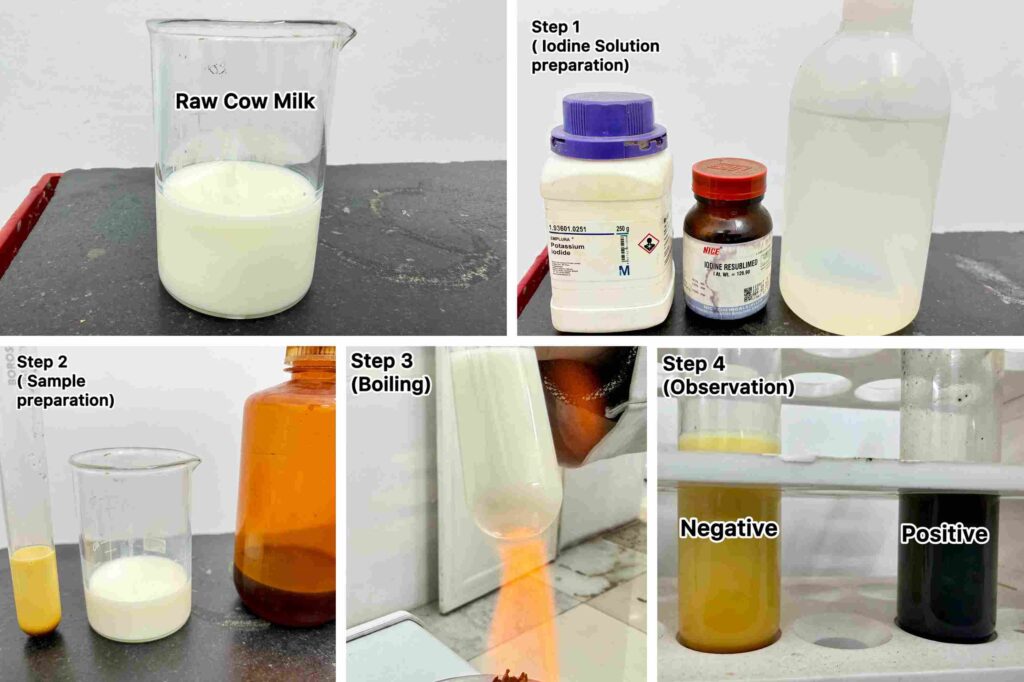
Here we test the Raw Cow milk Sample.
Equipments,Chemicals & Glasswares used in this testing
- Test Tube (15 ml) & Holder – To hold the sample & perform the test.
- Bunsen Burner – To boil the sample.
- Iodine (I)-Acts as a chemical indicator that detects starch adulteration in milk by producing a blue-black color when starch is present.
- Potassium Iodide(KI)– Acts as a solubilizing agent for iodine that enable iodine to react effectively with starch.
- Distilled Water – Used to prepare reagent.The conductivity of distilled water should be <5 μS/cm to prevent contamination.
Starch Testing carried out by following method –
Reagent Preparation
- Iodine solution: Dissolve 2.6 g iodine and 3 g potassium iodide in distilled water and make up to 200 ml.
Procedure
- Take about 5 ml of the milk sample in a clean test tube.
- Bring the sample to boiling and then allow it to cool to room temperature(20°C-25°C)
- Add 1–2 drops of the prepared iodine solution to the cooled milk.
- Mix gently and observe for color change.
Observation
- A blue colour develops if starch is present, indicating adulteration.
- The blue color disappears on boiling and reappears on cooling, which confirms the presence of starch.
Purpose of Testing Milk for Starch
- Maintenance of Nutritional Integrity-To ensure the nutritional value of milk is not compromised by adulterants.
- Detection of Adulteration-To identify the presence of starch added intentionally to increase thickness and apparent quality of milk.
- Verification of Milk Purity-To confirm that milk contains only its natural components and is free from non-dairy substances.
- Consumer Health Protection-To prevent health issues such as indigestion or allergies, particularly in infants and elderly consumers.
- Quality Control in Dairy Industry-To support routine quality checks during milk processing, storage, and distribution.
- Regulatory Compliance-To ensure milk meets food safety standards.
- Prevention of Economic Fraud-To protect consumers from being misled by artificially enhanced milk solids.
Handling Mistakes Which Should Be Avoided During Starch Testing in Milk
- Using Contaminated Glassware-Residual starch or chemicals in test tubes can lead to false positive results.
- Adding Excess Iodine Solution-Using too much iodine may mask the actual color change and affect result interpretation.
- Improper Mixing of Sample and Reagent-Insufficient mixing may prevent uniform reaction, giving inaccurate results.
- Using Expired or Diluted Iodine Solution-Old or improperly stored iodine solution may not produce a clear color change.
- Ignoring Control Samples-Not using a control sample (milk) can make it difficult to compare and confirm results.
- Delay in Observation-Waiting too long to observe the color change may result in fading or misleading results.
Conclusion
The qualitative test for starch in milk is a simple, reliable, and effective method for detecting milk adulteration. Since starch is not a natural component of milk, its presence clearly indicates adulteration intended to increase thickness. The iodine test provides a quick visual confirmation through the characteristic blue or blue-black color formation. Regular application of this test helps ensure milk purity, safeguards consumer health, supports regulatory compliance, and maintains quality standards in the dairy industry.By following these method, you can easily test the starch testing in milk at laboratory & also in manufacturing industries with availability of the equipments & chemicals. If you can’t understand the procedure you can check our real time photo attached with this writing or also you can reach to Pro Research & Testing Laboratory for the advance testing.
Frequently Asked Questions (FAQ) – Starch Testing in Milk
1. Why starch testing is important in milk?
Starch is tested to detect adulteration, as it is not a natural component of milk and is added to increase thickness.
2. What is the principle of starch testing in milk?
The test is based on the reaction between iodine and starch, which produces a blue-black color.
3. Which reagent is used for starch testing?
Iodine solution (iodine–potassium iodide) is used as the detecting reagent.
4. What does a positive result indicate?
A blue or blue-black color indicates the presence of starch in milk.
5. What does a negative result indicate?
No color change (iodine remains yellow-brown) indicates the absence of starch.
6. Why is the milk sample boiled before testing?
Boiling helps dissolve starch completely and improves the accuracy of the test.
7. Is this test qualitative or quantitative?
This is a qualitative test; it detects the presence or absence of starch but does not measure its amount.
8. What are the health risks of starch-adulterated milk?
It may cause indigestion and is particularly harmful to infants, elderly individuals, and people with weak digestion.
How We Verified This Testing/Research Procedure :
This testing is done under qualified analysts in our lab.Continually monitored by expertise.Repeatedly testing is always done to get accurate result.

Written by
Anwesha Das (M.Sc Microbiology,BU)
Designation – Microbiologist
Reviewed by
Riya Ghosh (M.Sc. Food Technology, MAKAUT)
Designation – Chemist
Verified By
Dr. Jyotirmoy Kumar Dey (Phd,Chemistry)
Designation – Senior/Chief Chemist
Experience – 25 Years +