
Food packaging plays a vital role in maintaining the quality, safety, and integrity of food samples from the point of collection to laboratory testing. It helps protect the food from contamination, moisture, physical damage, and environmental factors such as temperature, light, and air. Proper packaging ensures that the sample remains in the same condition as it was at the time of collection, allowing accurate and reliable analytical results.Packaging is very crucial in laboratory testing since even a tiny amount of contamination or spoilage can change the food’s chemical or microbiological composition and result in inaccurate findings.
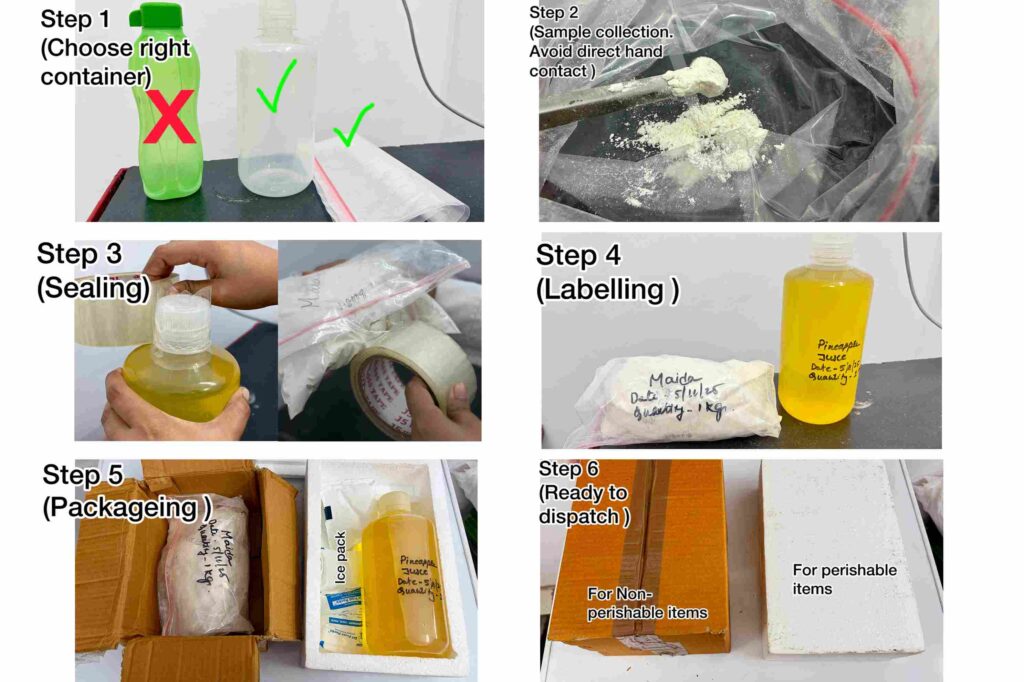
Here’s a detailed explanation of how to package & send perishable and non-perishable food items for quality testing in our Lab
Packaging of Perishable Food Items(Spoil quickly at room temperature)
Milk & milk products, meat, fish, eggs, cooked food, fruits, vegetables,fruit juices,bread & cake items, etc.
Sample Collection
(Collect sample in sterile, airtight containers or pouches.Avoid direct contact of the sample with hands or unclean surfaces)
│
▼
Sealing & Packaging
(Seal the container properly to prevent leakage.Place sealed container in secondary zip-lock or insulated bag)
│
▼
Labelling
(Label the container with sample name, date & type)
│
▼
Icing
(Add ice packs or cooling gel to maintain temperature,2–8°C)
│
▼
Final Packaging & Transportation
(Put all items inside an insulated thermocol box.Add few rounds of tape to ensure no-leakage.
Deliver to the lab as soon as possible (within 24-72 hours) by self /through courier services )
Packaging of Non-Perishable Food Items (Do not spoil easily but still need protection from contamination,moisture & oxidation.)
Cereals, Flour,Canned foods,Wheat flour (atta), Rice, and Pulses,Sugar and Salt,Spices and Condiments (turmeric, chili powder),Edible oils and Ghee,Honey and Jam,Biscuits and snacks,Tea, coffee, and Powdered milk,Dry fruits and nuts,Sauces & Pickles and Packaged foods etc.
Sample Collection
(Collect sample in sterile, airtight containers or pouches.Avoid direct contact of the sample with hands or unclean surfaces)
│
▼
Sealing & Packaging
(Seal the container properly to prevent leakage.Ensure moisture-proof and contamination-free packaging.Place sealed container in secondary zip-lock or insulated bag.)
│
▼
Labelling
(Label the container with sample name, date & type.Send to laboratory at normal room temperature, (20–25°C))
│
▼
Final Packaging & Transportation
(Put all items inside an insulated carton box.Add few rounds of tape to ensure no-leakage.
Deliver* to the lab as soon as possible (within 24-72 hours) by self /through courier services– like-
DTDC , FedEx , Bluedart ,Ecom Express, Delhivery, Ekart Logistics ,Gati (Allcargo Gati).
Also you can contact to Pro Research & Testing Laboratory ,
we can book a courier on behalf of you.)
| *Name of the Indian regions from where you can send the samples to our lab | You can reach to us from anywhere and also from the following regions like- Eastern regions-Kolkata, Dhanbad,Patna,Bhubaneswar,Jamshedpur, Ranchi , Guwahati ,Bihar, Purulia,Bankura,Asansol ,Burdwan,Medinipur, Haldia, Howrah,Siliguri Western regions –Ulhasnagar,Gurgaon,Jalandhar, Solapur,Jodhpur,NaviMumbai,Rajkot,Nashik,Vadodara,Thane,Kota,Nagpur,Jaipur,Surat,Pune,Mumbai, Ahmedabad Northern region –Loni, Aligarh,Bareilly,Moradabad,Amritsar,Aurangabad,Srinagar,Varanasi, Meerut ,Faridabad,Ludhiana,Ghaziabad,Agra, Prayagraj, Lucknow,Kanpur,Delhi Southern region – Gulbarga,Mangalore,Nellore,Guntur,Salem,Mysore,Thiruvananthapuram, Tiruppur,Tiruchirappalli,Coimbatore,Visakhapatnam,Hyderabad,Chennai, Bangalore or you can send from these places also Raipur,Gwalior ,Jabalpur,Bhopal,Indore |
Why Proper Packaging Is Needed Before Sending Food Samples to the Laboratory for Testing?
Proper packaging of food samples is essential to ensure the accuracy, reliability, and safety of laboratory test results. The condition of a sample during transport can directly affect its physical, chemical, and microbiological properties. Therefore, following correct packaging procedures is a critical step before sending any food item to the lab.
- To Prevent Contamination: Proper packing prevents dust, dirt, bacteria, and other external things from entering the food sample and altering its composition. Contamination can cause incorrect results or wrong readings in chemical or microbiological tests.
- To Maintain Sample Integrity: Exposure to air, moisture, or light can cause food to decay, dry up, or react chemically. Packaging ensures that the sample’s original characteristics such as color, odor, texture, and nutrient content are preserved until examination.
- To Preserve Temperature-Sensitive Samples: Perishable items like milk, meat, and cooked food require temperature-controlled packaging with ice packs or insulated boxes to prevent spoilage. Maintaining proper temperature helps ensure the sample remains suitable for testing.
- To Avoid Leakage and Spillage: Leak-proof and sealed containers protect liquid or semi-solid samples from leaking during transport. This not only prevents loss of the sample but also avoids contamination of other samples or damage to transport materials.
- To Enable Proper Identification: Labeled packaging provides important information such as sample name, collection date, source, and type of test required. This helps laboratory personnel handle and process samples correctly without confusion.
- To Comply with Laboratory Standards: Laboratories often have strict guidelines for sample handling. Proper packaging ensures that samples meet standard collection and transport requirements, maintaining the credibility of the testing process.
Precautions During Food Sample Packaging and Transport
- Use Sterile Containers:Always use clean, sterilized, and dry containers to avoid introducing external microorganisms or contaminants into the food sample.
- Avoid Cross-Contamination: Handle each sample separately using new gloves, spoons, or sampling tools for every food item. Never mix different samples in one container.
- Maintain Proper Temperature:Keep perishable items (like milk, meat, and fruits) in ice boxes or coolers (2–8°C) during transport to prevent spoilage.
- Seal and Label Properly:Ensure all containers are airtight and clearly labeled with sample name, source, collection date, and test type before sending to the laboratory.
- Handle Samples Carefully:Protect samples from sunlight, heat, shaking, or physical damage during transport. Always deliver them to the lab as quickly as possible—preferably within 24 hours for perishable foods.
Conclusion
Before laboratory testing, it’s very important to package food samples correctly to get accurate and reliable results. It keeps the sample’s original quality, composition, and freshness while also stopping contamination, leakage, or spoilage during transport. Using the right containers, labeling them correctly, and keeping the right temperature will keep the food sample safe. So, careful and clean packaging not only keeps the sample safe, but it also makes sure that the lab test really shows how safe and good the food is. By following these steps, the true quality of food can be assessed.If you can’t understand the procedure you can check our real time photo attached with this writing or also you can reach to Pro Research & Testing Laboratory.
FAQ (Frequently Asked Questions)
- Why is proper packaging important before sending food samples to the lab?
Proper packaging prevents contamination, spoilage, and leakage. It ensures that the food sample remains in its original condition, allowing accurate and reliable test results. - What type of container should be used for food sample collection?
Use clean, sterile, and airtight containers such as glass bottles, plastic jars, or sealed polythene bags, depending on whether the sample is solid, liquid, or semi-solid. - How should perishable food items be packed?
Perishable items like milk, meat, or cooked food should be packed in insulated boxes with ice packs or cooling gel to maintain a temperature between 2–8°C until testing. - How should non-perishable food items be packed?
Non-perishable items such as flour, cereals, or spices should be packed in dry, moisture-proof, and airtight containers and stored at room temperature. - What information should be included on the sample label?
Each sample should be clearly labeled with sample name, code, collection date, source, and type of test required. - How long can a food sample be stored before testing?
Perishable samples should be tested within 24 hours of collection, while non-perishable samples can be stored for a few days if properly sealed and protected. - What precautions should be taken during transport?
Samples should be transported carefully to avoid exposure to heat, sunlight, or vibration. Always use sealed and leak-proof packaging to prevent damage. - Can one container be used for multiple samples?
No. Each food sample must be collected and packed separately to prevent cross-contamination. - What happens if the sample is not packed properly?
Improper packaging can lead to spoilage, contamination, or inaccurate test results, making the analysis invalid.

Written by
Anwesha Das (M.Sc Microbiology,BU)
Designation – Microbiologist
Reviewed by
Riya Ghosh (M.Sc. Food Technology, MAKAUT)
Designation – Chemist
Verified By
Dr. Jyotirmoy Kumar Dey (Phd,Chemistry)
Designation – Senior/Chief Chemist
Experience – 25 Years +
Verified By
Tathagata Talukdar (M.Sc,Microbiology) University of Calcutta
Designation – Senior/Chief Microbiologist
Experience – 12 Years + of experience including medical microbiology (NABL 15189) and general microbiology (NABL 17025)