
Sucrose determination in honey is an important quality-control test used to assess purity and detect possible adulteration. Honey naturally contains very low sucrose because most of the sucrose from nectar is enzymatically converted into glucose and fructose by bees. Fehling’s method is a classical analytical technique that measures reducing sugars based on their ability to reduce cupric ions (Cu²⁺) to cuprous oxide (Cu₂O). Since sucrose is a non-reducing sugar, its amount is determined indirectly by measuring reducing sugars before and after acid inversion. The increase in reducing sugar after hydrolysis corresponds to the sucrose originally present in the honey. This method is simple, reliable, and widely used in routine laboratory analysis of honey quality. Here we have used raw honey.
Apparatus & Chemicals Used For the Test
- Burret(50 ml)- Used to hold sample solution during titration with precise measurement. It ensures accurate control of solution volume added.
- Pipette(5 ml)-Used to measure and transfer the desired volume of solution accurately. Essential for standardization and sample handling.
- Volumetric Flask(100ml,250 ml)– Used to prepare or dilute solutions to an exact volume. Provides high accuracy in quantitative analysis.
- Conical Flask(100 ml)- Holds Fehling’s solution during boiling and titration.
- Bunsen Burner-Provides a constant flame for boiling the solution. Maintains uniform heating during titration.
- Hot Plate -Used to warm or maintain the solution at required temperature 60-70°c.
- Watch Glass– To covers beakers to prevent contamination or evaporation.
- Beaker(250 ml)-To hold or mix solutions & for warming or preparing solutions.
- pH Meter-Measures whether the solution is neutral or adjusted correctly. Ensures proper conditions after inversion.
- Analytical Balance(4-digit)-Used to measure precise weight of chemicals. Accuracy in weighing ensures correct reagent strength.
Chemicals Used
- Copper sulphate solution ( Fehling’s Solution A)– Preparation Previously described
- Potassium Sodium Tartrate(Fehling’s Solution B)-Preparation Previously described
- Sucrose solution-Reference solution to standardize Fehling’s factor. Ensures accuracy of sugar estimation.
- Hydrochloric acid– Hydrolyzes sucrose into glucose and fructose. Converts non-reducing sugar into reducing sugars.
- C12H22O11 (Sucrose) + H2O(Water) → C6H12O6 (Glucose) +C6H12O6(Fructose) [Hydrolysis with Dilute HCl]
- Sodium carbonate– Neutralizes excess acid after inversion. Helps to maintain the solution near pH 7 for correct titration conditions.
- Methylene blue indicator– Acts as an indicator, turning colorless once all Cu²⁺ is reduced,signals the endpoint of the titration clearly.Here we have used all the following chemicals/reagents of Researchlab company. You can use the same company or any other companies.
- Distilled water -To make the reagent.The conductivity of distilled water should be <5 μS/cm to prevent contamination.
Procedure-
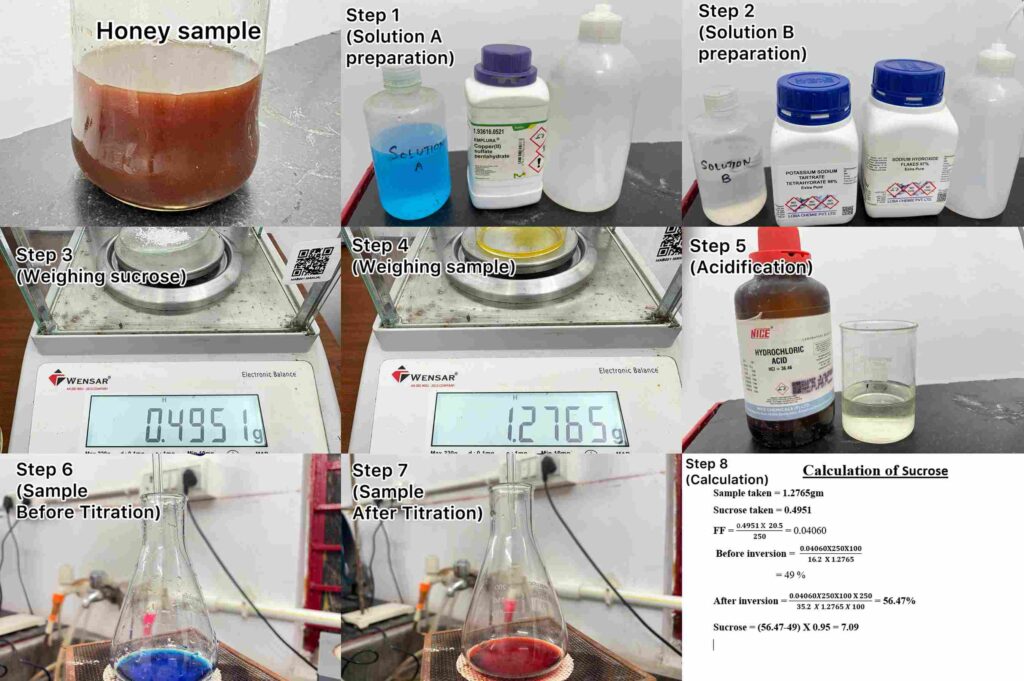
| Step-1 | The invert sugar/sucrose is weighed (0.4750gm approx) and taken in a beaker dissolved in distilled water 1 ml HCL ( used to breakdown the non- reducing sugar) is added and boiled gently and kept aside for overnight. |
| Step-2 | Approximately 1 gm honey sample is taken in 250ml volumetric flask and and volume make up to the mark with distilled water(Before inversion).Take 100 ml from it, add 1 ml HCL and boil gently(After inversion). kept overnight. |
| Step-3 | After 24 hrs maintain pH-7 of invert sugar with sodium carbonate as the medium is acidic & volume make up to 250ml. |
| Step-4 | Titrate the solutions as mentioned previously. |
| Step-5 | Calculate according to the formula. Fehlings Factor(FF) mentioned previously. Before inversion = (FF X volume make up X 100) / (titre value X sample taken) After inversion = (FF X volume make up X 100 X final volume ) / (titre value X sample taken X taken volume) Sucrose(%)= (After inversion – Before inversion) X 0.95 |
Purpose of Testing Sucrose in Honey (Fehling’s Method)
- To check the purity of honey, since genuine honey naturally contains very low sucrose.
- To detect adulteration, especially addition of cane sugar, sugar syrup, or invert syrup.
- To ensure honey meets food-quality standards, as regulatory limits often specify maximum sucrose content.
- To assess proper honey maturation, because immature or improperly processed honey may retain higher sucrose levels.
- To evaluate the effectiveness of natural enzymatic inversion carried out by bees during honey formation.
- To support quality grading and labelling, ensuring the product is safe, authentic, and compliant for market sale.
Handling Mistakes in Sucrose Determination of Honey
- Not homogenizing the honey properly before sampling, leading to uneven sugar distribution and incorrect results.
- Overheating while liquefying crystallized honey, which can degrade sugars and falsely alter reducing sugar values.
- Improper standardization of Fehling’s solution, causing inaccurate reducing sugar calculations.
- Incomplete inversion of sucrose during acid hydrolysis, resulting in underestimation of sucrose content.
- Failure to completely neutralize the hydrolyzed sample, as residual acid interferes with Fehling’s reaction.
- Incorrect endpoint detection when observing the disappearance of the blue colour or formation of brick-red Cu₂O.
- Boiling too vigorously, causing sample loss or splashing, which affects sugar concentration.
- Using dirty or contaminated glassware, which can trigger unwanted side reactions or alter titration results.
- Skipping blank determination, leading to uncorrected reagent contributions and systematic errors.
- Allowing Fehling’s A and B to sit mixed for too long, since the mixture deteriorates quickly and must be prepared fresh.
Conclusion
Sucrose determination in honey using Fehling’s method is a reliable classical technique that measures the increase in reducing sugars after acid inversion. Since pure, mature honey naturally contains very little sucrose, this test helps assess the authenticity, quality, and proper processing of the product. Accurate inversion, careful neutralization, and proper standardization of Fehling’s solution are essential for dependable results. Overall, the method effectively detects adulteration with cane sugar or syrups and ensures that honey meets regulatory purity standards.By following these method, you can easily test the sucrose of any honey products at laboratory & also manufacturing industry with availability of the equipments & chemicals. If you can’t understand the procedure you can check our real time photo attached with this writing or also you can reach to Pro Research & Testing Laboratory for the advance testing.
Frequently Asked Question
1.Why do we determine sucrose in honey?
To check purity and detect adulteration. Genuine honey contains very low sucrose because bees convert most of it into glucose and fructose.
2.Why is sucrose measured indirectly in Fehling’s method?
Because sucrose is a non-reducing sugar and cannot reduce Fehling’s solution. It must first be hydrolyzed (inverted) into glucose + fructose, which are reducing sugars.
3.Why must Fehling’s A and B be freshly mixed?
The mixed reagent is unstable and loses oxidizing power quickly. Using fresh mixture ensures accurate endpoint detection.
4.What causes high sucrose results?
Incomplete inversion, poor homogenization, adulteration with sugar syrup, or immature honey.
5.Why is neutralization after inversion important?
Residual acid interferes with Fehling’s reaction and may reduce the copper ions incorrectly.
6.What is the colour change in Fehling’s test?
Blue solution (Cu²⁺) → brick-red precipitate of cuprous oxide (Cu₂O) when reducing sugars are present.
How We Verified This Testing/Research Procedure :
This testing procedure is done under qualified analyst .Continually monitored by expertise.Repeatedly testing is always done to get accurate result.

Written by
Riya Ghosh (M.Sc. Food Technology, MAKAUT)
Designation – Chemist
Reviewed by
Anwesha Das (M.Sc Microbiology,BU)
Designation – Microbiologist
Verified By
Dr. Jyotirmoy Kumar Dey (Phd,Chemistry)
Designation – Senior/Chief Chemist
Experience – 25 Years +