
Surface swab testing is a microbiological sampling technique used to assess the cleanliness and hygienic condition of environmental and equipment surfaces. It is an essential component of environmental monitoring programs in laboratory. The procedure involves collecting microorganisms from a defined surface area using a sterile swab, followed by microbiological analysis to determine the presence and number of viable microorganisms.
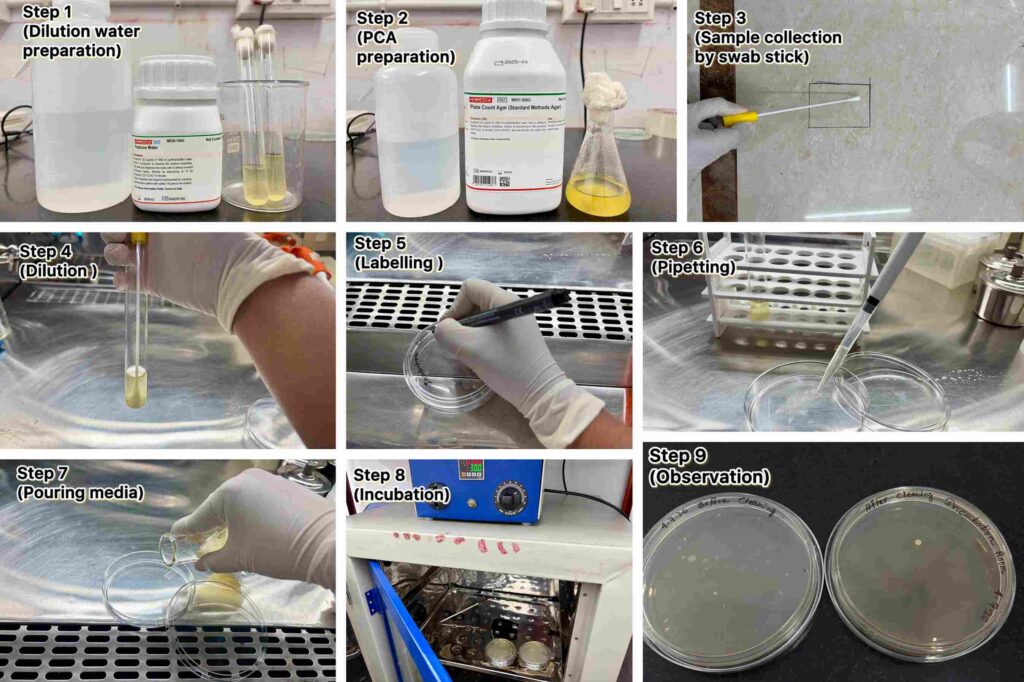
This testing can be done after or before fumigation as well as after cleaning & mopping also. Here we have test before & after mopping the floor(Incubation Area) with disinfectant.
Materials Required For Surface Swab Testing:
- Sterile cotton swab stick-Sterile cotton swab sticks are primarily used to collect surface samples for microbiological analysis.
- Sterile test tube containing sterile diluent(Dilution water) – To moisten the swab stick.Dilution water Preparation process described previously.
- Personal protective equipment (gloves, lab coat, mask)– To prevents the contamination.Bare hands can contaminate the equipments which affect the result accuracy. If you don’t wear gloves & masks can affects on analyzer’s body also.
- Test tube(15ml) & Conical Flask-To hold the dilution water & media.
- Distilled Water : To prepare media,distilled water should be autoclaved & contamination free.The conductivity of distilled water should be <5 μS/cm.
- Petri plate & Micropipette(1ml)– To hold the Agar and transfer the culture microorganisms.Here we used Plate Count Agar as media.Preparation process described previously.
- Bio Safety Cabinet: Used to conduct the process in a sterile area for safety.
- Bacteriological Incubator(30°C ±1): Incubators are equipment used in biological laboratories to grow, maintain or revive bacteria or microorganisms.Incubators have specific temperature range optimum for growth and aerobic or anaerobic conditions. Incubators are also available with shelves & fan with specific distance to ensure uniformity of temperature throughout the chamber.
- Autoclave : For sterilization of equipments & media at 121°C & 15 lbs pressure( it is the minimum & standard temperature which kill microorganism & its spore) and for disinfection of all equipments at same temperature & pressure after completion of testing.
- 4 digit Weight Balance : To weigh the media that supports the growth of bacteria.
Method For Surface Swab Testing:
| Step-1 | Wear Personal protective equipment (gloves, lab coat, mask) to prevents the contamination. |
| Step-2 | Make 10 ml dilution water in test tube. Label the tubes & Petri dishes with the sample location, date, and time. Open the sterile swab without touching the swab stick. Moisten it with sterile diluent. |
| Step-3 | Gently press the swab against the inside wall of the tubes to remove excess liquid. |
| Step-4 | Mark the area(100 cm²) Rub the swab flat against the surface in a horizontal, unidirectional motion (left to right). |
| Step-5 | Carefully place the swab stick into the test tube. |
| Step-6 | Then take 1ml sample into a sterile petriplate and pour the plate with plate count agar.Immediately and gently swirl the plate clockwise and anticlock wise direction to mix the sample and agar evenly. Allow the plate to solidify for about 15 minutes. |
| Step-7 | Invert the Petri dish and incubate at the temperature at 30°C ±1for 24 to 48 hours. |
Importance of Surface swab Testing :
- It is preventing cross contamination.
- It identifies invisible pathogens.
- It is essential for verifying cleaning efficacy.
- It Confirms that cleaning and disinfection procedures have successfully redueces microorganisms.
- It demonstrates that manufacturing and laboratory processes are under control.
- Reduces the risk of product spoilage and health hazards caused by microbial contamination.
Handling Mistakes During Surface Swab Test:
- Using contaminated glassware or equipment.Glasswares should be cleaned properly as mentioned earlier.
- If the swab stick drops onto a non-sterile surface or the floor, it must be thrown away.
- Hand, glove, or clothing touches the swab stick before sampling, it is contaminated.
- Sampling area should be 100 cm².
- Ensure the swabstick is sterilize before testing.
- Wear appropriate PPE and maintain aseptic technique.
Conclusion Of Surface Swab Analysis:
Surface swab testing results indicate the effectiveness of cleaning and sanitation practices within the facility. The absence of microorganism within acceptance limits confirms that the cleaned surfaces are hygienic and suitable for production activities. Regular surface swab monitoring provides assurance that contamination risks are effectively controlled. By following these method,you can easily do the surface swab testing procedure at any laboratory or manufacturing industry with availability of the equipment & chemicals.If you can’t understand the procedure you can check our real time photo attached with this writing or also you can reach to Pro Research & Testing Laboratory for the testing purposes.
FAQ related to Surface swab testing:
What is the Surface swab testing ?
Surface swab testing is a sampling method used to collect microbial contamination.
What is the standard sample area for a surface swab test?
A standard area is 100 cm² for surface swab test .
What is the typical incubation temperature and duration for bacterial culture?
The plates are generally incubated at 30°C ±1 for bacteria.
How is contamination prevented during swabbing?
Technicians must use proper Personal Protective Equipment (PPE),collect the sample carefully and also used the sterile swab for sample colletion.
Which of the microbial procedure is typically performed on a surface swab test?
Total Plate Count (TPC) or Aerobic Plate Count is typically performed on a surface swab test.
How We Verified This Testing/Research Procedure :
This testing procedure is done under qualified analyst .Continually monitored by expertise.Repeatedly testing is always done to get accurate result.

Written by
Ankita Samanta (M.Sc Microbiology,Vidyasagar University)
Designation – Junior Microbiologist
Reviewed by
Anwesha Das (M.Sc Microbiology,BU)
Designation – Microbiologist
Verified By
Tathagata Talukdar (M.Sc,Microbiology) University of Calcutta
Designation – Senior/Chief Microbiologist
Experience – 12 Years + of experience including medical microbiology (NABL 15189) and general microbiology (NABL 17025)