
Ammonium sulfate is a highly water-soluble, odorless inorganic salt. Milk with added water has lower density,so ammonium sulphate addition can increases the density,showing the milk is thick and pure.This testing helps to ensures product quality,detect adulteration & maintain safety as per regulations.
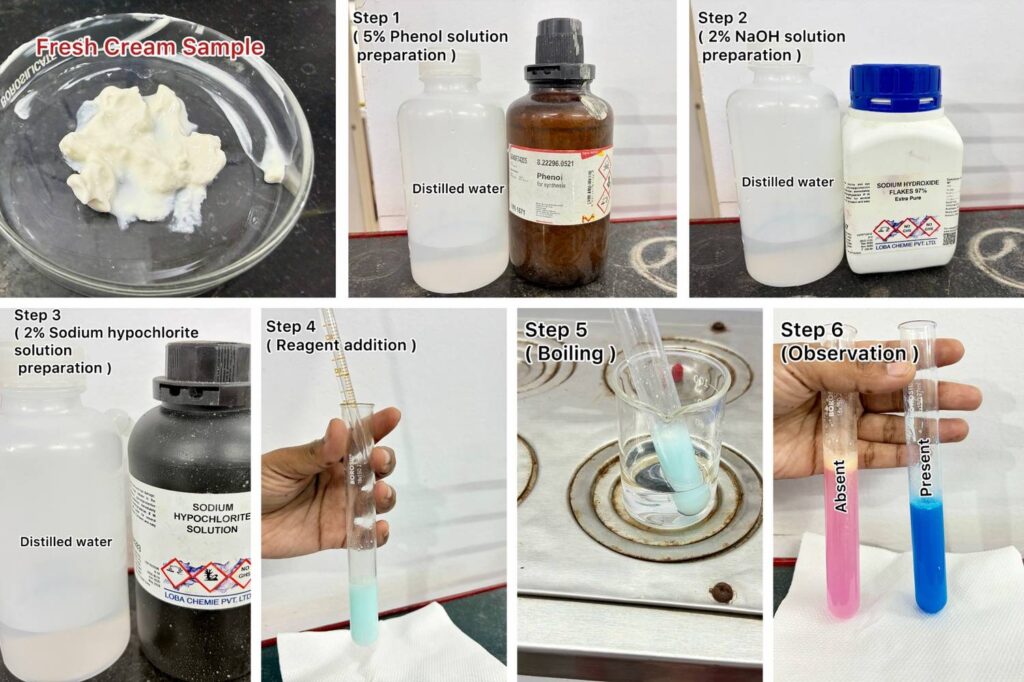
In our lab ,We followed the chemical colour test for detection of Ammonium Sulphate. Here We take Fresh Cream as a sample.
Chemicals & Equipments Used During Testing for detection of Ammonium Sulphate:
Chemicals Used
- Sodium Hydroxide(2%) : Take 80 ml distilled water, add 2 gm of sodium hydroxide pellets . After that make up the volume to 100 ml.It provides an alkaline medium to release ammonia gas from ammonium sulphate present in milk, helping in its detection.
- Sodium Hypochlorite(2%) : Take 40 ml of Sodium Hypochlorite and add 60 ml distilled water. It is used as an oxidizing reagent.It reacts with ammonia released from ammonium compound to participate in color-producing reactions used for detection.
- Phenol(5%) : Phenol helps create a blue colour in the test which indicates the presence of Ammonium.Add 5 ml phenol in 95 ml distilled water.
- Distilled Water :It is used to prepare reagents used during testing.The conductivity of distilled water should be <5 μS/cm to prevent contamination.
Equipments Used
- Digital Water Bath (100°C) : Digital water bath is used for boiling the mixture of sample.
- 4 digit Analytical Balance: To measure the accurate weigh of sample and reagent.
- Test Tube(15ml) : It is used to keep the sample mixture during testing.
- Pipette(1ml) : Pipettes are used to transfer a precise volume of the sample and reagents into a beaker.
Procedure to Follow While Doing Ammonium Sulphate Detection Test of Milk & Milk Products:
Take 1.0gm of sample in a test tube.
│
▼
Add 0.5 ml of 2% sodium hydroxide, 0.5 ml of 2% sodium hypochlorite and 0.5 ml of 5% phenol solution in it.
│
▼
After that boil the mixture with the help of water bath for 20 sec.
│
▼
Observe the colour change of sample mixture.
│
▼
If bluish colour turns deep blue that indicates the presence of ammonium sulphate. The
development of pink colour shows that the sample is free from Ammonium sulphate.
Purpose of Ammonium Sulphate Detection testing In Milk & Milk Products:
- Ammonium sulphate testing in milk & milk products identifies the adulterant.
- The test ensures food safety, protects public health, and verifies the nutritional quality of dairy products.
- Dishonest vendors mix it into milk & water, with the help of this test we identify it.
- Ammonium Sulphate detection testing confirms the actual quality of the product .
- To maintain the quality of product in every batches.
Handling Mistakes should avoided during analysis of Ammonium Sulphate Detection In Milk & Milk Products :
- Using the dirty Container & Glass wares can hamper the testing result. Proper cleaning Process described previously
- Using too much or too little sample can lead to inaccurate result .
- Due to incorrect heating affects colour release.
- Using incorrectly prepared solutions affects result accuracy.
- Using too much or too little reagents can lead to inaccurate result .
- Old sample may not produce a clear colours change which affects on testing.
Conclusion of Ammonium Sulphate detection testing In Milk & Milk Products:
Ammonium sulphate testing in milk & Milk products identifies adulterant. Dishonest vendors mix ammonium sulphate into milk alongside water. The test ensures food safety, protects public health, and verifies the nutritional quality of the dairy Products.By following these method,you can easily test the Ammonium Sulphate adulteration in all types of milk products like Whipped Cream, dahi, Channa, Paneer, Cheese,Ice-cream etc. at any laboratory or manufacturing industry with availability of the equipment & chemicals.If you can’t understand the procedure you can check our real time photo attached with this writing or also you can reach to Pro Research & Testing Laboratory for the testing purposes.
FAQ on Testing Procedure For Detection of Ammonium Sulphate In Milk & Milk Products :
Q. Which test we have been done for performing this method?
A. We have done Chemical colour test for performing this method.
Q. Why Ammonium Sulphate is added to the milk?
A. Adding ammonium sulphate increases the density,showing the milk is thick and pure.
Q. What does a positive and negative result indicate?
A. Dark blue colour indicates the presence of ammonium sulphate. The development of pink colour shows that the sample is free from Ammonium sulphate.
Q. What mistake may affect the result during the test?
A. Insufficient addition of reagents may cause improper colour development.
Q. Why boiling is important in this testing?
A. Boiling is important in testing for ammonium compounds in milk because heat helps release ammonia gas (NH₃) from ammonium salts or adulterants present in the milk.
Q. Can I test other any milk products by this method?
A. Yes, by this method we can detect adulteration of any milk products like milk,whipped Cream, dahi, Channa, Paneer,ice-cream,cheese, yogurt etc. or you can reach out to Pro Research & Testing Laboratory for further details.
How We Verified This Testing/Research Procedure :
This testing procedure is done under qualified analyst .Continually monitored by expertise.Repeatedly testing is always done to get accurate result.

Written by
Ankita Samanta (M.Sc Microbiology,Vidyasagar University)
Designation – Junior Microbiologist
Reviewed by
Anwesha Das (M.Sc Microbiology,BU)
Designation – Microbiologist
Verified By
Dr. Jyotirmoy Kumar Dey (Phd,Chemistry)
Designation – Senior/Chief Chemist
Experience – 25 Years +