
Caffeine , which is a natural compound,found in coffee , tea ,cocoa products.Caffeine works as a stimulating agent.Testing the caffeine content in coffee ensures accurate labeling for consumer safety, and product consistency.Caffeine in coffee acts as a stimulant, providing physical benefits, including improved mood, and enhanced focus.
Here we take grounded coffee to determine the caffeine content.
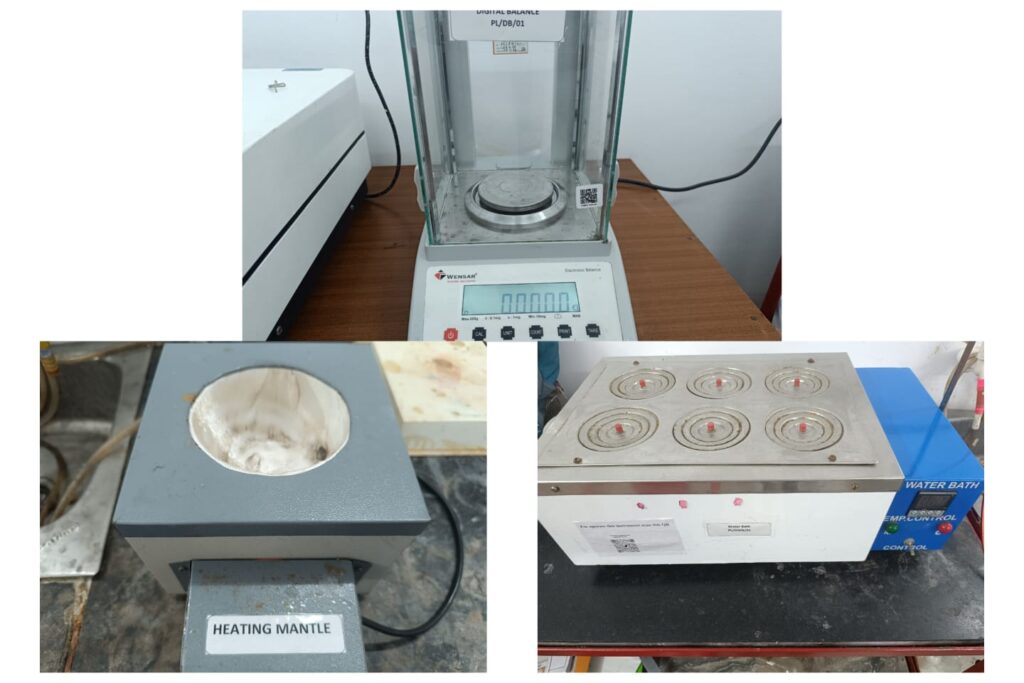
Chemical & Equipments Used During Testing of Caffeine Content of Coffee Sample:
Chemicals Used
- Dilute Sulphuric Acid(1:9) : Sulphuric Acid acts as a extraction agent to remove impurities and provide acidic medium. To prepare it mix 1 ml sulphuric acid in 9 ml of distilled water.
- Potassium Hydroxide(1%) : Potassium Hydroxide use to create a strongly basic environment that converts acidic impurities. Add 1gm KOH in 100 ml distilled water.
- Chloroform : Chloroform used as a highly affective non polar organic solvent to isolate caffeine from aqueous solution.
- Magnesium Oxide powder :Magnesium oxide (MgO) powder is used in caffeine testing act as a purifying agent.
- Potassium Sulphate :Potassium sulphate is primarily used in the Kjeldahl method of caffeine testing to enhance the boiling point of sulphuric acid.
- Copper Sulphate:It acts as a powerful catalyst in the Kjeldahl method.
- Sodium Hydroxide Solution : During sample preparation, NaOH acts as a strong base to separate caffeine.Preparation process describe previously.
- Standard H₂SO₄ Solution(0.1 N): Dilute 2.8 ml of concentrated H₂SO₄ to 1 liter of distilled water to prepare 0.1 N H₂SO₄ solution.It absorbs ammonia during distillation.
- Methyl Red Indicator : It is used as an indicator during the titration to indicate the end point of titration.Preparation process describe previously.
- Standard Sodium Hydroxide Solution(0.1N) :This solution is utilized throughout the titration procedure.Preparation process describe previously.
- Distilled Water: Acts as a solvent .The conductivity of distilled water should be <5 μS/cm to prevent contamination.
Equipments Used
- Digital Water bath(100°C): Digital water bath is used for boiling the mixture of sample.
- 4 digit Analytical Balance: To measure the accurate weigh of sample and reagent.
- Fume Hood : Ensures safe removal of toxic fumes during digestion.
- volumetric flask(100 ml): It used to accurately measure out a precise volumn of liquid .
- One mark pipettes(50 ml): Pipettes are used to transfer a precise volume of the sample into a separation funnel for extraction.
- Seperating Funnel: To seperate chloroform & sample solution.
- Kjeldahl Digestion Unit: To digest the organic sample with sulfuric acid.
- Kjeldahl Distillation Unit :To distill ammonia from the digested mixture.
- Titration Burette (50 ml capacity) :To determine the amount of ammonia captured.
- Heating Mantle : It provides consistent high heat(approx 75°C-85°C) during digestion.
- Water Tap : To continuous supply of the water throughout the distillation process.
- Whatman 41 Filter Paper : Used during filtration of sample after refluxing.
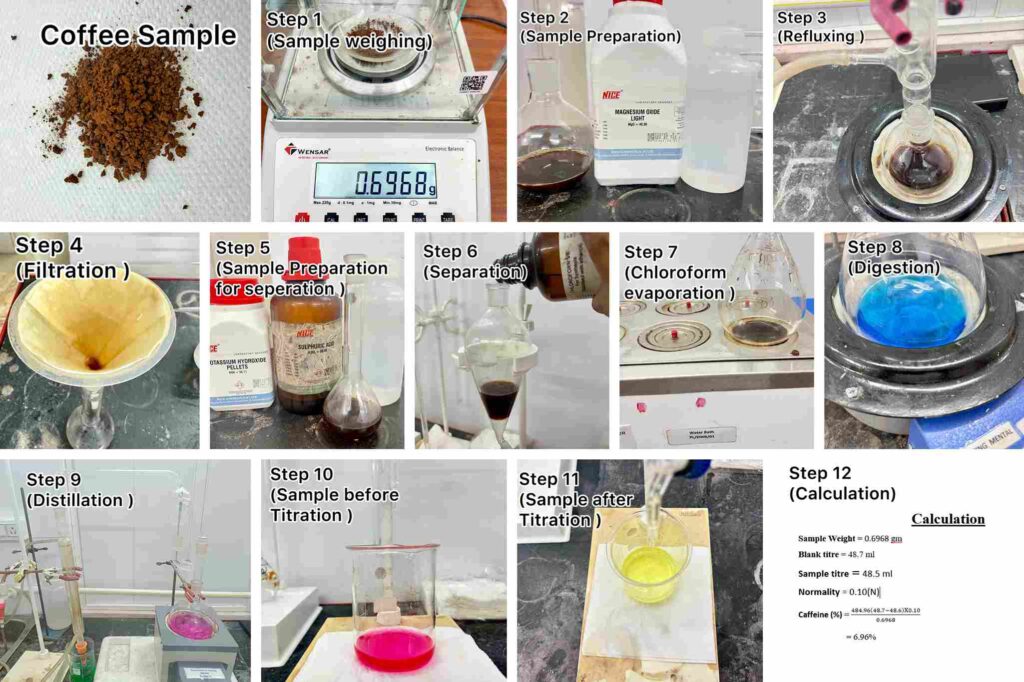
Procedure to Follow While Doing Caffeine Test of Coffee :
Take 0.5-1 gm of the sample ,transfer into a flask(250 ml),Add 3 g of magnesium oxide and 100 ml of distilled water.Reflux it for one hour
│
▼
Cool the mixture . Mix well and filter through a dry filter paper directly into a 100 ml volumetric flask and make up the volume with distill water.
│
▼
Take 50 ml aliquot and transfer it into a seperating funnel.Add 4 ml dilute sulphuric acid,10 ml chloroform,shake vigorously for one minute.
│
▼
Collect the bottom layer in another separating funnel & then add 5 ml potassium Hydroxide solution(1%) shake again.Drain the chloroform layer into a kjeldahl Flask.
│
▼
Rinse the flask with 3 ml chloroform and heat with the help of waterbath untill the chloroform evaporate.
│
▼
Add 25 mL conc. H₂SO₄, 0.5 gm copper sulphate (CuSO₄) & 10 gm potassium sulphate (K₂SO₄) with sample. Shake occasionally.Heat gently until the solution becomes clear blue or green.
│
▼
Add NaOH (40%) slowly to make the solution strongly alkaline & check the pH whether it is pH 12.0,if not add more NaOH.
│
▼
After distillation titrate the trapped ammonia with 0.1 NaOH solution.Titrate untill the colour changes from pink to yellow.
Calculation:
Caffeine (%) = {484.96 (B-A) N}/ M1
B =volume, in ml, of the standard sodium hydroxide used to neutralize the acid in the blank determination;
A = volume, in ml, of the standard sodium hydroxide used to neutralize the excess of acid in the test with the material;
N = normality of the standard sodium hydroxide solution
M1 = Sample weight, in g
Purpose of caffeine testing of Coffee:
- To maintain the quality of product in every batches.
- Caffeine testing confirms the actual caffeine concentration in product.
- Excess caffeine intake may cause health problems such as insomnia, anxiety, high blood pressure, and rapid heartbeat. Testing ensures that caffeine levels remain within safe consumption limits.
- The caffeine content gives an indication of the strength and stimulating effect of coffee. This information helps consumers choose products according to their preference.
Handling Mistakes should avoided during the test of Caffeine of coffee :
- Using the dirty Container & Glasswares can hamper the testing result. Proper cleaning Process described previously
- Using too much or too little sample can lead to inaccurate caffeine calculation.
- Due to incorrect heating or insufficient acid or catalyst affects caffeine release.
- Using incorrectly prepared standard acid or alkali solutions affects result accuracy.
- Waiting too long after digestion before distillation or titration may cause incorrect result.
Conclusion of Caffeine testing of coffee:
Caffeine testing is a vital process in assessing the quality and safety of coffee.Testing the caffeine content in coffee ensures regulatory compliance, accurate labeling for consumer safety, and product consistency.By following these method, you can easily test the Caffeine of coffee,tea,cocoa products,energy booster drinks etc. at laboratory & also manufacturing industry with availability of the equipments & chemicals. If you can’t understand the procedure you can check our real time photo attached with this writing or also you can reach to Pro Research & Testing Laboratory for the advance testing.
FAQ on Caffeine Analysis of Coffee :
Q:What is the Purpose of Caffeine testing in Coffee ?
A: Testing the caffeine content in coffee ensures regulatory compliance, accurate labeling for consumer safety, and product consistency.
Q: What is Caffeine?
A: Caffeine , which is a natural compound with a stimulant effect.It is found in coffee , tea ,cocoa etc.
Q: Why Chloroform is used for caffeine content testing?
A: Chloroform is hydrophobic with water, meaning it does not mix, forming a distinct layer that is easy to separate the caffeine in a separator funnel.
Q: Why do we use 0.1N NaOH solution in the Kjeldahl method and not more concentrated solution?
A: 0.1 N NaOH allows for precise control during titration, reducing the risk of overshooting the endpoint.
Q: Is it important to maintain pH at 12.0?
A: Yes,if the solution is not proper alkaline, it won’t release ammonia properly which cause low protein result. 40% NaOH provides strong alkalinity & it is safe,control release of ammonia.Higher concentrations can cause excessive boiling or splashing which may cause ammonia loss.
Q: Why does the Kjeldahl method use 0.1N H₂SO₄ and not a stronger acid?
A: 0.1 N acid is ideal for accurate titration.Strong or weak concentrated acids would complicate titration control & cause error titre value.
Q: Can I do this test in any cocoa or caffeine content products in laboratory or manufacturing units?
A:Yes,by following above mentioned method,you can easily test the caffeine content of any products like green coffee,roasted coffee,grounded coffee,instant coffee,tea etc at any laboratory or manufacturing industry with availability of the equipments & chemicals.If you can’t understand the procedure you can check our real time photo attached with this writing or also you can reach to Pro Research & Testing Laboratory for the testing purposes.
How We Verified This Testing/Research Procedure :
This testing procedure is done under qualified analyst .Continually monitored by expertise.Repeatedly testing is always done to get accurate result.

Written by
Ankita Samanta (M.Sc Microbiology,Vidyasagar University)
Designation – Junior Microbiologist
Reviewed by
Anwesha Das (M.Sc Microbiology,BU)
Designation – Microbiologist
Verified By
Dr. Jyotirmoy Kumar Dey (Phd,Chemistry)
Designation – Senior/Chief Chemist
Experience – 25 Years +