
Protein estimation in milk is a critical quality control test used to determine its nutritional value and ensure compliance with food safety standards. Milk contains two main types of proteins — casein and whey proteins, which are vital for human health. Accurate estimation of protein( casein and whey proteins) helps detect adulteration, evaluate milk quality for dairy processing, and ensure proper nutritional labeling of milk products.
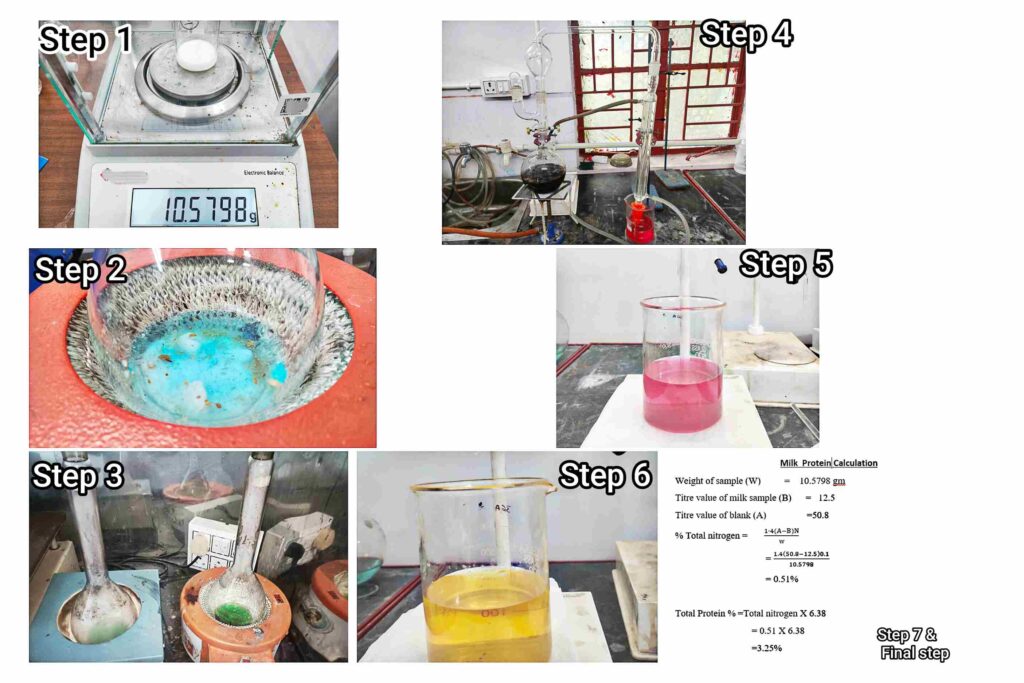
Kjeldahl Method:
We belief the Kjeldahl method is the most recognized and standard methodology for determining total protein content in milk. It works by measuring nitrogen and converting it to protein.The nitrogen is converted into ammonium sulfate through digestion with strong sulphuric acid in the presence of copper sulfate (catalyst).The ammonia generated during alkalization is distilled, combined with a predetermined amount of standard acid, and titrated.
Here we briefly describe the method which we are follow in our lab- Pro Research Testing & Laboratory. Here we have taken cow milk sample.
Chemicals & Apparatus used in Protein Estimation in Milk Sample
- Kjeldahl Digestion Unit: To digest the organic sample with sulfuric acid.
- Kjeldahl Distillation Unit :To distill ammonia from the digested mixture.
- Fume Hood : Ensures safe removal of toxic fumes during digestion.
- Condenser : Prevents loss of ammonia by condensing steam during distillation.
- Titration Burette (50 ml capacity) :To determine the amount of ammonia captured.
- Kjeldahl Flask : Used for digestion of sample with potassium sulphate,copper sulphate in the presence of concentrated sulphuric acid.
- Measuring Cylinder & Pipettes (25 ml & 50 ml capacity) : Accurate measurement of reagents and samples.
- Heating Mantle : It provides consistent high heat(approx 75°c-85°C) during digestion.
- Bunsen Burner- It provided constant flame during titration.
- Beaker( 500 ml capacity): To collect the distilled converted ammonia mixed with 0.1 N sulphuric acid.
- pH-paper: To maintain pH(12.0) of digested sample before distillation.
- Water Tap : To continuous supply of the water throughout the distillation process.
- Weight Balance : To weigh the sample & reagents.
Chemical used :
- Concentrated Sulfuric Acid (H₂SO₄) : It is used as digestion reagent.It oxidizes organic matter and converts organic nitrogen into ammonium sulfate. It breaks down proteins and releases nitrogen in a usable form.Here we have used all the following chemicals/reagents of Researchlab company. You can use the same company or any other companies.
- Catalyst Mixture (Copper Sulfate with Potassium Sulfate): This mixture speed up digestion and raise boiling point.Copper Sulfate acts as a catalyst to accelerate the oxidation process,where potassium Sulfate (K₂SO₄) increases the boiling point of sulfuric acid, allowing more efficient digestion.
- 40% Sodium Hydroxide (NaOH):Dissolve 40 grams of NaOH pellets in distilled water and make the final volume 100 ml.It makes the digested solution alkaline.It converts ammonium ions (NH₄⁺) into ammonia gas (NH₃) by raising the pH,which is necessary for the distillation step.
- Standard H₂SO₄ Solution(0.1 N): Dilute 2.8 ml of concentrated H₂SO₄ to 1 liter of distilled water to prepare 0.1 N H₂SO₄ solution.It absorbs ammonia during distillation.The ammonia reacts with the acid to form ammonium salt. Then it is titrated which determines how much acid stays unreacted.
- Standard NaOH Solution (0.1 N): Prepare a 0.1 N NaOH solution by dissolving 4 grams of NaOH pellets in distilled water and diluting to 1 liter. This solution is utilized throughout the titration procedure. It neutralizes any excess standard acid.The volume used helps calculate the nitrogen content in the sample.
- Methyl Red indicator: It is used as an indicator added in 0.1 N H₂SO₄ during the titration to indicate the end point of titration.It is prepared by add alcohol into methyl red powder.
Testing Process of Protein Estimation in Milk
The Kjeldahl method involves three main stages: digestion, distillation, and titration.
| Step | Description |
| 1. Sample weighing | Take 10 mL of milk sample & measured the weight by weigh balance.Transfer into a Kjeldahl flask. |
| 2. Digestion | Add 25 mL conc. H₂SO₄, 0.5 gm copper sulphate (CuSO₄) & 10 gm potassium sulphate (K₂SO₄) with sample. Shake occasionally.Heat gently until the solution becomes clear blue or green. |
| 3.Cooling | Let the digested sample cool at room temperature. |
| 4.Dilution | Carefully(as H2SO4 is in heat condition, if water is added it become over-heat which can lead to explosion) add distilled water to dilute the digest. |
| 5.Alkalization | Add NaOH (40%) slowly to make the solution strongly alkaline & check the pH whether it is pH 12.0,if not add more NaOH.If the solution is not proper alkaline, it won’t be released ammonia properly which cause low protein result. 40% NaOH provides strong alkalinity & it is safe,control release of ammonia.Higher concentrations can cause excessive boiling or splashing which may cause ammonia loss. |
| 6.Distillation | Distill the ammonia and trap it in 50 mL(for complete ammonia absorption) standard 0.1 N H₂SO₄ with methyl red indicator. 0.1 N acid is ideal for accurate titration.Strong or weak concentrated or excess volume of acids would complicate titration control & cause error titre value. |
| 7.Titration | Titrate the trapped ammonia with standard NaOH (0.1N). 0.1 N NaOH matches with acid strength & ideal for making calculations of protein content straight-forward.End of the titration is indicated by the colour changes from pink to yellow.Note the value & calculate the result using by the following formula. Titrate only 0.1 N sulphuric acid with same volume as taken during sample against 0.1 NaOH solution to determine blank value. |
Calculation of Protein Estimation of Milk Sample:
Total nitrogen, percent by weight = 1·4(A-B)N/W
where,
A = Titre value of blank
B = Milk sample titre value
N = normality of the standard sodium hydroxide
W =Sample weight
Total Protein % =Total nitrogen, percent by weight X 6.38
Purpose of Testing for Protein Estimation in Milk
- Protein estimation in milk is an essential analytical procedure to determine its nutritional and commercial value. Milk is vital for human growth and development. Accurate estimation of protein content ensures that milk meets the nutritional requirements and food safety standards set by regulatory authorities such as FSSAI.
- One of the primary purposes of this test is to detect adulteration. Water or other non-protein substances are sometimes added to milk to increase volume, reducing its actual protein concentration. Protein estimation helps identify such fraudulent practices.
- In milk processing industries, knowledge of protein content is crucial for producing value-added products like cheese, yogurt, paneer, and milk powders. Different dairy products require specific protein levels for desirable texture, taste, and yield.
- Protein content is a key component of nutritional labeling.
Handling Mistakes to Be Avoided During Protein Estimation Test in Milk
Avoiding the following mistakes ensures accurate and reliable protein estimation in milk samples.
- Using too much or too little milk can lead to inaccurate protein calculation.
- Due to incorrect heating or insufficient acid or catalyst affects nitrogen release.
- Using dirty or wet glassware can introduce external nitrogen.Proper cleaning Process described previously.
- Using incorrectly prepared standard acid or alkali solutions affects result accuracy.
- Waiting too long after digestion before distillation or titration may cause nitrogen loss.
- Using the incorrect nitrogen-to-protein conversion factor (should be 6.38 for milk) results in incorrect protein values.
- Failure to run a blank sample leads to incorrected nitrogen, affecting final values.
- Repeat minimum 5 times to get accurate results.
Conclusion of Testing of Protein Estimation in Milk Sample
Protein estimation in milk is a vital test to ensure its nutritional quality,detect adulteration.Accurate measurement of protein helps maintain food safety standards, guides processing requirements.Regular protein analysis not only protects consumer health but also upholds the integrity of the milk supply chain.Kjeldahl method is the standard approach used for estimating protein in milk .It is the widely accepted technique for this purpose.It involves determining the total nitrogen content and converting it to protein using a specific factor (6.38 for milk).Protein estimation plays a vital role in quality control, nutrition assessment ,labelling for packaged food, and maintaining consumer trust in milk and dairy products.By following these method,you can easily test the protein at any laboratory or manufacturing industry with availability of the equipments & chemicals.If you can’t understand the procedure you can check our real time photo attached with this writing or also you can reach to Pro Research & Testing Laboratory for the testing purposes.
FAQ on Protein Estimation in Milk
Q: Why is protein estimation important in milk?
A: It helps assess nutritional quality, detect adulteration, and ensure standard compliance. Also it is an important parameter for nutritional labelling for packaging of food products.
Q: Which method is commonly used for protein estimation in milk?
A: The Kjeldahl method is the standard and widely accepted method.
Q: What is the nitrogen-to-protein conversion factor for milk?
A: The factor is 6.38, specific to milk proteins.
Q: Why do we use 0.1N NaOH solution in the Kjeldahl method and not more concentrated solution?
A: 0.1 N NaOH allows for precise control during titration, reducing the risk of overshooting the endpoint.
Q: Is it important to maintain pH at 12.0?
A: Yes,if the solution is not proper alkaline, it won’t release ammonia properly which cause low protein result.
Q: Why does the Kjeldahl method use 0.1N H₂SO₄ and not a stronger acid?
A: 0.1 N acid is ideal for accurate titration.Strong or weak concentrated acids would complicate titration control & cause error titre value.
Q: Why 40% NaOH solution is used in the Kjeldahl method instead of more concentrated NaOH?
A: Higher concentrations can cause violent boiling or splashing, posing a safety hazard,which can lead to bumping or sudden gas release, which may result in NH₃ loss.
Q: Why is a blank sample necessary?
A: To correct for background nitrogen and improve result accuracy.
Q: Can milk adulteration affect protein results?
A: Yes, dilution or addition of non-protein substances lowers true protein content.
Q: Can I do this test in any laboratory or manufacturing units?
A:Yes,by following above mentioned method,you can easily test the protein at any laboratory or manufacturing industry with availability of the equipments & chemicals.If you can’t understand the procedure you can check our real time photo attached with this writing or also you can reach to Pro Research & Testing Laboratory for the testing purposes.
How We Verified This Testing/Research Procedure :
This testing is done under qualified analysts in our lab.Continually monitored by expertise.Repeatedly testing is always done to get accurate result.

Written by
Anwesha Das (M.Sc Microbiology,BU)
Designation – Microbiologist
Reviewed by
Riya Ghosh (M.Sc. Food Technology, MAKAUT)
Designation – Chemist
Verified By
Dr. Jyotirmoy Kumar Dey (Phd,Chemistry)
Designation – Senior/Chief Chemist
Experience – 25 Years +