
Zinc testing in zinc alloys is an important quality-control process used to determine the zinc content and verify the alloy’s chemical composition. Accurate testing ensures that the alloy meets required specifications. Proper testing contributes to improved product quality, process control, and overall material performance.
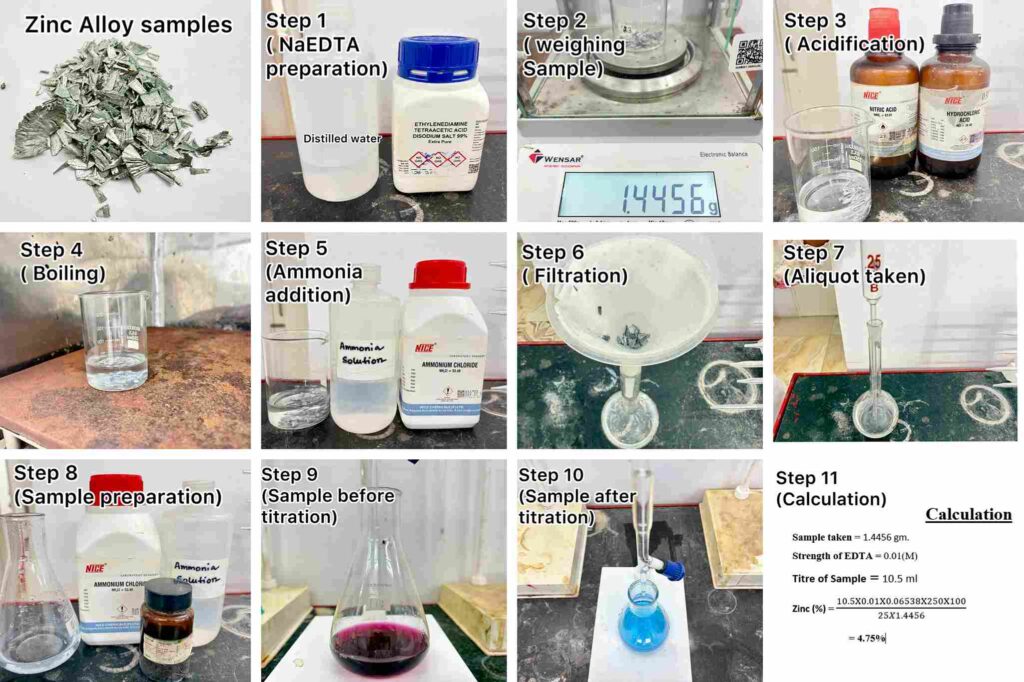
Chemicals & Equipments used during Zinc in Zinc Alloy Testing:
Chemical Used
| Hydrochloric Acid(HCl) | Used to dissolve the zinc alloy sample.It helps bring zinc and other alloying elements into solution. |
| Nitric Acid(HNO₃) | Acts as an oxidizing acid to dissolve metals that may not dissolve completely in hydrochloric acid alone. It helps ensure complete digestion of the alloy sample. |
| Ammonium Chloride–Ammonia Solution Buffer | Used together with ammonia solution to form an ammonium chloride–ammonia buffer. This maintains the pH required for accurate EDTA titration of zinc.Preparation process described previously. |
| DiSodium Ethylenediaminetetraacetic acid(EDTA) | The volume of titrant (EDTA) consumed is used to calculate the zinc content in the sample.Preparation process described previously. |
| Eriochrome Black T(EBT) Indicator | Used as an indicator. Before the endpoint, it forms a reddish-purple. When all zinc ions have reacted with EDTA, the indicator changes to blue, signaling the endpoint. |
| Distilled Water | Used for preparing solutions, dilutions, washing glassware, and making up volumes. The conductivity of distilled water should be <5 μS/cm to prevent contamination. |
Equipments Used
| Volumetric Flask(250 ml) | Used to prepare the sample solution to an exact known volume after dissolving the alloy. |
| Beaker(250ml) | To hold the sample during digestion. |
| Whatman 1 Filter Paper with Funnel | Used to filter the dissolved sample solution and remove insoluble impurities. |
| Pipette(25ml) | Used to accurately transfer a fixed aliquot (typically 25 mL) of the prepared sample solution into the conical flask for titration. |
| Conical Flask(250ml) | To hold the prepared sample solution during titration. |
| Burette(50ml) | Holds the standardized disodium EDTA solution and delivers it accurately during titration. |
| Hot Plate | Used during sample preparation to heat the alloy with acids (HCl-HNO₃), accelerating dissolution and ensuring complete digestion of the sample. |
Procedure followed to determine the Zinc in Zinc Alloy Sample:
| Sample Preparation Weigh about 1.0-1.5gm of the zinc alloy sample.Transfer the sample into a beaker.Add 25ml hydrochloric acid-Nitric acid.Heat gently on a hot plate until nitrous fume are out.Allow the solution to cool.Add 1gm ammonium chloride then add ammonia solution till ammonical(depending on the nature of ingredients).Warm on Hot plate.Coagulation of precipitation occurs. │ ▼ |
| Filtration and Dilution Filter the solution through Whatman No. 1 filter paper using a funnel to remove any insoluble residue.Collect the filtrate in a 250 mL volumetric flask.Wash the filter paper with distilled water and add the washings to the flask.Make up the volume to the 250 mL mark with distilled water and mix thoroughly. │ ▼ |
| Preparation for Titration Transfer 25 mL of the prepared sample solution into a 250 mL conical flask.Add about 10 mL ammonium chloride–ammonia buffer solution.Add small amount of Eriochrome Black T (EBT) indicator.The solution should develop a reddish-purple color. │ ▼ |
| EDTA Titration Fill a 50 mL burette with standardized disodium EDTA solution.Titrate the sample solution with EDTA.Continue until the color changes from reddish-purple to pure blue, indicating the endpoint.Record the final burette reading. │ ▼ |
| Calculation Zinc % = (Titre Value of Sample x SEDTA x 0.06538 x 250 x 100)/ (Volume of Aliquot Sample(25 ml) x Sample Weight) |
Why Zinc Content Testing in Zinc Alloy is necessary?
- Composition Evaluation:To determine the percentage of zinc present in the alloy.
- Quality Control:To ensure consistency in alloy composition during production & To maintain uniform product quality.
- Impurity Detection:To identify unwanted elements or contaminants in the alloy.To prevent defects caused by excessive impurities.
- Performance Assurance:To maintain corrosion resistance and durability.
- Standards Compliance:To verify compliance with industry and customer specifications.
Handling Mistakes During Zinc Alloy Testing
- Equipment Handling Errors:Incorrect calibration of testing instruments gives false results.
- Documentation Errors:Incorrect labeling of samples can be mislead with the correct result.
- Contaminated Glasswares Used:Contaminants may introduce extra ions, leading to false higher readings. Proper cleaning Process described previously.
- Titrating too fast: Rapid titration can cause overshooting of the endpoint, resulting in low values.
- Adding excess indicator: Excess indicator can form stable complexes with calcium or magnesium, leading to false readings or higher EDTA consumption.
- Sample Preparation Errors:Improper sample or uneven sample can also lead to result errors.
Conclusion about Zinc Test in Zinc Alloy
Zinc testing in zinc alloys is an essential quality-control process that verifies the zinc content and overall chemical composition of the material. The test helps ensure product quality, and achieve the desired corrosion-resistant properties.By following the above-mentioned method, you can easily test the Zinc Content in Zinc Alloy at any laboratory or manufacturing industry with the availability of the equipments and chemicals.This testing process ensures accurate results, which are crucial for quality control in various applications. Furthermore, if you can’t understand the procedure, you can check our real-time photo attached with this writing, which visually guides you through each step and enhances your understanding. Additionally, for those who prefer professional assistance or require more advanced testing, you can also reach out to Pro Research & Testing Laboratory for testing purposes.
Frequently Asked Questions (FAQ) – Zinc Testing in Zinc Alloy
Q1: Why is zinc testing performed in zinc alloys?
Ans:Zinc testing is performed to verify the zinc content, ensure product quality, and confirm compliance with specifications.
Q2: Why is accurate zinc content important?
Ans:Accurate zinc content ensures the alloy has the required strength, corrosion resistance, and performance characteristics.
Q3: What can affect the accuracy of test results?
Ans:Sample contamination, improper calibration, incorrect sample preparation, and operator errors can affect accuracy.
Q4: Why is heating required during sample dissolution?
Ans:Heating on a hot plate speeds up the reaction between the alloy and acids, ensuring complete dissolution of the sample.
Q5:What is the purpose of ammonium chloride and ammonia solution?
Ans: They form a buffer solution that maintains the pH around 10, which is necessary for proper complex formation between zinc ions and EDTA.
How We Verified This Testing/Research Procedure :
This testing is done under qualified analysts in our lab.Continually monitored by expertise.Repeatedly testing is always done to get accurate result.

Written by
Anwesha Das (M.Sc Microbiology,BU)
Designation – Microbiologist
Reviewed by
Riya Ghosh (M.Sc. Food Technology, MAKAUT)
Designation – Chemist
Verified By
Dr. Jyotirmoy Kumar Dey (Phd,Chemistry)
Designation – Senior/Chief Chemist
Experience – 25 Years +