
Due to its strong flavor and high nutritional oil content, mustard seed, also known as rai seed, is one of the most important oilseeds and spices. Mustard seed quality and purity are essential for maintaining industrial processing standards as well as consumer safety. Determining the amount of acid insoluble ash is one of the key requirements for evaluating quality.
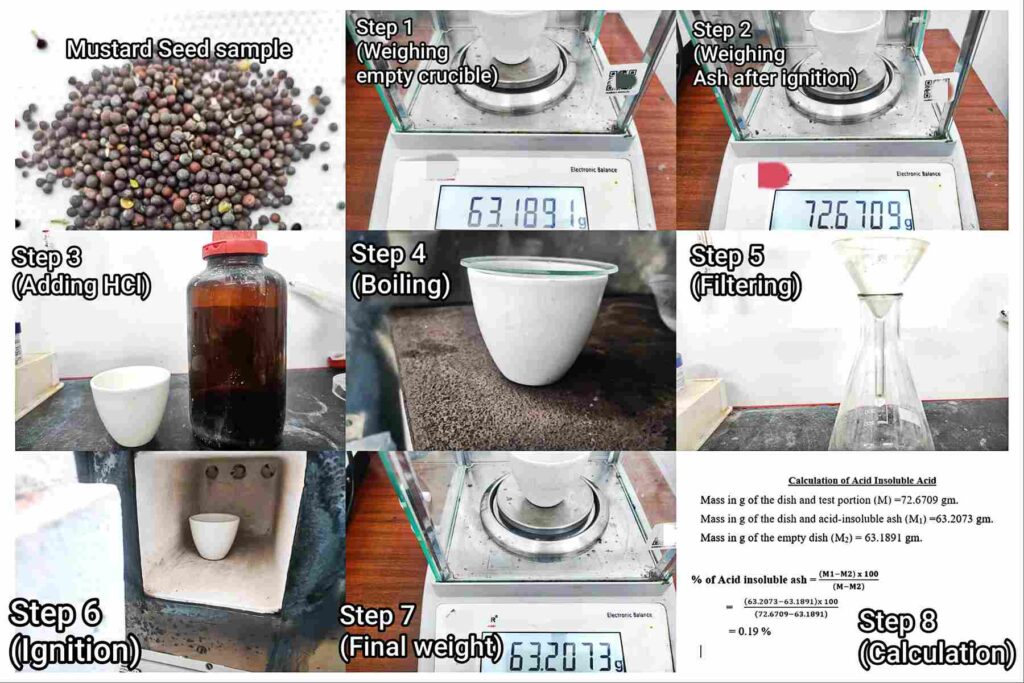
Acid insoluble ash is the portion of the total ash that remains insoluble when treated with dilute hydrochloric acid. It primarily consists of siliceous matter, sand, dirt, and other inorganic contaminants that may enter the sample during harvesting, handling, or storage. Since these materials are non-nutritive and indigestible, their presence in significant amounts reduces the quality and safety of the mustard seed.This parameter serves as an indicator of adulteration, poor processing practices, or accidental contamination. A low value suggests a clean and properly processed product, while a high value reflects contamination by soil, dust, or other insoluble impurities.
Instruments,Chemicals and Glasswares used for the test of Acid Insoluble Ash in Mustard Seed:
- Analytical Balance– Used to measure sample & ash. We use 4 digit balance for this testing.
- Silica Crucible– This high-heat resistant container made of silica, holds the food sample during incineration.
- Hot Air Oven– To dry( at 105°c) the crucible before starting the procedure.
- Muffle Furnace– It incinerates( 550°C) the organic matter at high temperature turns the inorganic residue into ash.
- Hot Plate –For boiling the sample after acidification to dissolve soluble mineral matter.
- Tongs-To hold the hot crucible safely without direct contact.
- Desiccator– It maintains moisture free environment to prevent rehydration of ash before weighing. Silica beads are used in the desiccator which absorbs the moisture from the crucible. the color of silica beads change from blue to pink detects that the silica beads has to be replaced by the moisture free beads.
- Watch-glass -.Watch-glass is used to cover the crucible while boiling.
- Ashless Whatman 1 filter paper – To collect the residue by filtering the sample.
- Hydrochloric Acid – To boil the sample.It removes soluble minerals from ash,leaving behind only harmful insoluble matter that indicates contamination. Here we have used the Nice company’s Hydrochloric Acid. You can use the same company or any other companies.
- Distilled Water & pH paper – To wash the sample for making it acid free.pH paper is used to check whether it becomes acid free(pH-7) or not.The conductivity of distilled water should be <5 μS/cm to prevent contamination.
Process of Acid Insoluble Ash Test in Mustard Seed:
| Sample Preparation | Take weight (about 2–5 g) of dried mustard seed sample & make it ash.Procedure described previously |
| Treatment with Acid | Add 25 ml of dilute hydrochloric acid to the total ash in the crucible. Cover with a watch glass and boil for 5 minutes to dissolve soluble mineral matter. |
| Filtration | Filter the mixture through an ashless filter paper (whatman 1). Wash the residue thoroughly with hot distilled water until free from acid (check with pH 7.0 with paper ). |
| Ignition of Residue | Transfer the filter paper with residue to a pre-weighed silica crucible. Dry and ignite again in the muffle furnace at 550°C until constant weight is obtained. Cool in a desiccator and weigh. |
| Calculation | % of Acid insoluble ash: (M1-M2) x 100/ (M-M2) [ M= mass in g of the dish and test portion, M1= mass in g of the dish and acid-insoluble ash, M2=mass in g of the empty dish] |
Purpose of Testing of Acid Insoluble Ash in Mustard Seed::
- To assess purity: Acid insoluble ash helps determine the level of unwanted earthy materials such as sand, silica, and dirt in mustard seed. A lower value indicates a clean and pure product.
- To detect adulteration: High acid insoluble ash values may indicate deliberate adulteration with sand or mineral matter to increase weight, compromising product quality and safety.
- To check processing quality: It reflects how well mustard seeds have been cleaned, sorted, and handled during processing, storage, and transportation.
- To ensure compliance with food standards: Regulatory agencies such as Indian Standard set limits(max 1.5%) for acid insoluble ash in mustard seeds. Testing ensures the product meets these legal standards.
- To safeguard consumer health: Excess inorganic contaminants are indigestible and harmful to health. Regular testing prevents unsafe products from reaching the market.
Handling Mistakes to be Kept in Mind during Acid Insoluble Ash Testing in Mustard Seed::
- Incomplete incineration: If the mustard seed sample is not fully incinerated while preparing total ash, carbon particles may remain, leading to inaccurate results.
- Excess heating: Overheating can cause loss of volatile mineral salts, reducing ash weight and giving false values.
- Improper acid treatment: Insufficient boiling time with acid, may leave soluble matter undissolved, altering the acid insoluble ash value.
- Loss of residue: During filtration, careless handling may cause spillage or loss of insoluble residue, affecting accuracy.
- Contamination of sample: External dust, sand, or glass particles can artificially increase ash content. All apparatus must be clean and handled carefully. Proper cleaning Process described previously.
- Improper drying and ignition: If the residue is not properly dried before weighing, moisture may give higher readings.
- Weighing errors: Residue must be cooled in a desiccator before weighing to prevent errors due to moisture absorption.
Conclusion of Acid Insoluble Ash Testing in Mustard Seed
The determination of acid insoluble ash in mustard seed is a vital quality control test that indicates the presence of earthy matter and other indigestible impurities. A low percentage of acid insoluble ash confirms that the mustard seed is clean, properly processed, and free from adulteration, while a higher value suggests contamination with soil, sand, or deliberate adulteration.By following these method, you can easily test the Acid Insoluble Ash of Mustard seeds/Rai seeds/Sorshe or any other spices at laboratory & also manufacturing industry with availability of the equipments & chemicals. If you can’t understand the procedure you can check our real time photo attached with this writing or also you can reach to Pro Research & Testing Laboratory for the advance testing.
FAQ about Acid Insoluble Ash Test in Mustard Seed:
Q1. Why is acid insoluble ash tested in mustard seeds?
To assess purity, detect adulteration with earthy matter, and ensure compliance with food safety standards.
Q2. What does a high acid insoluble ash value indicate?
It indicates contamination with soil, sand, or other insoluble impurities, or adulteration during processing and storage.
Q3. What is the role of hydrochloric acid in this test?
Dilute HCl dissolves soluble mineral salts, leaving behind only insoluble impurities for measurement.
Q4. What is the acceptable limit of acid insoluble ash in mustard seed?
As per Indian standards, the maximum permissible limit is usually around 1.5 %.
Q5. Why is this test important for consumers?
Because high levels of acid insoluble ash indicate poor quality and possible health risks due to adulteration or contamination.
Q6.Can you test other spice’s acid insoluble ash by this method?
Yes, you can test the acid insoluble ash in any spices like cumin, clove, coriander, cinnamon, turmeric, fenugreek, and cardamom etc by this procedure or you can reach out to Pro Research & Testing Laboratory for further details.
How We Verified This Testing/Research Procedure :
This testing is done under qualified analysts in our lab.Continually monitored by expertise.Repeatedly testing is always done to get accurate result.

Written by
Anwesha Das (M.Sc Microbiology,BU)
Designation – Microbiologist
Reviewed by
Riya Ghosh (M.Sc. Food Technology, MAKAUT)
Designation – Chemist
Verified By
Dr. Jyotirmoy Kumar Dey (Phd,Chemistry)
Designation – Senior/Chief Chemist
Experience – 25 Years +