
Acid value is an important parameter in assessing the quality and purity of groundnut oil.In groundnut oil, a higher acid value indicates hydrolytic rancidity due to the breakdown of triglycerides into free fatty acids, often caused by improper storage, moisture. Measuring acid value is essential in food testing laboratories to ensure oil quality, edibility, stability, and compliance with regulatory standards.
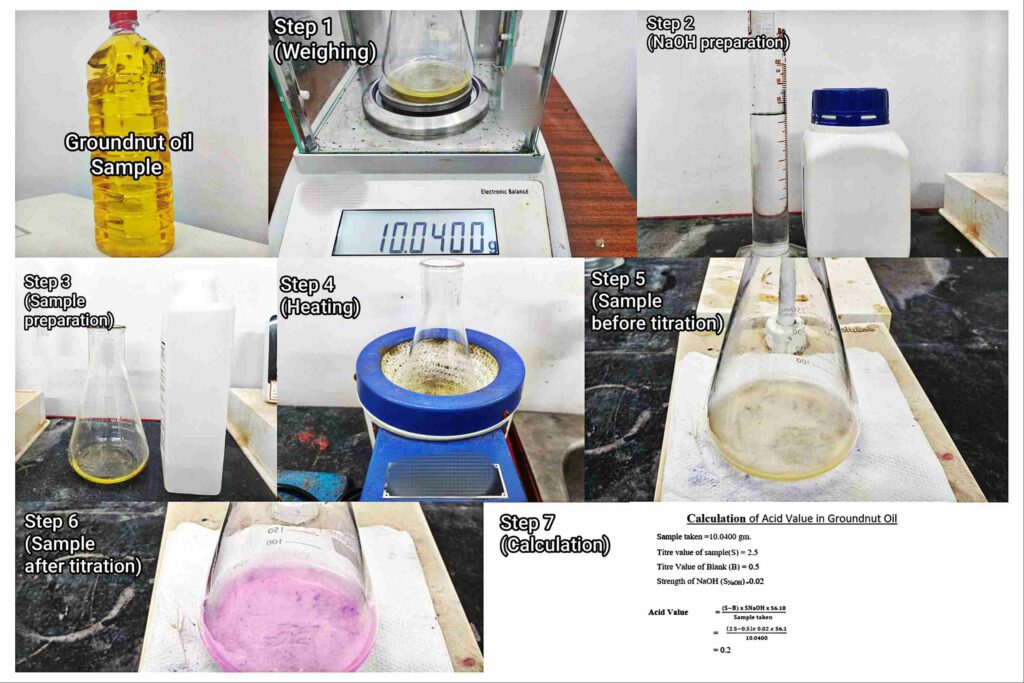
Instruments, Glassware, and Chemicals Used in Acid Value Test
| Instruments | Analytical Balance(4-digit)– For accurately weighing the oil sample. Heating Mantle – To dissolve the oil in solvent. Burette (50ml) – For titration with standardized NaOH solution. Hot air oven – To dry the flask for avoiding the contamination; |
| Glasswares | Conical Flask (100 ml) – To hold the oil–solvent mixture during titration. Measuring Cylinder (50 ml & 1000 ml)– For preparing NaOH solution. Volumetric Flask(1000 ml) – For preparing and standardizing NaOH solution. |
| Chemicals | Ethyl alcohol – Acts as solvent to dissolve the oil and allow titration. Distilled Water – To prepare Standard Solution.The conductivity of distilled water should be <5 μS/cm to prevent contamination Phenolphthalein Indicator – Shows the endpoint of titration with a faint pink color.Preparation described previously. Standardized Sodium Hydroxide (NaOH) Solution(0.02N) – Titrant used to neutralize the free fatty acids in the oil.To prepare 0.02 N NaOH Solution add 0.8 gm NaOH in 1000 ml distilled water.Standardization process described previously |
Procedure of Acid Value in Groundnut Oil Sample
- Weigh 10 gm of groundnut oil into a conical flask.
- Add a 50ml of ethyl alcohol as solvent.
- Heat for few minutes to dissolve the oil with solvent.
- Add 2 drops of phenolphthalein indicator.
- Titrate with standardized NaOH solution until a faint pink color persists.
- Calculate the acid value using this formula: (S-B) x SNaOH x 56.10 / Weight of the sample in gm, [S- Titre value of sample, B- Titre Value of Blank, SNaOH – Strength of NaOH]
Purpose of Testing of Acid Value in Groundnut Oil Sample
The purpose of determining the acid value in groundnut oil is to assess its freshness, quality, and suitability for consumption or industrial applications.The acid value test helps to:
- Helps to determine oil quality & edibility.
- Indicates the extent of rancidity and deterioration in oil.
- Ensure compliance with food safety and regulatory standards.
- Evaluate the shelf life and stability of groundnut oil.
- Protect consumer health by preventing the use of spoiled or degraded oil.
Handling Mistakes to be Kept in Mind for Acid Value Test in Groundnut Oil Sample
- Avoid exposing oil to air, moisture, or light before testing.
- Use analytical balance carefully to prevent weighing errors.
- Add phenolphthalein in correct quantity (2 drops) to ensure clear endpoint.
- Perform titration slowly near endpoint to avoid overshooting.
- Use freshly prepared and standardized NaOH solution.
- Keep all glassware clean and dry to avoid contamination used in Acidity (as Formic Acid) Test in Honey.Proper cleaning Process described previously.
- Repeat the test at least thrice for accuracy.
Conclusion of Acid Value in Groundnut Oil Sample
The determination of acid value in edible oils like groundnut oil/olive oil/coconut oil/refined oil is a simple yet essential analytical test in food and oil testing laboratories. A low acid value indicates fresh and good-quality oil, while a high acid value reflects hydrolysis, rancidity, and reduced acceptability. Regular monitoring ensures oil stability, consumer safety, and compliance with quality standards, making acid value testing crucial in the edible oil industry.To perform acid value test at a oil company or laboratory should ensure by following standard procedures mentioned above to accurately determine the acid value and assess the quality of the oil with availability of the apparatus & chemicals and also the above real-time photo attachment will help to understand the testing process completely. In addition, if expert guidance is needed ,please reach out to Pro Research & Testing Laboratory.
Frequently Asked Questions (FAQ) of Acid Value in Groundnut Oil Sample
Q1. Why is acid value important in groundnut oil?
It indicates the quality, freshness, and edibility of groundnut oil. A high acid value shows rancidity or deterioration due to hydrolysis of triglycerides.
Q2. What is the principle of acid value determination?
The free fatty acids in oil react with a standardized NaOH solution. The endpoint is detected by phenolphthalein indicator, which turns faint pink in slightly alkaline conditions.
Q3. What causes a high acid value in groundnut oil?
Prolonged storage,exposure to moisture, air, or heat,improper refining or processing.
Q4. What is the acceptable limit of acid value in edible oils?
For most edible oils, the acid value should be maximum 0.5–10.0 for expressed and maximum 0.5-25.0 for solvent extracted depending on regulatory standards.
Q5. How can the acid value of oil be reduced?
By refining the oil, removing free fatty acids, and ensuring proper storage in airtight, moisture-free containers away from heat and light.
Q6. What errors may occur during acid value testing?
Errors can arise due to non standardized NaOH solution, improper endpoint detection, contaminated glassware, or exposure of the oil to air/moisture before testing.
Q7. Can you test other edible oil’s acid value by this method ?
Yes, you can test the acid value in mustard oil, rice bran oil,sunflower oil, soybean oil,sesame oil,palm oil or any other edible oils by this procedure or you can reach out to Pro Research & Testing Laboratory for further details.
How We Verified This Testing/Research Procedure :
This testing is done under qualified analysts in our lab.Continually monitored by expertise.Repeatedly testing is always done to get accurate result.

Written by
Anwesha Das (M.Sc Microbiology,BU)
Designation – Microbiologist
Reviewed by
Riya Ghosh (M.Sc. Food Technology, MAKAUT)
Designation – Chemist
Verified By
Dr. Jyotirmoy Kumar Dey (Phd,Chemistry)
Designation – Senior/Chief Chemist
Experience – 25 Years +