
Formic acid, a measure of honey’s acidity, indicates the presence of organic acids that impact the honey’s flavor, stability, and quality. A naturally occurring substance created during the fermentation and developing of honey is formic acid. Assessing the acidity of honey helps in determining its freshness, microbial stability, and potential for spoiling. Increased acidity could be a sign of fermentation brought on by poor storage or too much moisture. In order to guarantee product quality and consumer safety, regulatory standards frequently set limits for honey’s acidity.
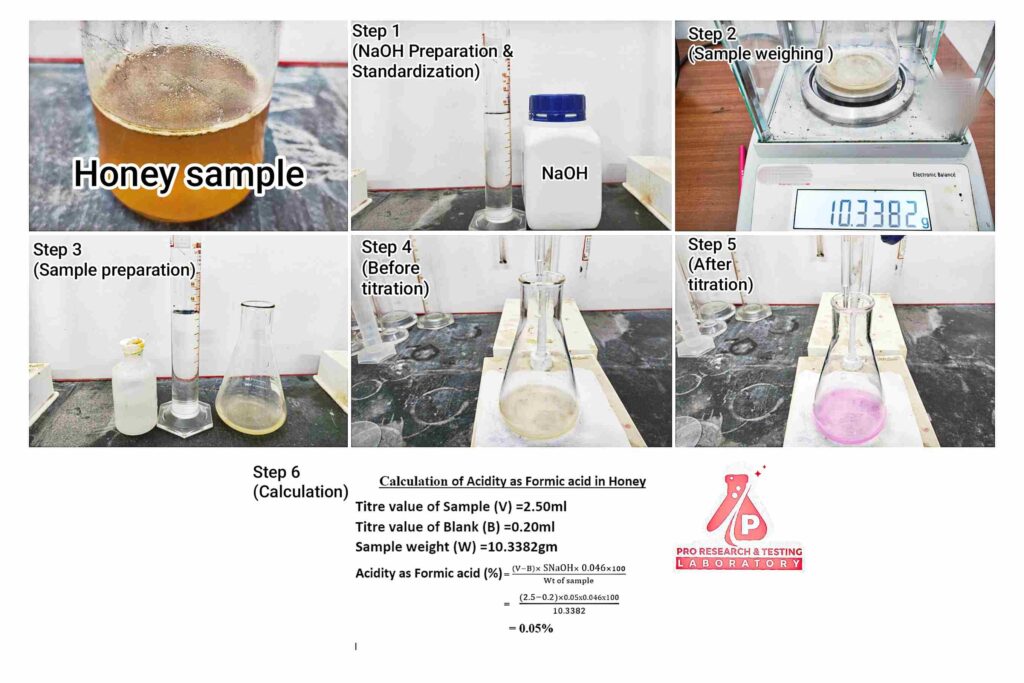
Acid-base titration is the basis for the test. A known concentration of a strong base (NaOH) reacts with the organic acids found in honey, primarily formic acid. The phenolphthalein indicator changes color to indicate the endpoint when all of the acids have been neutralized. The acidity of the honey, which is then calculated and expressed as formic acid, determines how much NaOH is used.
Instruments, Glassware, and Chemicals Used in Acidity (as Formic Acid) Test in Honey (by Titration Method) :
Instruments and Glassware:
- Burette(50ml) – Dispenses accurate volumes of titrant (NaOH).
- Conical Flask (250 mL) – For titrating samples.
- Volumetric Flask (1000 mL & 250 mL) – Used to prepare standard solutions.
- Measuring Cylinder (100 mL) – For precise distilled water transfer.
- Pipette(10 ml)- To add distilled water while doing standardization.
- 4 digit analytical balance-For accurate weighing of sample and reagents.
Chemicals and Reagents:
- 0.05 N Sodium Hydroxide (NaOH) – Titrant for neutralizing acids.This solution is utilized throughout the titration procedure. It neutralizes any excess standard acid.The volume used helps calculate the acid content in the sample.
- Phenolphthalein Indicator – Used to detect endpoint (colourless to pink).To prepare phenolphthalein indicator solution dissolve 0.5 gm phenolphthalein in 100 ml ethyl alcohol.
- Potassium Phthalate (KHTa)- Used to standardize the titrant (NaOH).
- Ethyl Alcohol – Used to prepare phenolphthalein indicator.
- Distilled Water – For diluting honey samples. The conductivity of distilled water should be <5 μS/cm to prevent contamination.
Procedure Used in Acidity (as Formic Acid) Test in Honey:
| Preparation & Standardization of 0.05 N NaOH Solution | To prepare 0.05 N NaOH Solution add 2 gm NaOH in 1000 ml distilled water. Prepare standard potassium phthalate solution by dissolving 0.1-0.15 g potassium phthalate (KHTa) in 10 ml of distilled water (equals 0.05 N), pipetted into a conical flask. Add 2-3 drops phenolphthalein indicator to it & titrate against the NaOH solution. Titrate until it become colorless to pink which indicates the end point. Calculate the exact normality using the formula: SNaOH = Weight of KHTa X 1000/ Molecular weight of KHTa X Titre value |
| Sample Preparation | Take 10 gm sample into conical flask. Add 75 ml distilled water & few drops of phenolphthalein indicator to it. Mix thoroughly. |
| Titration | Titrate against 0.05 N NaOH by using phenolphthalein indicator until it become colorless to pink which indicates the end point.Note the titre value & calculate by following formula. For blank(without sample) titre value titrate distilled water against 0.05 NaOH solution. |
| Calculation | (V-B) X SNaOH X 0.046 X 100/W V= Titre value of Sample B = Titre value of Blank W =Sample weight |
Purpose of Testing Acidity (as Formic Acid) in Honey:
- To assess freshness and quality – Fresh honey has a low acidity,higher acidity could be a sign of spoiling or aging.
- To detect fermentation – High acidity often results from fermentation caused by excess moisture or poor storage.
- To evaluate shelf life and stability – Acidity affects honey’s microbial stability and preservation.
- To detect filtration -High acidity as formic acid also represents acidic residues from dead bees which indicates the sample may be not filtered properly.
Handling Mistakes to Avoid in Acidity (as Formic Acid) Testing of Honey and Reasons:
- Incorrect sample weight – Leads to wrong acidity calculation.
- Using contaminated glassware – Residues can alter pH and endpoint accuracy.Proper cleaning Process described previously.
- Improper NaOH standardization – Causes titration errors and false results.
- Over-titration past endpoint – Increases NaOH volume, giving higher acidity values.
- Not mixing sample properly – Causes uneven acid distribution, leading to inconsistent results.
- Using old or degraded indicator – Fails to give a sharp color change at the endpoint.
Conclusion of Acidity (as Formic Acid) Test in Honey:
Acidity (as formic acid) testing in honey is an essential quality control measure to determine freshness, purity, and stability. Maintaining acidity within permissible limits ensures consumer safety, prevents fermentation issues, and meets regulatory standards. Accurate handling, proper titration, and use of standardized reagents are crucial for reliable results.To perform acidity test at a food manufacturing company or laboratory should ensure by following standard procedures mentioned above to accurately determine the acidity (as formic acid) testing and assess the quality of the honey/natural sweetener with availability of the apparatus & chemicals and also the above real-time photo attachment will help to understand the testing process completely. In addition, if expert guidance is needed ,please reach out to Pro Research & Testing Laboratory.
FAQ – Acidity (as Formic Acid) Testing in Honey:
Q1. Why is acidity expressed as formic acid in honey?
A1. Formic acid is the natural acid in honey, so total acidity is calculated and expressed in its equivalent for standardization.
Q2. What is the acceptable acidity limit for honey?
A2. As per Indian standard specification acidity of should be maximum 0.2%.
Q3. Does high acidity mean the honey is spoiled?
A3. Not always, but significantly high acidity often indicates fermentation or poor storage conditions.
Q4. Can acidity affect the taste of honey?
A4. Yes, higher acidity can make honey taste sour, affecting flavor quality.
Q5. Which method is commonly used for acidity testing?
A5. Acid-base titration using NaOH with phenolphthalein indicator is the standard method.
Q6. How often should honey acidity be tested?
A6. Ideally, it should be tested during production, before packaging, and periodically during storage for quality assurance.
Q7. Why proper collection of honey is important ?
A7. Formic acid is a natural acid found in honey.If proper collection or filtration is not done, dead bees may remain in honey which can increase acidity,ultimately deteriorate the sample.
Q8. Can I do this test in any laboratory or manufacturing units?
A8. Yes,by following above mentioned method,you can easily test the Acidity at any laboratory or manufacturing industry with availability of the equipments & media.If you can’t understand the procedure you can check our real time photo attached with this writing or also you can reach to Pro Research & Testing Laboratory for the testing purposes.
How We Verified This Testing/Research Procedure :
This testing is done under qualified analysts in our lab.Continually monitored by expertise.Repeatedly testing is always done to get accurate result.

Written by
Anwesha Das (M.Sc Microbiology,BU)
Designation – Microbiologist
Reviewed by
Riya Ghosh (M.Sc. Food Technology, MAKAUT)
Designation – Chemist
Verified By
Dr. Jyotirmoy Kumar Dey (Phd,Chemistry)
Designation – Senior/Chief Chemist
Experience – 25 Years +