
| Carbonated beverages are popular soft drinks that contain dissolved carbon dioxide, sweeteners, flavoring agents, and other additives. Among these, added sugar is the major component that contributes to taste, energy value, and consumer acceptability. However, excessive sugar intake is linked with health issues like obesity, diabetes, and dental problems, making the determination of sugar content an important quality control step. Testing of added sugar in carbonated beverages helps manufacturers ensure compliance with food safety standards, maintain product consistency, and provide nutritional labeling. |
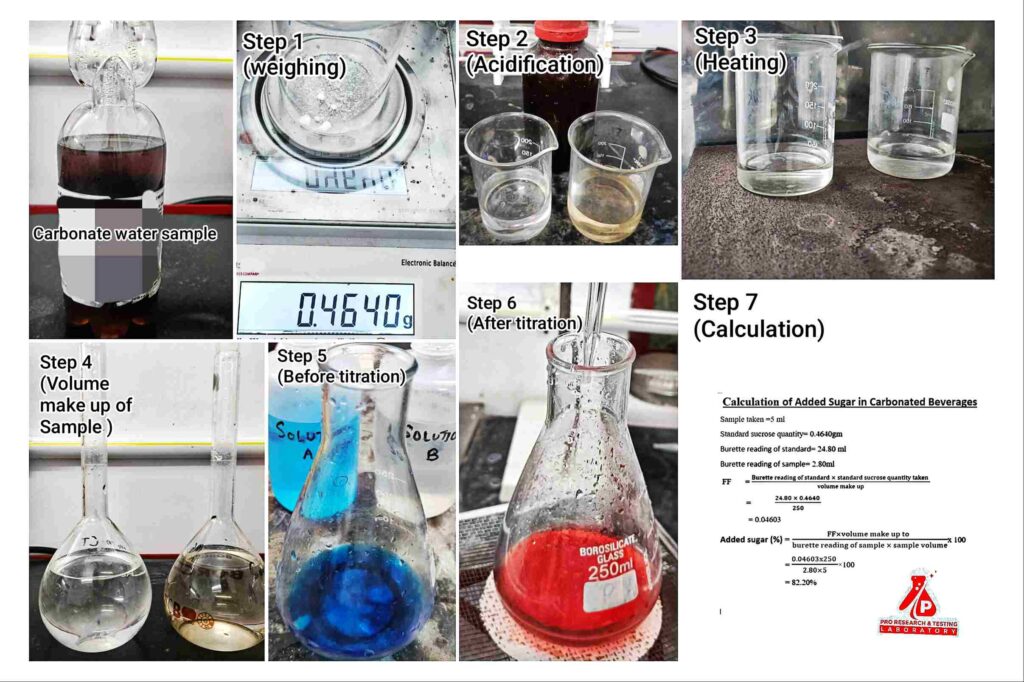
| The commonly used qualitative and quantitative method for added sugar testing is using Fehling’s method. Here we,Pro Research & Testing Laboratory will discuss about detailed process. |
Apparatus & Chemicals Used For Added Sugar Testing in Carbonated Beverages
- Burret(50 ml)- Used to hold sample solution during titration with precise measurement. It ensures accurate control of solution volume added.
- Pipette(5 ml)-Used to measure and transfer the desired volume of solution accurately. Essential for standardization and sample handling.
- Volumetric Flask(100ml,250 ml)– Used to prepare or dilute solutions to an exact volume. Provides high accuracy in quantitative analysis.
- Conical Flask(100 ml)- Holds Fehling’s solution during boiling and titration.
- Bunsen Burner-Provides a constant flame for boiling the solution. Maintains uniform heating during titration.
- Hot Plate -Used to warm or maintain the solution at required temperature 60-70°c.
- Watch Glass– To covers beakers to prevent contamination or evaporation.
- Beaker(250 ml)-To hold or mix solutions & for warming or preparing solutions.
- pH Meter-Measures whether the solution is neutral or adjusted correctly. Ensures proper conditions after inversion.
- Analytical Balance(4-digit)-Used to measure precise weight of chemicals. Accuracy in weighing ensures correct reagent strength.
Chemicals Used
- Copper sulphate solution ( Fehling’s Solution A)– Preparation Previously described
- Potassium Sodium Tartrate(Fehling’s Solution B)-Preparation Previously described
- Sucrose solution-Reference solution to standardize Fehling’s factor. Ensures accuracy of sugar estimation.
- Hydrochloric acid– Hydrolyzes sucrose into glucose and fructose. Converts non-reducing sugar into reducing sugars.
- C12H22O11 (Sucrose) + H2O(Water) → C6H12O6 (Glucose) +C6H12O6(Fructose) [Hydrolysis with Dilute HCl]
- Sodium carbonate– Neutralizes excess acid after inversion. Helps to maintain the solution near pH 7 for correct titration conditions.
- Methylene blue indicator– Acts as an indicator, turning colorless once all Cu²⁺ is reduced,signals the endpoint of the titration clearly.
- Distilled water -To make the reagent.The conductivity of distilled water should be <5 μS/cm to prevent contamination.
Testing Procedure For Added Sugar Testing in Carbonated Beverages
| Step-1 | The sucrose is weighed (0.4750gm approx) and taken in a beaker dissolved in distilled water. 1 ml HCL ( used to breakdown the non- reducing sugar) is added and boiled gently and kept aside for overnight. |
| Step-2 | Approximately 5 ml beverage sample is taken in 100 ml volumetric flask and volume make up to the mark with distilled water.Take it in a beaker, add 1 ml HCL, heat gently and kept overnight. |
| Step-3 | After 24 hrs maintain pH-7 of sucrose standard and the sample with sodium carbonate as the medium is acidic & volume make up to 250ml. |
| Step-4 | Freshly prepared 5 ml each Fehling’s solution A & B is taken in a conical flask and first titrate against the standard sucrose with constant flame of bunsen burner using methylene blue indicator. |
| Step-5 | Same as take prepared 5 ml each Fehling’s solution A & B is taken in a conical flask and titrate against the sample with constant flame of bunsen burner using methylene blue indicator.The end point for the titration is indicated the colour change from blue to brick red. |
| Step-6 | Stop the heat and note the reading. |
| Step-7 | Calculate according to the formula. Fehlings Factor(FF) =( Burette reading of standard × standard sucrose quantity taken )/ volume make up Added sugar(% m/v)= (FF×volume make up to × 100%)/(burette reading of sample × sample volume) |
Purpose of Testing For Added Sugar Testing in Carbonated Beverages
- Quality Control-Regular sugar testing ensures that the sweetness level remains uniform across different batches of production. This helps maintain the desired flavor profile and overall product consistency that consumers expect.
- Regulatory Compliance-Food safety authorities prescribe labeling rules for sugar in aerated beverages. Testing ensures that the product meets these FSSAI requirements.
- Nutritional Labeling-Accurate sugar analysis provides reliable data for nutrition facts labeling. This enables consumers to make informed choices about their sugar intake and supports transparency in the food industry.
- Health Concerns-Excessive sugar consumption is linked to obesity, diabetes, and dental issues. Monitoring sugar levels in beverages helps reduce health risks and supports initiatives toward healthier product options.
- Product Development-Sugar testing aids in developing new formulations such as reduced-sugar or sugar-free beverages. It also helps in comparing sweetness intensity with alternative sweeteners for better market acceptance.
Handling Mistakes To be Avoided During Added Sugar Testing in Carbonated Beverages
- Incomplete degassing: Not removing CO₂ fully makes the solution acidic and affects sugar inversion and titration accuracy.
- Overheating during inversion: Excessive boiling with HCl may caramelize sugars, leading to underestimation.
- Incorrect neutralization: Leaving solution too acidic or too alkaline alters Fehling’s reaction and spoils the endpoint.
- Using old Fehling’s solutions: Copper sulphate or tartrate solution that is degraded gives wrong results.
- Rapid titration without boiling: Adding sample too quickly without maintaining boiling causes incomplete reduction.
- Wrong standardization of Fehling factor (F): Errors in glucose standard preparation give systematic errors in sugar calculation.
- Ignoring replicate analysis: Running only one titration may overlook experimental errors or inconsistencies. Perform at least 3 times to get exact results.
- Using unclean or contaminated glassware, which may affect test results. Proper cleaning Process described previously.
Conclusion For Added Sugar Testing in Carbonated Beverages
Carbonated beverages/soft drink/ sparkling drink usually contain added sugars to enhance taste and provide energy. When tested by Fehling’s method, the hydrolyzed sugars (glucose and fructose) reduce the copper(II) ions to red cuprous oxide. The appearance of the red precipitate confirms the presence of added sugars in the carbonated beverage.By following these method, you can easily test the Added Sugar content at any laboratory or manufacturing industry with availability of the equipments & chemicals. If you can’t understand the procedure you can check our real time photo attached with this writing or also you can reach to Pro Research & Testing Laboratory for the testing purposes.
Frequently Asked Questions For Added Sugar Testing in Carbonated Beverages
1. What is the purpose of testing added sugar in soft drink?
Ans-The purpose is to ensure product quality, verify sugar content for nutritional labeling, comply with food regulations, and assess health impacts. High sugar intake is linked to obesity, diabetes, and dental problems, so testing helps protect consumer health.
2.Why is Fehling’s test chosen for sugar detection?
Ans- Fehling’s test is a simple chemical test that detects sugars. It provides a quick and visible indication (red precipitate) of sugar presence without the need for advanced equipment.
3.Why is hydrolysis necessary before performing the test?
Ans-Hydrolysis (inversion) breaks sucrose into its monosaccharide components (glucose + fructose). Without this step, sucrose would give a false negative result since it does not reduce Fehling’s solution.
4.Why is sugar testing important in carbonated beverages?
Ans-Because sugar affects taste, preservation, fermentation stability, caloric value, and consumer health. Monitoring ensures that the manufacturer follows regulations and that consumers are not mislead about sugar content.
5.What safety precautions should be followed during the test?
Ans-Safety precautions should follow like-handle acids carefully during hydrolysis (risk of burns),mix Fehling’s solutions freshly, as they decompose on standing,avoid overheating the test mixture, which can decompose sugars and cause false results.
6.Why is carbon dioxide (in carbonation) not interfering with the test?
Ans-Carbon dioxide escapes during boiling and does not reduce Fehling’s solution. However, excessive carbonation may initially dilute or neutralize reagents, so proper degassing of the beverage before testing is necessary.
7.How can CO₂ be removed before testing?
Ans– CO₂ can be removed by shaking and leaving it open to release dissolved CO₂ and mild heating during hydrolysis, which automatically releases CO₂.
How We Verified This Testing/Research Procedure :
This testing procedure is done under qualified analyst .Continually monitored by expertise.Repeatedly testing is always done to get accurate result.

Written by
Riya Ghosh (M.Sc. Food Technology, MAKAUT)
Designation – Chemist
Reviewed by
Anwesha Das (M.Sc Microbiology,BU)
Designation – Microbiologist
Verified By
Dr. Jyotirmoy Kumar Dey (Phd,Chemistry)
Designation – Senior/Chief Chemist
Experience – 25 Years +