
Alkalinity in water is due to the presence of bicarbonate (HCO₃⁻), carbonate (CO₃²⁻) ions. When titrated with a standard acid, these ions are neutralized. The mixed indicator changes color, marking the endpoint of titration where total alkalinity is measured.In laboratory testing, alkalinity is accurately determined through acid-base titration using standardized 0.02 N sulfuric acid and an appropriate indicator such as Bromocresol Green–Methyl Red.
Here we take Drinking Water to test the parameter.
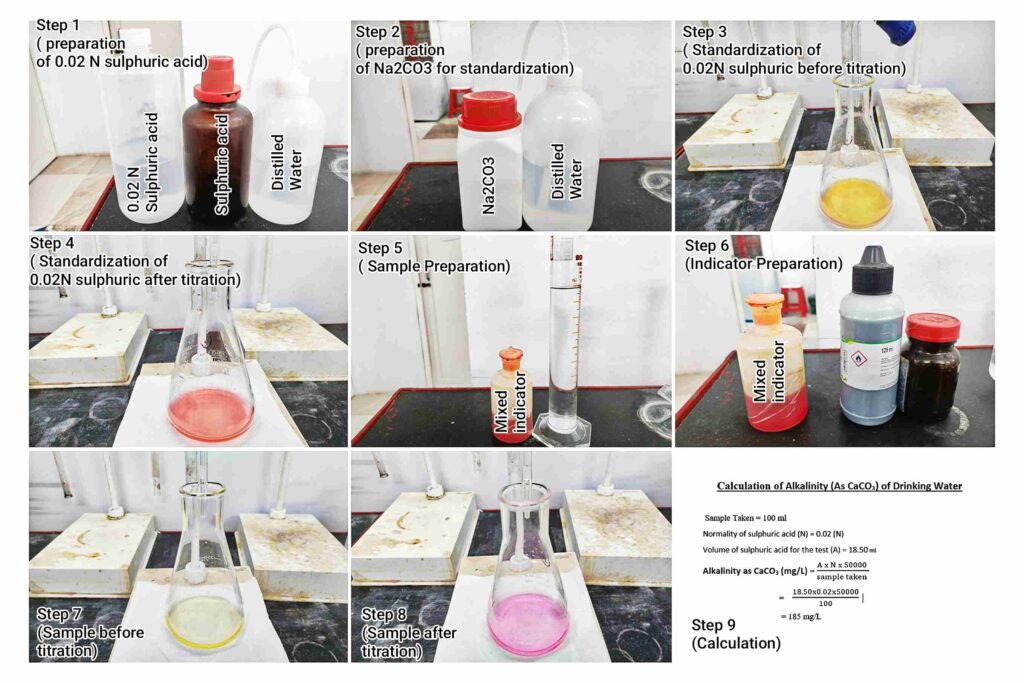
We, Pro Research & Testing Laboratory test alkalinity in drinking water by indicator method.
Apparatus used in Alkalinity (as CaCO3) Testing in Water
- Burette (50 ml capacity) – For accurate dispensing of titrant ( sulphuric acid for alkalinity test)
- Pipette(1 ml) – Accurate measurement of sulphuric acid.
- Conical Flask(250 ml) – Used in titration, to mix sample with indicator and titrant.
- Measuring Cylinder (100ml, 50ml) –Measuring approximate volumes of water and ethyl alcohol.
- Volumetric Flask( 1000ml) – Preparing standard solutions (titrants).
- Dropper- To add indicator dropwise.
- 4 Digit Analytical Balance – For accurate weighing of indicator.
Chemicals used in Alkalinity (as CaCO3) Testing in Water
- 0.02 (N) Sulfuric acid (H₂SO₄) – In alkalinity testing, 0.02 N sulfuric acid (H₂SO₄) is used as the standard titrant to neutralize the alkaline substances (carbonates & bi-carbonates) present in drinking water.
- Mixed Indicator Solution: To make the mixed indicator solution,dissolve 0·02 gm methyl red and 0.01 gm bromocresol green In 100ml 95% ethyl alcohol.
- Methyl Orange- Methyl orange is used to standardize sulfuric acid (e.g., 0.02 N H₂SO₄) against a primary standard like sodium carbonate (Na₂CO₃). The endpoint color change confirms exact acid strength, critical for accurate alkalinity calculation.
- Sodium Carbonate (Na₂CO₃)– In alkalinity testing, sodium carbonate is used as a primary standard to standardize sulfuric acid (H₂SO₄) which is ideal for accurately determining the exact concentration (normality) of acid.
- Ethyl alcohol- Use to make the indicator.
- Distilled water-To make the titrant. The conductivity of distilled water should be <5 μS/cm to prevent contamination.
Method to test the Alkalinity in Water Sample
| Preparation of 0.02 (N) Sulfuric Acid | Dilute 0.55ml concentrated sulfuric acid to 1000 ml volumetric flask . |
| Standardization of 0.02 N Sulfuric Acid | Weigh 0.053 gm of Na₂CO₃ and dissolve in 100 mL distilled water. Take 10 mL of Na₂CO₃ solution in conical flask. Add 2–3 drops of methyl orange indicator. Titrate with sulfuric acid until color changes from yellow to red. |
| Sample Preparation | Take 100 mL of the water sample in a conical flask. Add 2–3 drops of Bromocresol Green–Methyl Red mixed indicator. The solution appears greenish . |
| Titration | Titrate with 0.02 N acid slowly from a burette. Swirl the flask continuously until color changes from green to pink. Repeat the titration for 3 times to get exact results. Note the volume of acid used at this endpoint. |
Calculation for Alkalinity in Water
Standardization of Sulphuric acid
N1V1 = N2V2
N2=(0.053 x10)/26.5 = 0.02 (N)
N1= Normality of Na₂CO₃ (0.053N)
V1= Volume of Na₂CO₃ solution (10ml)
N2= Normality of H2SO4
V2= Volume of H2SO4 used in titration (26.5 ml)
Alkalinity (As CaCO3) of drinking water
Alkalinity as CaCO3 (mg/L) =( A x N x 50000 )/ Sample taken for the test
A= volume of sulphuric acid for the test
N= Normality of sulphuric acid
Importance of Testing Water’s Alkalinity
- pH Stability – Stable pH is essential for safe drinking water and for maintaining the effectiveness of water treatment processes .
- Corrosion Control – Adequate alkalinity neutralizes acids and keeps water from becoming corrosive.
- Scaling and Deposits Prevention – High alkalinity, can lead to calcium carbonate scaling, reducing equipment efficiency.
- Taste and Consumer Acceptability – High alkalinity can cause a bitter taste, while very low alkalinity can lead to unpleasant taste.
- Optimization of Water Treatment Processes – Helps determine the dosage (2%-4%) of chemicals especially soda ash to increase the pH necessary for pH correction before water softening and pH adjustment.
- Compliance with Water Quality Standards – To ensure water meets regulatory limits as per IS 10500 (the maximum acceptable limit of alkalinity as CaCO3 for drinking water is 200 mg/L.).
- Optimization of Waste- Water Treatment Processes– Determination of alkalinity indicates the dosage of soda ash (Sodium Carbonate) to increase the pH which is necessary for coagulation process during treatment of raw untreated effluent derived from industries for ETP and from domestic source for STP.
Handling Mistakes should avoided during Alkalinity test of Water
- Not Standardizing the Acid Titrant – Due to inaccurate acid strength can lead to incorrect alkalinity results. So always use standardized acid using sodium carbonate and an indicator methyl orange for the titration.
- Incorrect Endpoint Detection – Perform titration slowly to get the exact end point. use a white paper to observe sharp color recognition.
- Not Rinsing Burette or Pipette Properly – Not rinsing with the same solution before use, leading to incorrect readings.
- Using Dirty Glasswares –Using unclean or dirty burettes, pipettes, or flasks, causes contamination, affecting titration accuracy.
- Not Mixing Sample During Titration- Allowing sample to stand without swirling during titration, leading to false endpoint detection.
- Using Incorrect Sample Volume- Taking incorrect volume of the water sample affects calculation, may lead to wrong final result.
Conclusion of Alkalinity in Water
The alkalinity of drinking water represents its ability to neutralize acids and maintain stable pH levels, primarily due to the presence of bicarbonates, carbonates. It plays a critical role in ensuring water is non-corrosive, safe for consumption, and compatible with plumbing systems.Thus, alkalinity testing is essential for drinking water quality assurance, supporting both public health and infrastructure longevity.To perform the alkalinity as CaCO3 test at a water manufacturing company or laboratory should ensure by following standard procedures mentioned above to accurately determine the alkalinity as CaCO3 and assess the quality of the drinking water with availability of the apparatus & chemicals and also the above real-time photo attachment will help to understand the testing process completely. In addition, if expert guidance is needed ,please reach out to Pro Research & Testing Laboratory.
FAQ related to Alkalinity of Water Sample
1.What is total alkalinity?
Answer: Total alkalinity is the sum of all forms of alkalinity (bicarbonate, carbonate)present in water.
2.Why is alkalinity important in drinking water?
Answer: Alkalinity prevents sudden pH changes, prevents pipe corrosion, maintains pleasant taste, ensures effective disinfection,helps in water treatment process control.
3.What is the ideal range of alkalinity in drinking water?
Answer: According to BIS standard,the maximum acceptable limit of alkalinity is 200 mg/L as CaCO₃.We recommend that the alkalinity should be 20-70 mg/L in drinking water.
4.How is alkalinity measured?
Answer: Alkalinity is measured by acid-base titration using 0.02 N sulfuric acid and an indicator such as Bromocresol Green–Methyl Red. The acid is added until a color change indicates that the alkalinity has been neutralized.
5.What happens if alkalinity is too low?
Answer: Low alkalinity can cause-corrosion of pipes,leaching of metals (lead, copper),unstable pH & potential health hazards due to metal contamination.
6.What happens if alkalinity is too high?
Answer: High alkalinity can lead to bitter taste of water,scaling in pipes and appliances,reduced effectiveness of disinfection.
7.Is alkalinity the same as pH?
Answer: No. pH measures the hydrogen ion concentration (acidity/basicity), while alkalinity measures how well water resists pH changes.
8.For which type of water the alkalinity test is mandatory?
Answer: Including drinking water, water treatment plant and also before treating STP & ETP , the alkalinity testing should be done.
How We Verified This Testing/Research Procedure :
This testing procedure is done under qualified analyst .Continually monitored by expertise.Repeatedly testing is always done to get accurate result.

Written by
Riya Ghosh (M.Sc. Food Technology, MAKAUT)
Designation – Chemist
Reviewed by
Anwesha Das (M.Sc Microbiology,BU)
Designation – Microbiologist
Verified By
Dr. Jyotirmoy Kumar Dey (Phd,Chemistry)
Designation – Senior/Chief Chemist
Experience – 25 Years +