
Allyl isothiocyanate (AITC) is a naturally occurring compound responsible for the strong flavor and aroma of mustard oil. Testing for AITC in mustard oil is crucial to ensure product authenticity, quality, and safety. This test helps differentiate mustard oil from adulterated or synthetic oils and determines compliance with food safety standards. Accurate estimation of AITC content also ensures that the oil retains its natural therapeutic and preservative properties while remaining within safe consumption limits.By allyl isothiocyanate testing you can differentiate between the raw grade (unfiltered) & refined grade (filtered) mustard oil.
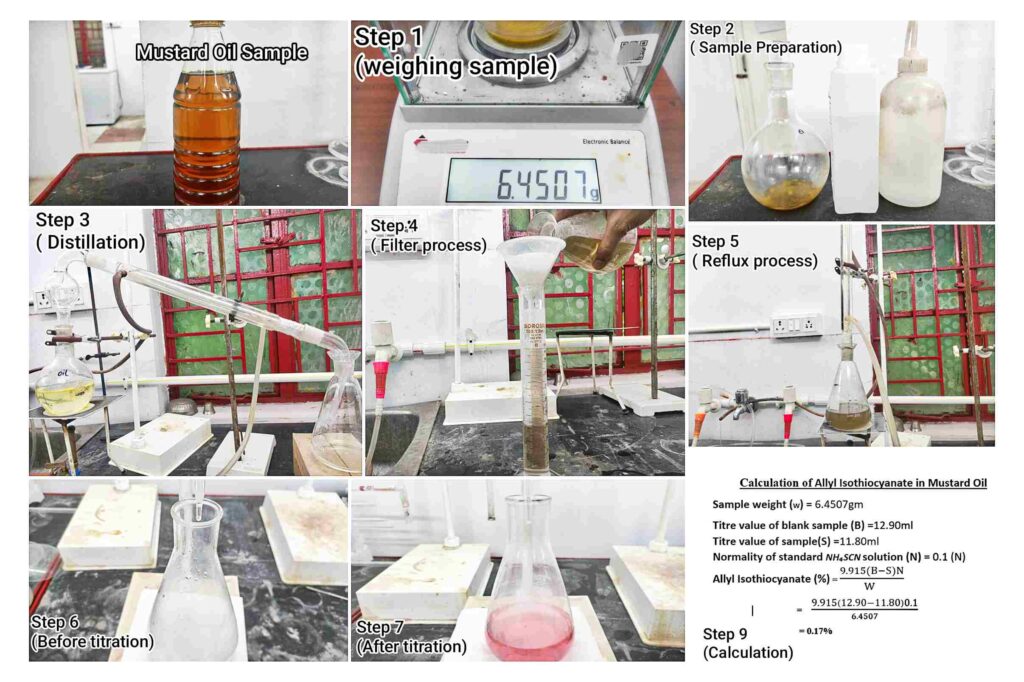
Here,in our lab Pro Research & Testing Laboratory, follow the titration method for AITC in mustard oil involves reacting the oil with a known volume of silver nitrate (AgNO₃), which forms a precipitate with AITC. The excess unreacted AgNO₃ is then titrated using standard ammonium thiocyanate (NH₄SCN) solution with ferric ammonium sulfate as an indicator. The appearance of a faint-pink color marks the endpoint.
Chemicals, Instruments, and Glassware Used in Allyl Isothiocyanate Testing of Mustard Oil by Titration Method:
Glassware Used:
- Flat Bottom Flask (500 ml) – For distillation of the sample with alcohol.
- Condenser-It is used to condense vapors back to liquid during distillation.
- Splash Head bulb – It operates between the flask and the condenser while distillation.
- Conical Flask(250 ml) – For carrying out the reaction and titration.
- Burette (50 ml) – For accurate titration of NH₄SCN solution.
- Pipette(25 ml) – For measuring specific volumes of reagents.
- Volumetric Flask(1000 ml) – For preparing standard solutions.
- Measuring Cylinder(10 ml) – For approximate volume measurements.
- Funnel & Whatman 41 Filter paper – For safe transfer & filtration of liquids.
- Water Supply – For constant water supply while doing distillation & reflux.
Instruments Used:
- 4-digit Analytical Balance – For accurate weighing of oil and reagents.
- Bunsen Burner – To gently heat the sample, if needed.
Chemicals Used:
- Silver Nitrate (AgNO₃) Solution– Reacts with isothiocyanates to form a precipitate (silver isothiocyanate), allowing reaction based on the remaining unreacted silver nitrate.
- Ammonia Solution – used as a supporting reagent to adjust medium clarity or solubility to facilitate precipitation of allyl isothiocyanate in form of silver isothiocyanate.If the medium is not ammoniacal then extraction of allyl isothiocyanate into silver nitrate is not possible.
- Nitric Acid (HNO₃)– Used to acidify the reaction medium and prevent silver ion hydrolysis & facilitates stoichiometric reaction between silver isothiocyanate & ammonium thiocyanate during titration.
- Ammonium Thiocyanate (NH₄SCN) Standard Solution-Used as titrant to determine excess silver nitrate.
- Ferric Ammonium Sulfate Indicator– Gives a red-colored complex with excess thiocyanate, indicating endpoint.To prepare the indicator add 0.1 gm Ferric Ammonium Sulfate in 100 ml distilled water.
- 95% Ethyl Alcohol -Helps in dissolving the oil and improving reaction efficiency. To prepare 95 % ethyl alcohol add 95 ml ethyl alcohol to 5 ml distilled water.
- Distilled Water- Used for dilutions, rinsing & preparation of standard solution.The conductivity of distilled water should be <5 μS/cm to prevent contamination.
Procedure followed to test the Allyl Isothiocyanate Testing in Mustard Oil
Standard Solution Preparation Process:
| Preparation | Standardization | |
| Standard 0.1 N Silver Nitrate (AgNO₃) Solution | Weigh 16.99 g of AgNO₃ crystals. In a small amount of distilled water, dissolve the AgNO₃. Transfer the solution into a 1-liter volumetric flask. Make up the volume to 1000 mL with distilled water and mix well. Store in a dark or amber-colored bottle, as AgNO₃ is light-sensitive. | Prepare standard NaCl solution by dissolving 5.8734 g NaCl in 1 liter of distilled water (equals 0.1 N). 25.00 mL of the standard NaCl solution should be pipetted into a conical flask. Add 2-3 drops potassium chromate indicator to it & titrate against the AgNO₃ solution. If the reddish-brown tint is still present, titrate with the AgNO₃ solution. Calculate the exact normality using the formula: N1V1 = N2V2 N1= Normality of NaCl (0.1 N) V1= Volume of NaCl solution (25 ml) N2= Normality of AgNO₃ V2= Volume of AgNO₃ used in titration |
| Standard 0.1 N Ammonium Thiocyanate (NH₄SCN) Solution | Weigh 7.61 grams of Ammonium Thiocyanate (NH₄SCN).Dissolve it in distilled water and make the final volume up to 1 liter. Mix thoroughly & store in a dark glass bottle as NH₄SCN is light sensitive. | Pipette 25.00 mL of 0.1 N standard AgNO₃ solution into a clean conical flask. Add 10 mL of distilled water and 2–3 mL of dilute HNO₃ to acidify. Add 2-3 drops of Ferric Ammonium Sulfate indicator (forms red complex with excess thiocyanate). Titrate with NH₄SCN solution from burette slowly, with constant swirling. Appearance of a permanent light reddish-brown color indicates the endpoint. Record the volume of NH₄SCN used. Calculate the exact normality using the formula: N1V1 = N2V2 N1= Normality of standard AgNO₃(0.1 N) V1= Volume of AgNO₃ used (25 ml) N2= Normality of NH₄SCN V2= Volume of NH₄SCN used |
Sample Testing Process:
| Sample Preparation | Weigh 5-6 gm sample in a 500ml Flat bottom flask. Add 25 ml ethyl alcohol to dissolve the oil completely & add 250 ml distilled water into it. |
| Distillation | Take 25 ml silver nitrate solution and 10 ml ammonia solution into a conical flask. Set up the distillation unit. Distilled 150 ml. Then attach the condenser & reflux for about one hour. |
| Titration | Cool to room temperature & add water to make up 200 ml. Filter to avoid contamination. Take 100 ml of the titrate, add 6 ml of nitric acid & few drops of ferric ammonium sulphate indicator. Titrate against the 0.1 N ammonium thiocyanate solution until colour changes to faint pink. Run a blank sample in a same way to get the accurate result. |
| Calculation | Note the titre value & calculate by using following formula 9.915(B-S)N/W B- Titre value of blank sample S- Titre value of sample N- Normality of standard ammonium thiocyanate solution W- Sample weight |
Purpose of Allyl Isothiocyanate Testing in Mustard Oil:
- To confirm the authenticity of mustard oil by detecting natural AITC, which is a key marker compound.
- To differentiate between the raw grade (unfiltered) & refined grade (filtered) mustard oil.
- To identify adulteration, especially with synthetic or non-mustard oils.
- To ensure compliance with food safety standards and regulatory limits set by FSSAI.
- To assess quality and freshness, since AITC content may degrade over time or due to improper storage.
- To evaluate flavor and strong smell, as AITC contributes to the characteristic taste and aroma of mustard oil.
Handling Mistakes to Avoid during Allyl Isothiocyanate (AITC) Testing and Their Reasons:
By avoiding these mistakes, you ensure accurate, reproducible, and reliable results during AITC testing in mustard oil.
- Improper Sample Storage: AITC is volatile and degrades easily when exposed to air, heat. Always store mustard oil samples & reagents in airtight bottles at cool temperatures.
- Inaccurate Measurement of Reagents: Incorrect reagent volumes can affect reaction efficiency and lead to false results. Use calibrated glassware and analytical balances.
- Using Contaminated or Wet Glassware: Moisture can interfere with AITC reactions by hydrolysis & loss of AITC.Ensure all glassware is dry and clean before use.Proper cleaning Process described previously.
- Delay in Testing After Extraction: AITC can rapidly degrade post-extraction. Perform analysis immediately after sample preparation.
- Not Using a Blank: Without controls, it’s difficult to ensure result accuracy. Always standardize ammonium thiocyanate during the test as it’s strength degrades.
Conclusion of Allyl Isothiocyanate Test in Mustard Oil:
Allyl isothiocyanate testing in mustard oil is a vital analytical procedure to ensure the oil’s authenticity, quality, and safety. By accurately identifying and quantifying AITC, the test helps detect adulteration, preserve consumer health, and maintain regulatory compliance. This testing ultimately supports the integrity of mustard oil as a natural and trusted edible product.Using the method described above, you can easily conduct the allyl isothiocyanate test in any lab,factory or other locations equipped with the necessary machineries and chemicals.This testing process provides accurate results,which are crucial for quality control in various fields. Additionally, if you find the procedure difficult to follow, you can refer to the real-time photo included with this text,which illustrates each step and simplifies understanding.Furthermore,if you require professional assistance or more advanced testing, feel free to reach out to Pro Research & Testing Laboratory for your testing requirements.
Frequently Asked Questions (FAQ) on Allyl Isothiocyanate Test in Water:
Q1. Why allyl isothiocyanate testing is important?
A: Allyl isothiocyanate helps to retard the cancer growth & develops antioxidants in the human body which helps to keep the White blood cells active.So that the body does not become week due to strenuous activity.
Q2. What is the role of silver nitrate in this test?
A: Silver nitrate reacts with allyl isothiocyanate to form a precipitate (silver isothiocyanate), allowing reaction based on the remaining unreacted silver nitrate.
Q3. What is the function of ferric ammonium sulfate?
A: It acts as an indicator, forming a red-colored complex with thiocyanate at the endpoint of the titration
Q4. Why is nitric acid added during the test?
A: Nitric acid prevents hydrolysis of silver nitrate and ensures a clear endpoint by keeping the medium acidic.
Q5. What precautions should be taken during the test?
A: Protect the sample from light and heat, ensure accurate reagent measurement, and perform titration immediately after reaction completion to prevent AITC loss.
Q6. What is the acceptable range of AITC in mustard oil?
A: According to FSSAI standards, AITC content in pure mustard oil should not exceed 1% (v/v).
Q7. Why is the titration method used for AITC testing?
A: It is a simple and cost-effective method to estimate the amount of AITC present in mustard oil through its reaction with silver nitrate and titration.
Q8. How to define raw grade & good refined grade mustard oil?
A: By testing allyl isothiocyanate testing you can differentiate between the raw grade & refined grade mustard oil.Besides this, raw grade don’t have the strong smell where as refined grade mustard oil has strong smell, by which we can easily know the good mustard oil.A good mustard oil has 0.4%-0.6% allyl isothiocyanate with a strong smell.
How We Verified This Testing/Research Procedure :
This testing is done under qualified analysts in our lab.Continually monitored by expertise.Repeatedly testing is always done to get accurate result.

Written by
Anwesha Das (M.Sc Microbiology,BU)
Designation – Microbiologist
Reviewed by
Riya Ghosh (M.Sc. Food Technology, MAKAUT)
Designation – Chemist
Verified By
Dr. Jyotirmoy Kumar Dey (Phd,Chemistry)
Designation – Senior/Chief Chemist
Experience – 25 Years +