
Jhalmuri which is ready-to-eat food, served as a dry snack, known for its crunchy texture, spicy-tangy flavor, and aromatic ingredients.It normally consist of puffed rice, peanuts, spices, mustard oil, salt etc. Ash content of a food sample refers to the total amount of minerals(Na,K,Ca,Mg,Fe,Cl & heavy metals etc) present in the food. It is the inorganic residue that remains after the complete combustion (burning) of organic matter in a sample, typically in a muffle furnace at temperatures around 600°C–700°C. We have used jhalmuri sample for the test.
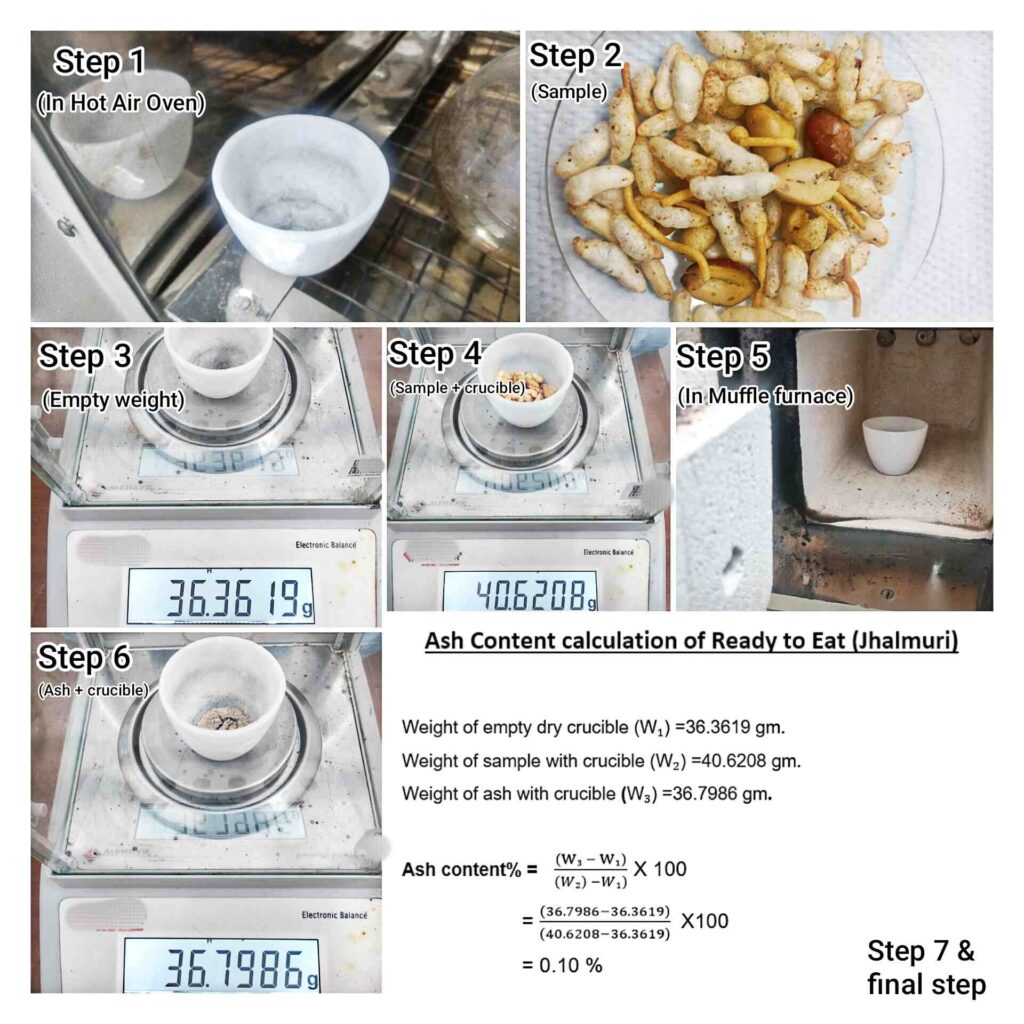
Here we briefly discuss the detailed procedure of testing Ash content which we follow in our lab – Pro Research & Testing Laboratory.
Instruments and Equipments used for Ash Content (Mineral Content) in Ready to Eat Food:
- Analytical Balance(4-digit)- Used to measure very small amount of sample & ash. We use 4 digit balance for this testing.
- Crucible– This high-heat resistant container made of silica, holds the food sample during incineration.
- Hot Air Oven– To dry(at 105°C) the crucible before starting the procedure.
- Muffle Furnace– It incinerates the organic matter at high temperature turns the inorganic residue into ash.
- Tongs-To hold the hot crucible safely without direct contact.
- Desiccator– It maintains moisture free environment to prevent rehydration of ash before weighing. Silica beads are used in the desiccator which absorbs the moisture from the crucible. the color of silica beads change from blue to pink detects that the silica beads has to be replaced by the moisture free beads.
Testing Procedure for Ash Content (Mineral Content) detection in Ready to Eat Food:
| Step-1(Crucible-Drying) | Put the silica crucible in the hot air oven at 105°C for 1 hour to remove moisture . |
| Step-2(Cool in Desiccator) | Cool the crucible in the desiccator to prevent moisture absorption. |
| Step-3(Weigh Crucible) | Weigh the empty dry crucible. |
| Step-4(Weigh Sample) | Weigh sample(approx 5 gm) in the crucible. |
| Step-5(Ignite in Muffle Furnace) | Ignite at 600°C–700°C for about 3 hours until all organic matter burns off & turns white. |
| Step-6(Cool in Desiccator) | Allow the crucible to cool in desiccator to protect the ash from absorbing atmospheric moisture otherwise it will give error result. |
| Step-7(Weigh Ash) | Measure remaining inorganic residue (ash) using an analytical balance until constant weight(to get proper weight) & calculate using following formula. |
Calculation for Ash Content (Mineral Content) detection in Ready to Eat Food:
Ash content%= [(W₃ – W₁)/(W₂-W₁)]×100
W₁=Weight of empty dry crucible
W₂=weight of sample with crucible
W₃= weight of ash with crucible
Purpose of Testing for Ash Content (Mineral Content) detection in Ready to Eat Food:
- To determine the total mineral content in food.
- For evaluate the nutritional value .After determining the ash content we further can detect the presence of Na,K,Ca,Mg,Fe,Cl & heavy metals/ toxicity in food.
- Detects adulteration or contamination such as sand/dust that increase the ash content percentage.
- It assists in quality control and nutritional labeling compliance.
Handling Mistakes to avoid while doing Ash Content (Mineral Content) detection in Ready to Eat Food :
- Not drying the crucible properly before ashing leads to over-estimation of ash due to leftover moisture.
- Contaminating the crucible or sample (with dust, spilled material) increases ash weight, causing false results.
- Using a wet or dirty crucible adds extra weight or contaminants, affecting accuracy.
- Overheating in muffle furnace (>700°C) can cause loss of volatile minerals (e.g. iron), leading to underestimation.
- Under-heating or incomplete combustion leaves unburned organic matter, giving lower ash values.
- Opening the muffle furnace while hot causes temperature drop and may crack crucibles or disrupt combustion.
- Always use tongs to hold the hot crucible unless it may lead to severe burn.
- The atmospheric temperature where weighing balance is kept, the temperature should be maintained at 25±2°C .
Conclusion for Ash Content (Mineral Content) detection in Ready to Eat Food:
The ash content of all food products reveals the total amount of inorganic minerals present in the sample. It provides important information about the nutritional value, especially essential minerals like calcium, iron, magnesium & heavy metals etc. The test also helps in identifying any adulteration or contamination by detecting abnormal mineral levels. Regular analysis ensures the quality, safety, and authenticity of this ready-to-eat food. Overall, ash content serves as a reliable indicator of both the nutrient richness and purity of jhalmuri/any other food. To perform the ash content test at a food manufacturing company or laboratory should ensure by following standard procedures mentioned above to accurately determine the mineral content and assess the quality of the food product with availability of the instruments and also the above real-time photo attachment will help to understand the testing process completely. In addition, if expert guidance is needed ,please reach out to Pro Research & Testing Laboratory.
FAQ for Ash Content (Mineral Content) detection in Ready to Eat Food
1. Why is ash content analysis important in Jhalmuri/any other food?
Ans: It helps determine the nutritional value, detect adulteration, and evaluate the quality and safety of the food product.
2. What type of minerals are found in the ash of Jhalmuri/any other food?
Ans: Common minerals include calcium, potassium, iron, magnesium,sodium present in the Jhal Muri mixture.
3. Which method is used to determine ash content in Jhalmuri/any other food?
Ans: The ashing method using a muffle furnace at 600°C–700°C is commonly used for ready-to-eat snacks like Jhalmuri.
4. Can ash content detect adulteration in Jhalmuri/any other food?
Ans: Yes. Abnormally high ash content might indicate the presence of non-food or inorganic materials such as sand or dust.
5. How do I know the ash content test is complete?
Ans: The test is considered complete when-all organic matter is fully burnt off, a stable greyish-white ash remains,no black or dark-colored particles are visible and the crucible weight becomes constant after repeated heating and cooling.
6. Is ash content is necessary for heavy metals/ toxicity detection?
Ans: Yes, for the primary process to determine heavy metal in food sample testing of ash content is mandatory step.
How We Verified This Testing/Research Procedure :
This testing procedure is done under qualified analyst .Continually monitored by expertise.Repeatedly testing is always done to get accurate result.

Written by
Riya Ghosh (M.Sc. Food Technology, MAKAUT)
Designation – Chemist
Reviewed by
Anwesha Das (M.Sc Microbiology,BU)
Designation – Microbiologist
Verified By
Dr. Jyotirmoy Kumar Dey (Phd,Chemistry)
Designation – Senior/Chief Chemist
Experience – 25 Years +