
Biochemical Oxygen Demand (BOD) testing is an important water quality analysis used to measure the amount of dissolved oxygen consumed by microorganisms while decomposing organic matter in water. It indicates the degree of pollution and the presence of biodegradable waste. A higher BOD value reflects greater organic contamination, which can reduce oxygen available for aquatic life. This test helps assess the efficiency of wastewater treatment plants, monitor surface water pollution, and ensure compliance with environmental standards. BOD testing is widely used in environmental monitoring, industrial effluent analysis and municipal water treatment evaluation.
Instruments, Glassware and Chemicals Used in Biochemical Oxygen Demand (BOD) Test:
Instruments:
| BOD Incubator (27 ± 1°C ) | BOD incubators are equipment used in laboratories to grow & maintain microorganisms.BOD incubators have specific temperature range,allows microorganisms to break down organic matter naturally. Darkness prevents photosynthesis by algae, which could artificially raise dissolved oxygen.A incubator ensures accurate and reproducible BOD results by maintaining constant conditions throughout the test. |
| Aerator | It is used to generate oxygen in distilled water before preparing BOD samples. |
Glassware
| BOD bottles (300 mL, airtight, glass-stoppered) | Collect water samples without air bubbles to avoid oxygen contamination. |
| Conical flasks (500 ml) | To hold the sample solution during titration. |
| Burette (50ml) | For accurate dispensing of titrant (Sodium Thiosulphate for BOD test) |
| Measuring cylinders(250ml) | Measures sample solution accurately. |
| Pipettes(2ml) | Used to add precise volumes of reagents & acid. |
| Volumetric flasks (1000 ml) | Preparation of standard solutions like sodium thiosulphate. |
Chemicals / Reagents:
| Manganese sulfate solution (MnSO₄) | It reacts with oxygen to form manganese hydroxide precipitate.Preparation described previously. |
| Alkaline iodide-azide Solution | Provides alkaline medium and iodide ions for iodine liberation.Preparation described previously. |
| Concentrated sulfuric acid (H₂SO₄) | Acidified solution to release iodine equivalent to dissolved oxygen. |
| Sodium thiosulfate solution (Na₂S₂O₃) standard | To prepare 0.025 N sodium thiosulphate solution dissolve 25 g of sodium thiosulphate in boiled distilled water & make up to 1000 ml. From there take 250 ml solution and volume make up to 1000 ml with distilled water.Here we have used the Sodium thiosulfate from Loba company. You can use the same company or any other companies. |
| Starch indicator solution | Forms a blue complex with iodine, showing titration endpoint.Dissolve 2 g of starch and 0.2 g of salicylic acid in 100 ml of hot distilled water( approx 50°C-60 °C) |
| Distilled water | To prepare dilution water,standard Solution & reagent.The conductivity of distilled water should be <5 μS/cm to prevent contamination.[If required distilled water seeded with phosphate buffer,magnesium sulfate, calcium chloride, ferric chloride solutions]. |
| Phosphate buffer | To prepare phosphate buffer dissolve 8.5 g potassium dihydrogen phosphate, 21.75 g potassium hydrogen phosphate, 33.4 g disodium hydrogen phosphate and 1.7 g ammonium chloride in about 500 ml distilled water and dilute to 1 litre.Used for maintain pH 7.2. |
| Magnesium sulfate | To prepare Magnesium sulfate dissolve 22.5 g magnesium sulphate in distilled water and dilute to 1 litre.It supplies magnesium for enzyme function. |
| Calcium chloride | To prepare Calcium chloride dissolve 27.5 g calcium chloride in distilled water and dilute to 1 litre.It helps to maintain cell wall stability & supports metabolism. |
| Ferric chloride solutions | To prepare Ferric chloride solutions dissolve 0.25 g hydrated ferric chloride in distilled water and dilute to 1 litre.It provides iron needed for microbial enzymes. |
Procedure of Biochemical Oxygen Demand (BOD) Test:
| Sample Collection | After evaluating COD value we should take sample dilutions according to the value.(process described previously) Collect the water/waste water sample in a clean, airtight BOD bottle without trapping air bubbles. |
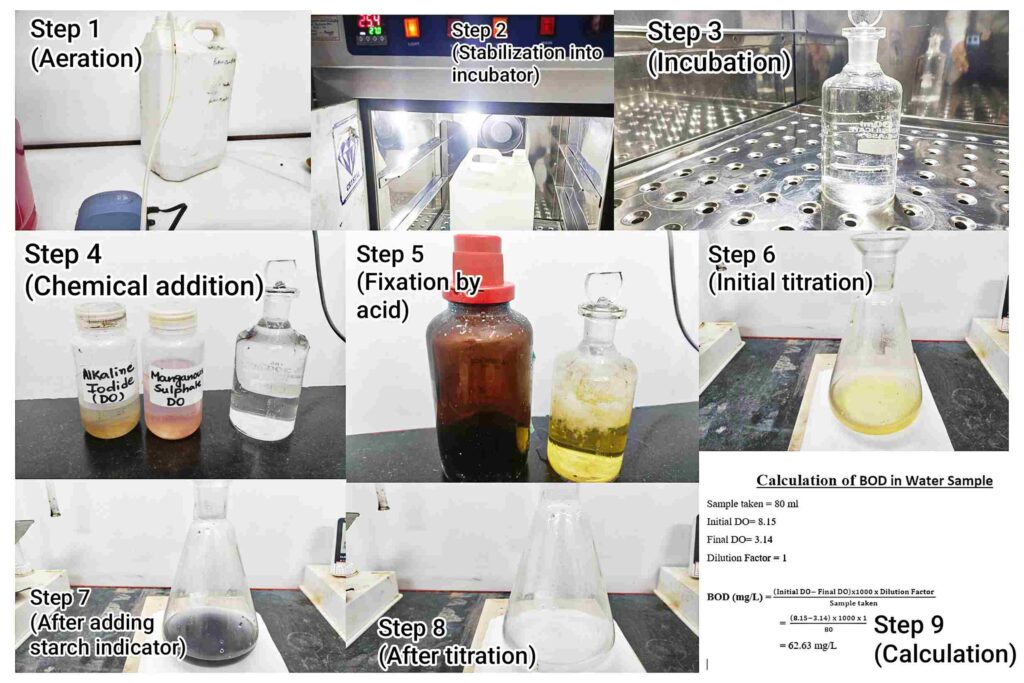
| Preparation of Dilution Water | Use distilled water saturated with oxygen [Aerated for 8-12 hrs] The distilled water is then stabilized at 27 ± 1°C for 4 hours. If COD value of is high then add nutrients (phosphate buffer, magnesium sulfate, calcium chloride, ferric chloride solutions) to support microbial activity.This nutrients should be added if the sample is industrial wastewater. |
| Initial Dissolved Oxygen (DO) Measurement (Day 0) | Fill one set of BOD bottles with the sample (use direct sample or sample diluted with dilution water). Immediately measure dissolved oxygen (DO) using Winkler’s titration method.Method described previously.It’s value is the Initial value of DO. |
| Incubation | Seal the remaining BOD bottles tightly. Place them in a BOD incubator at 27 ± 1°C for 3 days. |
| Final DO Measurement (Day 3) | After 3 days of incubation, measure the Final DO of the sample again using the same method as Day 0. |
| Calculation | BOD (mg/L)= (Initial DO- Final DO) x1000 x Dilution Factor/Sample taken The value indicates the oxygen demand of microorganisms to decompose organic matter in the sample over 3 days. |
Purpose of Biochemical Oxygen Demand (BOD) Test:
- To assess the level of organic pollution in water or wastewater or Effluent Water.
- To determine the amount of biodegradable organic matter present.
- To evaluate the efficiency of sewage and industrial effluent treatment plants.
- To check compliance with environmental regulations and water quality standards.
- To estimate the impact of wastewater discharge on rivers, lakes, and other natural water bodies.
- To help protect aquatic life by ensuring dissolved oxygen levels remain sufficient for survival.
Handling Mistakes to be Kept in Mind in BOD Test:
- Do not trap air bubbles while filling BOD bottles, as it may affect DO readings.
- Ensure bottles are properly stoppered and airtight to prevent oxygen entry.
- Avoid contamination of the sample with external microorganisms or chemicals.
- Use freshly prepared reagents and standardized sodium thiosulfate for accurate titration.
- Maintain incubator temperature at 27 ± 1°C throughout the test.
- Protect samples from exposure to light during incubation to prevent algal photosynthesis.
Conclusion:
The BOD test in wastewater/STP/ETP/Effluent water provides a reliable measure of the amount of biodegradable organic matter present in water. A higher BOD indicates greater organic pollution and higher oxygen consumption by microorganisms, which may harm aquatic life. This test is essential for monitoring water quality, assessing wastewater treatment efficiency, and ensuring environmental safety.By following these method, you can easily test the Biological Oxygen Demand (BOD), content at environmental science laboratory or any laboratory & also manufacturing industry with availability of the equipments & chemicals. If you can’t understand the procedure you can check our real time photo attached with this writing or also you can reach to Pro Research & Testing Laboratory for the testing purposes.
FAQ on Biochemical Oxygen Demand (BOD) Test:
Q1. What does BOD indicate in water?
BOD shows the amount of oxygen required by microorganisms to decompose organic matter in water, reflecting organic pollution levels.
Q2. What is the expected BOD value for river water?
The BOD value should be less than 5 mg/L.
Q3. How does high BOD affect aquatic life?
High BOD depletes dissolved oxygen, which can suffocate fish and other aquatic organisms.
Q4. What is the role of aerator & BOD incubator in BOD testing?
Aerator helps to achieve saturation of dissolved oxygen & ensures uniform distribution of nutrients & microorganism.BOD incubator provides a controlled,dark environment at 27 ± 1°C .This temperature allows microorganisms to break down organic matter naturally.
Q5. When external nutrient should seeded in distilled water?
External nutrients needed when the sample water lacks sufficient microorganisms for biodegradation.It also depends on the types of water like Industrial Wastewater,STP,ETP,Effluent water may contain chemicals contaminants where seed treatment should done while Pond water,domestic wastewater,Raw sewage water,River Water etc do not need seed treatment before BOD testing.
Q6.Which water’s BOD can be tested by this method?
By this method you can test BOD of Industrial Wastewater,STP,ETP,Effluent water, Pond water,domestic wastewater,Raw sewage water,River Water etc or you can reach out to Pro Research & Testing Laboratory for testing purposes.
How We Verified This Testing/Research Procedure :
This testing procedure is done under qualified analyst .Continually monitored by expertise.Repeatedly testing is always done to get accurate result.

Written by
Anwesha Das (M.Sc Microbiology,BU)
Designation – Microbiologist
Reviewed by
Riya Ghosh (M.Sc. Food Technology, MAKAUT)
Designation – Chemist
Verified By
Dr. Jyotirmoy Kumar Dey (Phd,Chemistry)
Designation – Senior/Chief Chemist
Experience – 25 Years +