
Borate testing in milk is an important quality control procedure used to detect the presence of boric acid or borax (sodium borate), which are sometimes illegally added as preservatives to extend milk’s shelf life. Although borates can prevent microbial growth and spoilage, they are toxic and harmful to human health when consumed regularly.
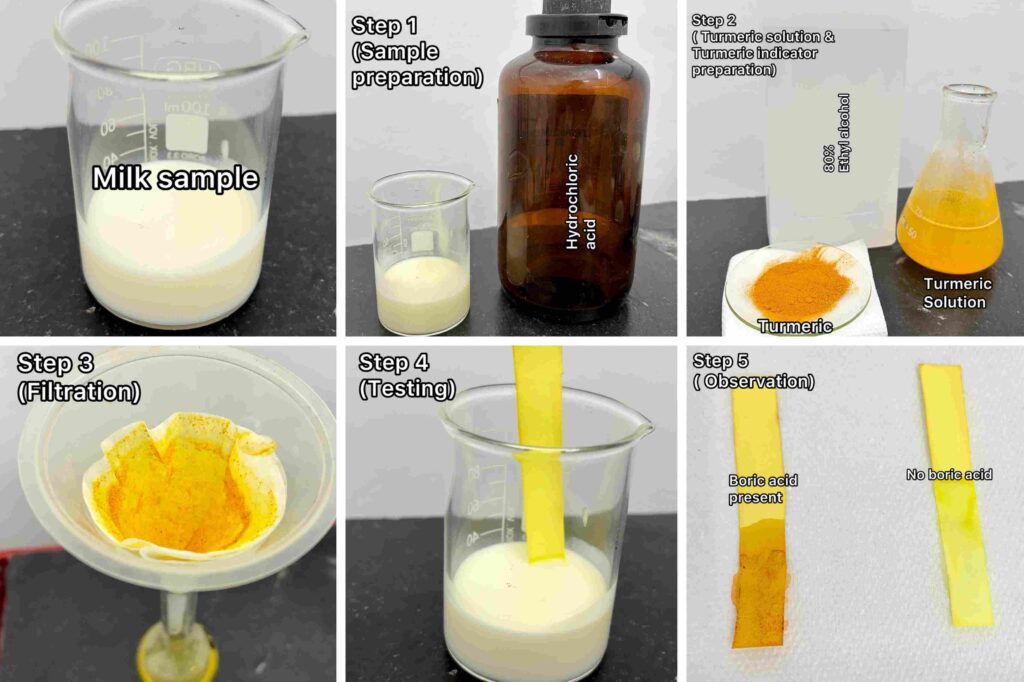
Here detailed procedure is described that how we detect this adulterant in our lab –ProResearch & Testing Laboratory.
Instruments & Apparatus Used
- Analytical balance(4-digit) – Measures sample and reagent masses with high precision.Here we have used the balance of Wensar company. You can use the same company or any other companies.
- Beaker(50 ml) & Flask (100 ml)- To hold the sample & to prepare turmeric solution.
- Turmeric paper– Acts as a chemical indicator that changes colour in the presence of boric acid.To prepare turmeric paper, dip Whatman filter paper in the clear filtrate turmeric Solution. Remove the paper and hang to dry in air. After 1 hour, cut the paper and store in tightly stoppered bottle protected from light.
Chemicals used
- Turmeric Solution – Reacts with boric acid to form rosocyanine,a red-colored compound.Weigh 1.5 to 2.0 g of turmeric powder in 100 ml flask and add 100 ml 80% ethanol. Shake for 5 min and filter. Collect the filtrate.
- Hydrochloric acid (HCl) – Used to confirm the presence of borate by reversing the colour change,happens because HCl breaks the rosocyanine complex.
- 80% Ethanol – Used as solvent & extraction medium,helping to prepare the indicator(Turmeric solution ).To prepare 80% ethanol add 80 ml ethanol in 20 ml distilled water.
- Distilled Water – To prepare 80% ethanol.The conductivity of distilled water should be <5 μS/cm to prevent contamination.
Procedure
Sample Preparation
(Take about 5 mL of milk in a clean beaker.Add 1.4 ml of conc. hydrochloric acid
and mix it thoroughly)
│
▼
Testing Step
(Take a strip of turmeric paper.Dip the turmeric paper into the milk sample for 1–2 minutes.Remove it and let it dry at room temperature.)
│
▼
Observation
(If boric acid or borax is present, the turmeric paper changes from yellow to red or brownish-red.If borate is absent, the paper remains yellow.)
Is it necessary to test Borate in Milk Sample?
Boric acid can cause vomiting, diarrhea, abdominal pain, and kidney damage, especially in infants and children. Therefore, its use in milk and dairy products is strictly prohibited under food safety standards such as the FSSAI (Food Safety and Standards Authority of India).The main purpose of borate testing in milk is to detect the presence of boric acid or borax, which are sometimes added illegally as preservatives.The test helps to:
- Ensure consumer safety by preventing harmful chemical intake.
- Identify adulteration and maintain the purity and natural quality of milk.
- Comply with food safety regulations such as FSSAI standards.
- Protect public health by monitoring and controlling food fraud practices.
- Maintain trust in dairy products and ensure their nutritional integrity.
Handling Mistakes to Be Kept in Mind During Borate Testing in Milk
- Use fresh milk samples — spoiled or old samples may give false results.
- Avoid contaminated glassware, as residues can alter the color reaction.
- Do not overheat or dry turmeric paper too quickly, it may affect color change.
- Ensure correct reagent concentration — impure turmeric or excessive acid can mislead results.
- Do not expose test papers to direct sunlight before observation, as it can fade the color.
- Handle acids carefully during confirmation steps to prevent injury or damage.
- Record observations immediately to avoid confusion due to color fading over time.
Conclusion
Borate testing in milk is a simple and effective method to detect the presence of boric acid or borax adulteration. These substances are harmful and strictly prohibited in milk. The test helps ensure that milk is safe, pure, and compliant with food safety standards. Regular testing protects public health and maintains consumer confidence in dairy products.By following these method, you can easily test the Borate adulteration at any laboratory & also manufacturing industry with availability of the equipments & chemicals. If you can’t understand the procedure you can check our real time photo attached with this writing or also you can reach to Pro Research & Testing Laboratory for the testing purposes.
FAQ on Borate Testing in Milk Sample
Q: What is borate testing in milk?
A: It is a test used to detect the presence of boric acid or borax, which may be added illegally as preservatives.
Q: Why is borate added to milk?
A: Some sellers add borate to prevent milk from spoiling, but it is unsafe and prohibited.
Q: How is borate detected in milk?
A: By using turmeric paper — if borate is present, the paper turns red or brownish-red.
Q: Why is borate harmful to health?
A: It can cause vomiting, stomach pain, kidney problems, and other health issues, especially in children.
Q: What indicates pure milk in this test?
A: If the turmeric paper remains yellow, it means the milk is free from borate adulteration.
How We Verified This Testing/Research Procedure :
This testing is done under qualified analysts in our lab.Continually monitored by expertise.Repeatedly testing is always done to get accurate result.

Written by
Anwesha Das (M.Sc Microbiology,BU)
Designation – Microbiologist
Reviewed by
Riya Ghosh (M.Sc. Food Technology, MAKAUT)
Designation – Chemist
Verified By
Dr. Jyotirmoy Kumar Dey (Phd,Chemistry)
Designation – Senior/Chief Chemist
Experience – 25 Years +